Introduction
Pipe couplings are the most underspecified fitting in industrial piping—and also the most common source of small-bore leaks. Procurement teams order them by nominal diameter and nothing else, then discover that a threaded carbon steel coupling in a chemical plant corrodes through in eight months, or a full coupling where a half coupling was needed weakens the vessel wall it was welded to. The mistake is repeatable because couplings look simple; they are not.
This guide explains what pipe couplings are, the ten main types and when each applies, how material and connection method determine pressure integrity, and the selection framework that prevents costly mismatches before they reach the field. You will learn the ASME standards that govern forged couplings, the industries that demand specific configurations, and the quality checks that separate a certified fitting from an untraceable commodity. Whether you procure for refineries, chemical plants, or power generation projects, the logic is consistent.
Types of Pipe Couplings
Coupling type is defined by function—how it connects pipe, whether it changes size, and whether the joint is permanent:
By end function
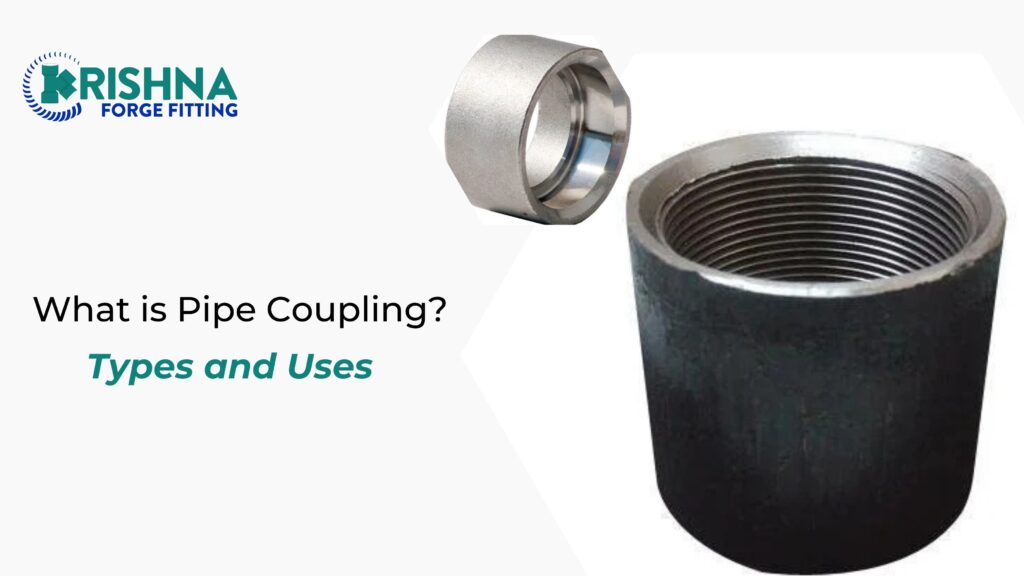
- Full coupling: internally threaded or socket-welded on both ends; joins two pipes of equal diameter in a straight run
- Half coupling: threaded or socket-welded on one end; the other end is plain and welded directly to a pipe body or vessel wall to create a branch outlet
- Reducing coupling: different diameters on each end; joins two pipes of unequal size without a separate reducer; saves fitting count in tight layouts
By joint method
- Threaded coupling: NPT or BSP threads; no welding; fast installation; suited to low-pressure, low-vibration systems
- Socket weld coupling: pipe inserts into a recessed socket; fillet welded at the shoulder; higher strength and fatigue life than threaded; ASME B16.11
- Butt weld coupling: beveled ends welded flush; ASME B16.9; used for larger bore or high-pressure applications
By application
- Compression coupling: ferrule or ring compresses against the pipe OD; no welding or threads; used in instrument lines and small-bore utility systems
- Slip coupling / repair coupling: slides along the pipe to cover a damaged section; overlapping sleeve design; used for in-line repairs without cutting flanges
- Flexible coupling: absorbs vibration, misalignment, and thermal expansion between two pipe ends; rubber or elastomeric sleeve inside a steel housing
- Flanged coupling: bolted flange on each end; fully disassembleable; used at equipment nozzles and anywhere regular maintenance access is required
One counterintuitive finding in field audits: half couplings are more frequently mis-installed than any other type. Engineers specify full couplings for branch connections to vessels, over-welding into the vessel wall weakens the nozzle zone, and the joint fails hydrostatic testing at commissioning.
Materials
Material selection drives long-term integrity:
- Carbon steel (A105, A234 WPB): general service; steam, water, oil, gas; up to 400 °C
- Stainless steel (304L, 316L): resists acids, chlorides, and high-temperature oxidation; chemical and pharmaceutical service
- Alloy steel (F11, F22): high-temperature steam and hydrocarbon service above 540 °C
- Brass/bronze: low-pressure water, compressed air, and non-ferrous utility systems
Carbon steel couplings cost 60% less than 316L stainless alternatives. In chloride-bearing or acidic service, the carbon steel alternative fails within one to two years; the 316L fitting runs fifteen years without replacement.
Standards and Specifications
Standards define dimensions, pressure ratings, and the mechanical minimums that make couplings reliable:
- ASME B16.11: forged socket-weld and threaded couplings; NPS ⅛–4; Class 2000–9000
- ASME B16.9: buttweld couplings; NPS ½–48
- ASTM A105: carbon steel forgings for pressure service (full and half couplings)
- ASTM A403: stainless steel buttweld couplings
Couplings stamped with these standards have undergone dimensional inspection, hydrostatic testing, and material verification. Fittings marked “equivalent” without traceable mill test certificates have not.
Applications by Industry
Oil and gas uses Class 6000/9000 forged socket-weld full and half couplings for high-pressure chemical injection lines, instrument tappings, and sample points where NACE compliance and sour-service ratings apply. Chemical processing specifies 316L stainless socket-weld couplings for reactor drain and vent connections that contact acids, caustics, and solvents. Power generation demands alloy-steel full couplings for superheated steam circuits where carbon steel would creep under sustained high temperature. Fire protection uses threaded carbon steel full couplings per NFPA 13 for sprinkler branch lines where installation speed matters more than fatigue life.
Installation Methods
Connection method determines joint strength, maintenance access, and long-term leak integrity:
- Threaded: apply PTFE tape or pipe dope; hand-tighten, then wrench two additional turns; do not overtighten or cross-thread
- Socket weld: insert pipe to full depth; withdraw 1.6 mm (1/16 inch) before welding to allow thermal expansion; fillet weld per ASME B31.3
- Butt weld: align beveled ends; root pass, fill passes, and cap per WPS; inspect per project NDT requirements
- Compression: insert pipe fully; tighten nut to compress ferrule; confirm manufacturer’s torque specification
Threaded joints in vibrating systems back out over time even with sealant. If vibration is present—pump discharge, compressor lines, offshore platforms—specify socket weld, not threaded.
Selection Guide
Four-step framework
- Define the service condition: pressure, temperature, and fluid chemistry narrow material grade and pressure class
- Choose coupling type: full coupling for pipe-to-pipe runs; half coupling for branch outlets; reducing coupling to step down size
- Select connection method: socket weld for high-integrity permanent joints; threaded for maintenance access points; flanged for regular disassembly
- Verify documentation: ASTM material compliance, heat numbers, mill test certificates, and dimensional inspection reports
Quality Assurance
Before approving any coupling shipment, confirm the supplier delivers:
- Material traceability: heat numbers linking each fitting to its mill test certificate and raw billet chemistry
- Dimensional conformance: bore diameter, wall thickness, and thread gauging verified against ASME tolerance tables
- Hydrostatic test records: pressure-tested to 1.5× rated pressure for high-pressure classes
- Third-party inspection access: factory audit rights for critical service or project-specified inspection
FAQs
What is the difference between a full coupling and a half coupling?
A full coupling has openings on both ends; it joins two pipe sections in a straight run. A half coupling has a threaded or socket-weld opening on one end and a plain end that welds directly to a pipe body or vessel wall. Use full couplings for in-line connections; use half couplings for branch outlets and instrument tappings.
When should I use socket weld instead of threaded couplings?
Specify socket weld when the line is subject to vibration, thermal cycling, or pressures above Class 2000. Threaded joints rely on thread interference and sealant; vibration breaks that seal over time. Socket weld delivers a continuous fused joint with fatigue life four to five times greater than threaded in high-cycle service.
Can I use a reducing coupling instead of a full coupling plus a separate reducer?
Yes, and it reduces fitting count, weld joints, and potential leak points in the run. Reducing couplings suit situations where the size step-down is modest (one or two sizes); large diameter reductions still require a dedicated reducer fitting for proper flow transition geometry.
What documentation should I receive with forged coupling orders?
Request mill test certificates with heat number, material chemistry, tensile and yield strength, and hardness data per ASTM A105 or A403. Add dimensional inspection reports confirming ASME B16.11 tolerances. For Class 6000/9000 service, request hydrostatic test certificates and NDT records.
Conclusion
Specify pipe couplings by locking in type, material grade, connection method, and ASME pressure class before you issue a purchase order. Request mill test certificates, dimensional reports, and thread gauging records on every shipment. A mis-rated or mismatched coupling creates a leak point that pressure testing will find—or operating conditions will create at far greater cost.
Krishna Forge manufactures ASME B16.11 forged full and half couplings, reducing couplings, and socket-weld and threaded configurations in carbon, stainless, and alloy steel—Class 2000 through Class 9000 in NPS ⅛ to NPS 4. Every coupling ships with full material traceability, dimensional inspection reports, and mill test certificates that meet EPC, ONGC, and international project specifications.
Need forged couplings with guaranteed ASME compliance and full documentation? Contact Krishna Forge at krishnaforge.com for technical data sheets, pressure-temperature ratings, and fast quotes on couplings engineered for your exact service conditions.
