Introduction
Branch connection failures rarely get traced back to the tee itself. Engineers examine the weld, inspect the pipe, review the pressure rating—and miss the actual cause: the wrong tee type was specified for the flow condition. An equal tee forces full-bore fluid into a 90° branch that sees half the flow, creating turbulence and pressure drop that erodes the fitting from the inside out.
Pipe tees are the most frequently misspecified fitting in process piping. Reducing tees get substituted with equal tees because they’re in stock. Lateral tees get replaced with standard 90° tees because the installer didn’t have the right part. Each substitution creates a hydraulic problem that compounds over time.
This guide explains what a pipe tee does, the types available, how each one handles flow differently, which materials apply to industrial service, and how to match tee selection to your actual operating conditions.
What Is a Pipe Tee
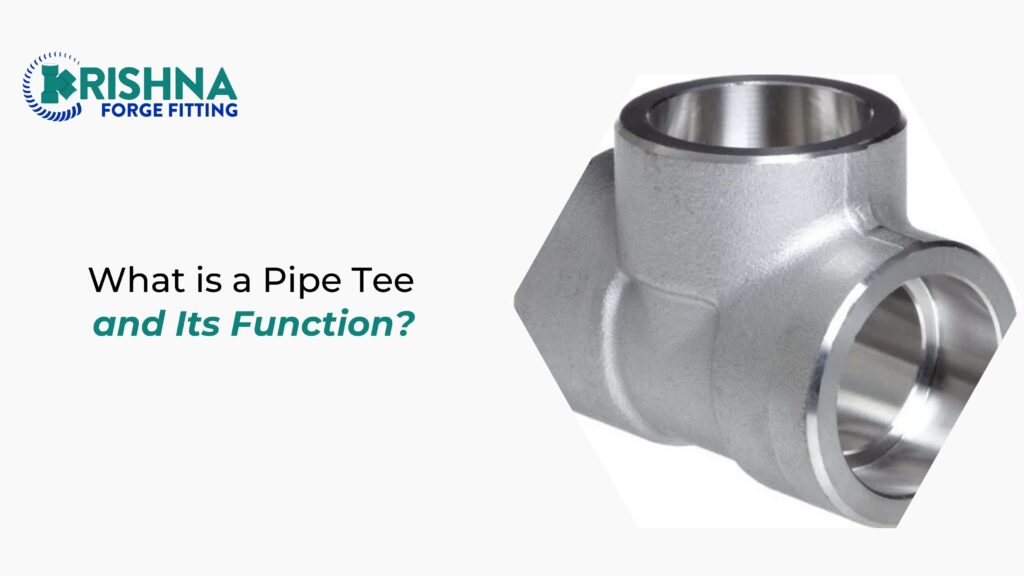
A pipe tee is a T-shaped fitting that creates a branch connection at 90° to the main pipe run. It connects three pipe ends simultaneously—two in line with each other (the run) and one perpendicular (the branch). Flow through a tee either splits from one inlet into two outlets or combines from two inlets into one outlet, depending on the direction of the process fluid.
Pipe tees are classified by the relative diameters of the run and branch. When all three outlets share the same diameter, it’s an equal tee. When the branch is smaller than the run, it’s a reducing tee.
Types of Pipe Tees
Equal Tee
The equal tee—also called a straight tee—has matching diameters on all three outlets. It suits branch connections where the branch carries the same flow volume and pipe size as the main run. Equal tees are the default specification on most piping drawings, which creates a common problem: they get used in applications where a reducing tee would perform better.
Reducing Tee
The reducing tee has a smaller branch outlet than the run. This matches branch pipe size to actual branch flow rate, preventing oversized connections that cause low-velocity zones, sediment accumulation, and internal corrosion. Using an equal tee where a reducing tee is needed wastes material and creates avoidable hydraulic inefficiencies.
Lateral Tee
The lateral tee branches at 45° instead of 90°. The angled transition reduces turbulence at the junction and lowers pressure drop through the branch connection. Lateral tees suit high-velocity systems where a hard 90° branch would create excessive energy loss or erosion.
Barred Tee
Barred tees include internal bars welded across the branch opening. These bars stop pipeline inspection gauge (pig) tools from entering the branch during cleaning or inspection runs. Barred tees are mandatory in oil and gas transmission pipelines where pigging operations are routine—installing a standard tee on a piggable line allows pigs to get trapped in the branch.
Other Key Types
- Sweep tee: Uses a curved internal transition instead of a sharp 90° turn; suits slurry and high-viscosity fluid systems
- Cross tee: Four-outlet fitting that creates two branch connections in opposite directions on a single main run; rarely used due to concentrated stress at the intersection
Connection Methods
Pipe tees come in three connection types that determine pressure rating and installation method:
- Butt weld (ASME B16.9): Full penetration weld; highest strength; suits large bore and high-pressure applications
- Socket weld (ASME B16.11): Pipe inserts into recessed socket; fillet weld seals the joint; limited to NPS 2 and below
- Threaded: No welding required; allows disassembly; limited to low-pressure, non-cyclic service
Seamless construction eliminates the longitudinal weld seam found in welded tees. Under cyclic pressure or fatigue loading, welded tees can fail at the seam. Seamless tees are the correct specification for high-pressure and fluctuating service conditions.
Materials for Industrial Pipe Tees
Material selection depends on process fluid chemistry, temperature, and pressure:
- Carbon steel (ASTM A234 WPB): General industrial service—oil and gas, steam, non-corrosive media; handles -29°C to 425°C
- Stainless steel 304 (ASTM A403 WP304): Corrosion-resistant service; food, pharmaceutical, chemical
- Stainless steel 316 (ASTM A403 WP316): Adds molybdenum; superior chloride resistance; marine and aggressive chemical service
- Alloy steel (WP5, WP9, WP11, WP22): High-temperature refinery and power plant applications
- Duplex/Super Duplex: Chloride environments, offshore, sour gas service
Flow Characteristics
Flow distribution through a tee is not equal even when the tee is. The branch typically receives less flow than the run due to the directional resistance of the 90° turn. Systems designed around equal flow split through a standard tee rarely achieve that split in practice.
Pressure drop through the branch is always higher than through the run. In systems where branch pressure drop affects downstream equipment performance—control valves, meters, injection points—this differential must be calculated during design, not corrected after commissioning.
Pressure Ratings and Standards
ASME B16.9 governs butt weld tees from NPS ½ through NPS 72. The standard specifies dimensions, tolerances, and material requirements.
ASME B16.11 covers socket weld and threaded tees for small bore piping. Pressure ratings vary by connection type and material grade—a socket weld tee in Class 3000 handles significantly higher pressure than a threaded tee in the same material.
Schedule compatibility matters throughout. A tee specified for Schedule 40 pipe installed on Schedule 80 creates a wall thickness mismatch at the weld that reduces the joint’s pressure-carrying capacity.
Applications by Industry
Oil and gas pipelines use barred tees at every branch on piggable lines. Reducing tees handle lateral connections to instrumentation and chemical injection points.
Chemical processing plants specify stainless steel or alloy tees based on fluid compatibility. Equal tees suit balanced distribution headers. Reducing tees serve instrument connections, bypass lines, and sampling points.
Power generation plants use alloy steel tees on steam lines. Carbon steel creeps above 425°C, making alloy grades mandatory for high-temperature steam distribution.
Water supply and HVAC systems use ductile iron, galvanised steel, or PVC tees depending on pressure, temperature, and water chemistry.
Conclusion
Pipe tee selection determines branch flow performance, pressure drop, and long-term reliability. Equal tees, reducing tees, lateral tees, and barred tees each suit specific conditions—substituting one for another because it’s available in stock creates hydraulic and maintenance problems that compound over time.
Match tee type to branch flow ratio, connection method to pressure class, and material to process fluid. Verify schedule compatibility before welding. These decisions prevent the failures that get misattributed to other components.
Ready to specify the right pipe tee for your piping system? Review your branch connection specifications and verify that tee type, material grade, and pressure class match your actual operating conditions.
Krishna Forge manufactures precision-forged pipe tees—equal, reducing, and lateral types—in butt weld and socket weld configurations across carbon steel (ASTM A234 WPB), stainless steel (ASTM A403 WP304, WP316), alloy steel, and duplex grades. Our tees meet ASME B16.9 and B16.11 dimensional standards with seamless and welded construction options, full material traceability, and pressure testing for oil and gas, chemical processing, power generation, and heavy industry applications.
Need forged pipe tees with verified material certifications and ASME-compliant dimensions?
Visit krishnaforge.com to review tee specifications, available material grades, size ranges, and custom manufacturing options. Get tees engineered for your branch flow conditions—with documentation that supports engineering review and procurement sign-off from day one.
