
Introduction
Pipe nipples are the most under-specified fitting in industrial procurement lists. Teams order by size and material alone, ignoring thread standard, engagement depth, and schedule wall thickness—then spend three times the fitting cost on labour to fix leaking joints. A single wrong nipple in a compressed air or chemical injection line can cause contamination, pressure loss, or complete joint failure within weeks of commissioning.
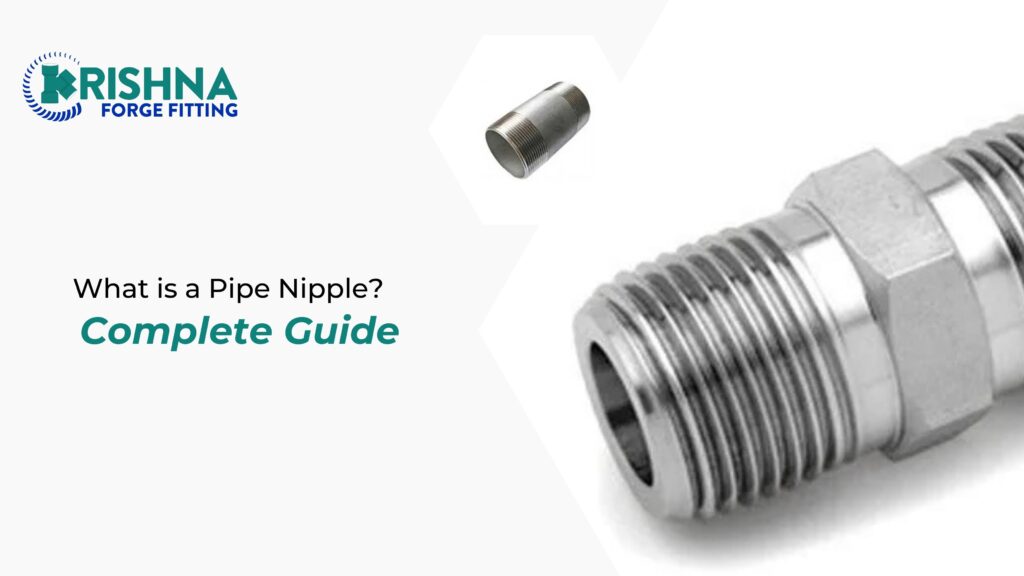
A pipe nipple is a short length of pipe with male threads on one or both ends, used to connect two female-threaded fittings or extend a pipe run by a fixed distance. They appear in virtually every piping system—from residential plumbing to oil refinery instrumentation lines operating at 3,000 PSI. Standard lengths run from close-nipple configurations under 1 inch to barrel nipples extending 12 inches or more.
This guide covers nipple types, thread standards, material grades, sizing, installation protocols, and application matching criteria for industrial and commercial piping projects.
Types of Pipe Nipples
Close Nipples
Close nipples are fully threaded end-to-end with no unthreaded centre section. They allow fittings to sit as close together as the thread length permits—useful in tight manifold assemblies and instrument connections. The fully threaded construction limits wrench grip, making installation torque control difficult without specialist tooling.
Barrel Nipples
Barrel nipples include an unthreaded centre section between two threaded ends. This plain middle section provides a gripping surface for pipe wrenches without damaging threads. They suit straight pipe extensions where fitting-to-fitting clearance is not the primary constraint.
Hex Nipples
Hex nipples feature a machined hexagonal centre section that accepts a standard spanner. This design eliminates the risk of wrench slippage onto threads during tightening. Hex nipples dominate instrument and process connections where controlled torque prevents thread galling and fitting damage.
Swage Nipples
Swage nipples taper from one diameter to a smaller diameter, combining a direction change in pipe size with a threaded connection. They replace a separate reducer and nipple in tight spaces, cutting component count and potential leak points. Common in tank nozzle and pressure vessel connections where size transitions occur at entry points.
Weld Nipples
Weld nipples have a plain end for welding and a threaded end for a screwed connection. They suit permanent high-pressure or high-temperature installations where full threading is impractical or where a welded-to-threaded transition is required. Instrumentation taps on boiler drums and chemical reactors frequently use weld nipples.
Nipples by End Configuration
- TOE (Thread One End): Threaded on one end only; plain end welded or swaged into pipe or vessel walls
- TBE (Thread Both Ends): Standard configuration for connecting two female fittings
- POE (Plain One End): One end plain for welding; one threaded
Thread Standards
NPT — National Pipe Taper
NPT threads use a 1°47′ taper that creates a self-sealing joint as threads engage deeper under torque. This standard dominates North American industrial piping and suits pressure applications from low-pressure utility lines up to Class 3000 forged fittings. PTFE tape or paste sealant fills thread-form gaps to complete the seal.
BSP — British Standard Pipe
BSP divides into BSPT (tapered, similar in function to NPT) and BSPP (parallel, requiring a face seal or O-ring). BSP is prevalent in European, Asian, and Commonwealth country installations. NPT and BSP threads are not interchangeable—forcing them together strips both thread forms and creates leak paths.
The most common procurement mistake on cross-border projects is mixing NPT nipples with BSP female fittings. Visual similarity hides dimensional incompatibility until pressurisation reveals the leak.
Material Selection
Carbon Steel
ASTM A53 and A106 seamless carbon steel nipples handle most industrial applications below 400°C. Galvanised versions add zinc coating for moderate corrosion resistance in water, air, and fire suppression systems. Schedule 40 suits standard service; Schedule 80 provides greater wall thickness for higher pressures.
Stainless Steel
Grades 304 and 316 resist corrosion in chemical, food, pharmaceutical, and marine service. Grade 316 handles chloride environments that attack 304 within months. Stainless nipples cost four to six times more than carbon steel but eliminate corrosion-related replacement cycles in aggressive media.
Brass
Brass nipples suit low-pressure plumbing, potable water, gas distribution, and instrument air lines. Dezincification-resistant grades handle hot water above 60°C without structural degradation. Brass machines to tighter thread tolerances than steel, making it preferred for fine-pitch instrument connections.
Sizing and Measurement
Length Classification
Nipple length is measured end-to-end including both threaded portions. Standard lengths follow a predictable pattern—close nipples start under 1 inch, then barrel nipples step up in half-inch increments from 1.5 inches through 12 inches.
Schedule determines wall thickness and therefore pressure capacity at a given nominal pipe size:
- Schedule 40: Standard wall, most common for utility and process service
- Schedule 80: Extra heavy wall for higher pressure or corrosive service requiring thicker walls
- Schedule 160 and XXH: Used in high-pressure hydraulic and petrochemical applications
Thread Engagement Depth
Insufficient thread engagement is the leading installation cause of nipple joint leakage. Minimum engagement equals one full thread depth times the number of threads specified for the pipe size. NPT fittings require a minimum of five to seven full thread turns in engagement depending on size.
Installation
Correct nipple installation follows a defined sequence:
- Inspect threads for damage, burrs, or contamination before assembly
- Clean threads with a wire brush to remove machining debris
- Apply PTFE tape clockwise to male threads—two full wraps minimum, leaving first two threads bare to prevent system contamination
- Apply pipe thread paste sealant over PTFE tape for high-pressure or gas service
- Hand-tighten until snug—typically three to four full turns
- Wrench-tighten two to three additional turns depending on size—stop when resistance increases sharply
- Pressure-test before covering or insulating joints
Over-tightening cracks fitting bodies and strips thread crests. Under-tightening leaves gaps that leak immediately under pressure.
Industrial Applications
Pipe nipples serve specific roles across industrial sectors:
- Oil and gas: Instrument taps, chemical injection points, pressure gauge connections, Class 3000 and 6000 service
- Power generation: Boiler drain connections, instrument air supply lines, steam trap outlet connections
- Chemical processing: Corrosion-resistant stainless connections for reagent feed lines and sample points
- Fire suppression: Schedule 40 galvanised nipples for sprinkler head and branch line connections
- HVAC: Gauge connections, drain points, air vent and fill connections on heating and cooling circuits
- Food and pharmaceutical: Sanitary stainless nipples with electropolished bores for hygienic fluid handling
Frequently Asked Questions
How is nipple length measured, and what does “close nipple” mean?
Nipple length is measured end-to-end including all threaded portions. A close nipple is fully threaded from end to end with no unthreaded centre section—its length equals the combined thread engagement depth of both ends with minimal or no gap. This configuration places connected fittings as close together as thread length allows, typically under 1 inch for small pipe sizes.
Can NPT and BSP nipples be used interchangeably?
No. NPT and BSP threads differ in thread angle (60° versus 55°), pitch, and taper rate. Forcing an NPT nipple into a BSP female fitting creates thread form interference that appears to tighten but never seals properly. Under pressure, these mixed joints leak immediately or fail within hours. Always match thread standard to the receiving fitting before ordering.
What schedule nipple should I specify for high-pressure service?
Schedule 80 suits most industrial high-pressure applications up to Class 3000 service. For Class 6000 or hydraulic service above 3,000 PSI, specify Schedule 160 or XXH (double extra heavy) wall nipples. Confirm that the wall thickness supports the fitting pressure class—a Class 6000 fitting with a Schedule 40 nipple creates a weak point that fails at a fraction of the rated system pressure.
What causes most pipe nipple leaks in service?
Thread mismatch between NPT and BSP accounts for a significant share of leaks in cross-border or retrofitted systems. Insufficient thread engagement follows closely—five to seven full thread turns minimum prevents most installation-related failures. Sealant applied to female threads rather than male threads bunches into the bore during assembly, creating debris and partial seal failure. Corrosion in the thread valleys from incompatible material-to-media combinations causes the remaining failures over time.
Conclusion
Pipe nipples are simple fittings with specific technical requirements that determine whether joints seal reliably for decades or leak within months. Type, thread standard, material grade, schedule, and installation torque all affect performance. Match each specification to actual service conditions and verify thread compatibility before ordering. Request technical specifications and material certificates from our team.
Krishna Forge Fitting manufactures precision forged pipe nipples in carbon steel and stainless steel grades meeting ASME B16.11 and ASTM specifications. We supply close, barrel, hex, swage, and weld nipple configurations from ½ inch to 4 inches in NPT and BSP thread standards, Schedule 40 through Schedule 160 wall thicknesses, for oil and gas, chemical processing, power generation, instrumentation, and industrial piping applications.
Our thread cutting process maintains dimensional accuracy within ASME B1.20.1 tolerances for leak-free engagement in critical service. Every order includes material test certificates with full chemical composition and mechanical properties traceability.
Request nipple specifications, thread standard confirmation, and pressure class guidance at krishnaforge.com. Our engineering team provides application-specific recommendations for material grade, schedule, and thread configuration for high-pressure, corrosive, and temperature-critical piping systems.
