Introduction
Small bore piping failures get misdiagnosed constantly. A leak at an instrument connection gets attributed to the gasket. A crack at a branch outlet gets blamed on vibration. The actual cause in most cases: a socket weld fitting incorrectly installed—wrong gap, contaminated socket, incomplete fillet weld.
Socket weld fittings dominate high-pressure small bore piping in refineries, chemical plants, and power stations precisely because they outperform threaded connections under pressure and cyclic loading. Yet they fail more often than they should because the installation requirements are specific and frequently ignored.
This guide covers what socket weld fittings are, the full range of types available, how installation procedure determines performance, which materials suit which service conditions, and how pressure class maps to application. By the end, you’ll know how to specify and install socket weld fittings correctly—eliminating the failures that follow from shortcuts.
What Are Socket Weld Fittings
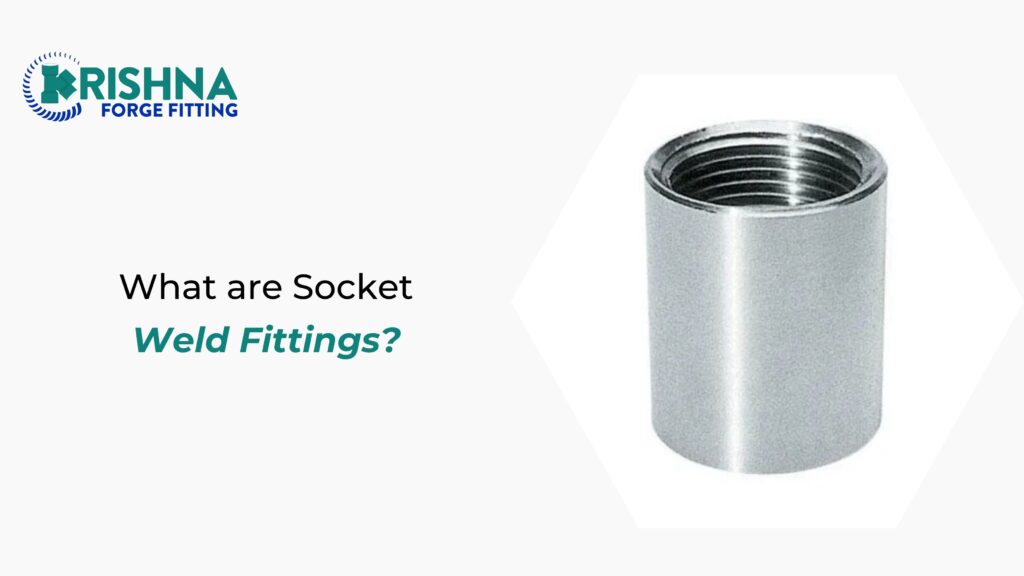
A socket weld fitting has a recessed socket—a cylindrical bore machined into each end—that accepts a pipe end for insertion before welding. The pipe slides into the socket, a mandatory expansion gap is set, and a single fillet weld seals the joint at the outer edge of each socket end.
This design differs fundamentally from butt weld fittings, which join pipe ends face-to-face with full penetration welds. Socket welds are faster to install and easier to align—no pipe bevel preparation required—making them practical for small bore piping where butt welding would be time-consuming and impractical.
Socket weld fittings are governed by ASME B16.11 and limited to NPS 3 and below in most piping codes. Above NPS 3, butt weld fittings take over.
Types of Socket Weld Fittings
Elbows, Tees, and Caps
The standard range covers directional changes, branch connections, and end closures:
- Elbows (90° and 45°): Redirect flow in small bore instrument lines, steam tracing, and hydraulic circuits
- Equal tees: Create branch connections at 90° to the run
- Reducing tees: Branch outlet smaller than the run; suit instrumentation tap-offs
- Caps: Seal pipe ends permanently or as test closures
Couplings and Unions
- Full couplings: Join two pipe sections in line; suit extensions and repairs
- Half couplings: Weld to vessel or pipe walls to create small bore branch outlets; common for instrument connections and chemical injection points
- Reducing couplings: Connect pipes of different sizes in the same run
- Unions: Three-piece fittings that allow full disconnection without cutting or rotating pipe; essential at equipment connections requiring periodic removal
Crosses and Speciality Types
- Crosses: Four-way connections; used where space prohibits multiple tees
- Reducers/inserts: Transition bore sizes within a socket weld assembly
- Sockolets: Branch outlet fittings that weld onto the main run to create socket weld branch connections for small bore offtakes
Socket Weld Installation Process
Pipe Preparation and Deburring
Clean cutting and deburring determine weld quality. Burrs inside the socket create turbulence at the joint and prevent full pipe insertion. External burrs on the pipe end interfere with socket seating. Remove both before assembly.
Expansion Gap Requirement
This is the step most installers skip. Insert the pipe fully into the socket until it bottoms out, then withdraw it 1.6mm (1/16 inch) before welding. This gap accommodates thermal expansion when the system heats up during service. Welding without the gap traps expansion forces at the weld root, causing cracks that propagate through the fillet weld under thermal cycling.
Fillet Welding Procedure
- Mark the pipe at the correct insertion depth before final positioning
- Confirm the 1.6mm gap is maintained after positioning
- Tack weld at two points 180° apart to lock the assembly
- Complete the fillet weld in a continuous pass around the full circumference
- Inspect for consistent weld profile, no undercut, and complete coverage
Inspection and Testing
Visual inspection confirms weld profile and coverage. For critical service—high pressure, sour gas, steam—dye penetrant or magnetic particle testing detects surface cracks invisible to the naked eye. Hydrostatic pressure testing verifies joint integrity before commissioning.
Materials for Socket Weld Fittings
Material selection follows the same logic as the piping system it connects to:
- Carbon steel (ASTM A105): General service—oil and gas, steam, water, compressed air; handles -29°C to 425°C
- Stainless steel 304 (ASTM A182 F304): Corrosion-resistant service; food, pharmaceutical, chemical processing
- Stainless steel 316 (ASTM A182 F316): Adds molybdenum; superior chloride resistance; marine and aggressive chemical environments
- Alloy steel (P-grades): High-temperature service in power plants and refineries
- Nickel alloys (Hastelloy, Inconel, Monel): Extreme corrosion, high-temperature aggressive media
Galvanic corrosion accelerates at junctions between dissimilar metals. Match fitting material to pipe material or install insulating components when material transitions are unavoidable.
Standards and Specifications
ASME B16.11 is the governing standard for socket weld and threaded fittings. It specifies dimensions, tolerances, pressure-temperature ratings, and marking requirements for each pressure class.
MSS SP-79 covers socket weld reducer inserts. MSS SP-83 addresses pipe unions. MSS SP-97 specifies branch outlet fittings including sockolets.
Pressure classes under B16.11 reflect the fitting wall thickness and material capacity:
- Class 2000#: Light service; threaded fittings only
- Class 3000#: Standard socket weld service; most common industrial specification
- Class 6000#: High-pressure service; thicker walls, higher material grade
- Class 9000#: Extreme pressure; less common; typically special order
Applications and Advantages
Socket weld fittings suit high-pressure small bore piping where threaded connections would loosen under vibration and butt welds would be impractical due to pipe size and space constraints.
Primary applications:
- Instrument impulse lines (NPS ½ to NPS 2)
- Chemical injection systems
- Steam tracing and condensate return
- Hydraulic and lube oil circuits in rotating equipment
- High-pressure water injection in oil and gas
Advantages over threaded fittings: No thread engagement degradation under vibration or thermal cycling; higher pressure ratings; better sealing integrity under cyclic loading.
Limitations: Crevice corrosion risk at the annular gap between pipe and socket in corrosive service; unsuitable above NPS 3; more time-intensive to install than threaded fittings.
FAQs
Why is the 1.6mm expansion gap so critical?
Without the gap, thermal expansion during heat-up forces the pipe against the socket bottom, loading the weld root in compression and tension alternately. This fatigue loading cracks the fillet weld over time. The gap absorbs the expansion and keeps the weld in its designed stress state.
Can socket weld fittings be used in corrosive service?
Yes, with the correct material grade and awareness of crevice corrosion risk. The annular gap between pipe and socket traps fluid that can concentrate and corrode in aggressive media. For highly corrosive applications, the gap should be minimised and material grade selected carefully—SS316 or higher alloys for chloride environments.
What’s the difference between Class 3000 and Class 6000?
Both are socket weld pressure classes under ASME B16.11. Class 3000 suits standard high-pressure service in most industrial piping. Class 6000 has thicker walls and higher allowable pressures—used in hydraulic systems, high-pressure steam, and applications where operating pressure exceeds Class 3000 limits at the relevant temperature.
Conclusion
Socket weld fittings deliver reliable, leak-proof connections in small bore high-pressure piping when installed correctly. The expansion gap is non-negotiable. Material grade must match process conditions. Pressure class must align with operating parameters.
Get the installation procedure right and socket weld joints outlast the pipe around them. Miss the gap or skip deburring and the joint becomes the weakest point in the system.
Review your current socket weld specifications and confirm that pressure class, material grade, and installation procedures match your actual service conditions. If you’re not certain, it’s worth checking before commissioning.
Krishna Forge manufactures precision-forged socket weld fittings—elbows, tees, couplings, unions, caps, and crosses—in carbon steel (ASTM A105), stainless steel (ASTM A182 F304, F316), alloy steel, and nickel alloy grades. Our fittings meet ASME B16.11 dimensional standards across Classes 3000, 6000, and 9000, with full material traceability, heat treatment records, and dimensional inspection certificates. Built for high-pressure instrument lines, chemical injection, steam systems, and oil and gas service, our socket weld fittings deliver the dimensional accuracy that correct installation depends on.
Need socket weld fittings with verified pressure ratings and complete material certification?
Visit krishnaforge.com to review fitting specifications, available material grades, pressure classes, and custom manufacturing options. Get forged socket weld fittings engineered for reliable service—with technical support that confirms correct selection for your application.
