Forged fittings are the backbone of modern piping systems, offering unmatched durability, strength, and reliability across demanding industrial environments. Whether for oil refineries, power plants, chemical facilities, or commercial buildings, forged fittings ensure the safe transfer of fluids and gases under high pressure and temperature. This in-depth guide answers your questions about forged fittings—their types, applications, advantages, and what sets them apart in the world of industrial piping.
What Are Forged Fittings?
Forged fittings are piping components shaped under immense pressure using a hot forging process. Unlike cast fittings (made by pouring molten metal into a mold), forged fittings are crafted by compressing solid metal billets—such as carbon steel, stainless steel, alloy steel, or nickel alloys—into specific shapes. This deliberate grain structure manipulation results in fittings that are stronger, tougher, and more resistant to wear and impact than their cast or welded counterparts.
The Forging Process Explained
- Material Selection: Premium billets or bars of steel or alloy are chosen.
- Heating: The metal is heated to temperatures above its recrystallization point, making it malleable.
- Shaping: High-pressure hammering or pressing shapes the fitting.
- Trimming & Machining: Excess material is removed, and precise dimensions are achieved through machining.
- Heat Treatment: To further enhance mechanical properties.
- Testing: Each fitting undergoes stringent quality checks for leaks, cracks, and dimensional accuracy.
Types of Forged Fittings
Forged fittings come in a variety of types and configurations to meet diverse piping requirements, commonly categorized by their connection method and shape:
1. Socket Weld Fittings
- Allow pipes to be inserted into a recessed area and fillet-welded around the joint.
- Ideal for small-bore (typically ≤2in), high-pressure applications.
- Examples: Socket weld elbows, tees, couplings, unions, caps.
2. Threaded (Screwed) Fittings
- Feature internal or external threads for easy assembly/disassembly.
- Suitable for low- and moderate-pressure piping where welding is impractical.
- Examples: Threaded elbows, tees, couplings, unions, plugs, bushings.
3. Buttweld Fittings
- Less common in forged form than in cast, but available for specialized needs.
4. Flanges
- Forged flanges include socket weld, threaded, slip-on, and blind flanges for secure pipe intersections and terminations.
5. Specialty Fittings
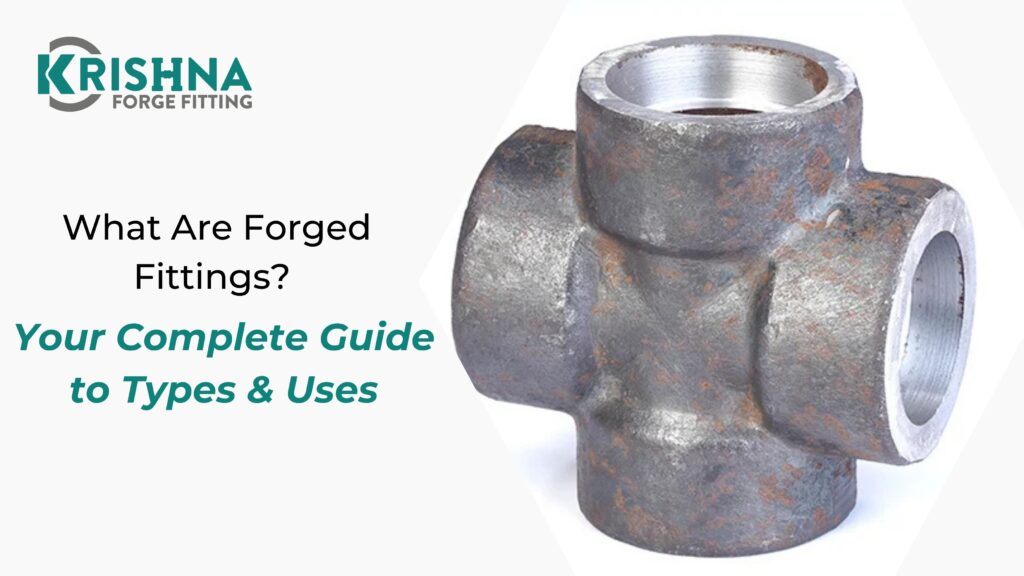
- Crosses (4-way intersections)
- Reducers (diameter transitions)
- Caps (pipe ends)
- Olets (branch connections)
Key Shapes & Functions of Forged Fittings
| Fitting Type | Function |
| 45°/90° Elbows | Change pipe direction |
| Tees | Split/combine fluid flow (three ways) |
| Couplings | Join two pipes in a straight run |
| Unions | Enable disconnection for maintenance |
| Bushings | Connect pipes of differing sizes |
| Crosses | Four-way flow intersection |
| Caps/Plugs | Seal pipe ends temporarily/permanently |
| Reducers | Transition between larger/smaller pipes |
Why Are Forged Fittings Superior?
Forged fittings outperform alternatives due to:
- Exceptional mechanical strength & ductility: Ideal for extreme pressure and cyclic loading.
- Tight grain structure: Ensures high resistance to impact, cracking, and fatigue.
- No porosity or shrinkage: Rarely suffer from internal voids or integrity issues that can plague castings.
- Consistent dimensional tolerance: Resulting in leak-proof and precise connections.
- Greater wear and corrosion resistance: Especially vital in aggressive and challenging environments.
Advantages of Forged Fittings Compared to Cast or Wrought
- Longer service life and enhanced safety
- Reduced risk of leaks and maintenance downtime
- Cost-effective over time despite higher upfront investment
- Suited for both critical and non-critical applications due to versatile shapes and sizes
Common Applications of Forged Fittings
Forged fittings are vital in any industry where strength, reliability, and leak-free performance are essential:
- Oil & Gas Production: Wellheads, flow lines, offshore rigs, refineries
- Petrochemical & Chemical Plants: Handling corrosive, toxic, or high-temperature fluids
- Power Generation (Thermal, Nuclear, Hydro): Steam, water, condensate systems
- Pharmaceutical & Food Processing: Clean, corrosion-resistant connections
- Water Treatment & Distribution: High-pressure water lines, desalination plants
- Firefighting and Sprinkler Systems: Durable and corrosion-resistant joints
- Marine and Shipbuilding: Saltwater tolerant, high-stress areas
- Construction & HVAC: Reliable heating, cooling, and plumbing systems
- Mining and Mineral Processing: High abrasion and pressure pipeline systems
- Instrument Connections: Secure, precise small-bore fittings
Pressure Ratings and Standards
Forged fittings are classified by pressure classes and international standards to ensure performance:
- Pressure Classes: 2000, 3000, 6000, and 9000 psi (pounds per square inch)
- Dimensions/Standards: ASME B16.11, MSS-SP-79, BS 3799, JIS B2316, IS standards
Material Options for Forged Fittings
- Carbon Steel: Cost-effective, robust; oil & gas, power, general industry
- Stainless Steel: Superior corrosion resistance for harsh or sanitary applications
- Alloy Steel: Withstands extreme temperatures and pressures
- Duplex and Super Duplex Stainless Steel: Maximum strength and corrosion resistance
- Nickel Alloys & Titanium: Specialized corrosive or high-pressure service
Quality Assurance and Manufacturing Excellence
Top manufacturers like Krishna Forge Fittings ensure:
- Rigorous material traceability
- Comprehensive quality inspections (dimensional, hardness, hydrostatic, PMI)
- Certification: ISO, ASME, PED
- Customization: Tailored to project specs (size, threading, pressure rating)
Installation Tips
- Choose appropriate pressure class and material for your service conditions.
- Follow torque, welding, and threading guidelines for safe, leak-free connections.
- Inspect for any signs of damage or corrosion before installation.
- Regular maintenance is key to long-term system safety and performance.
Frequently Asked Questions
Q1: Are forged fittings suitable for high-temperature environments?
A: Yes, forged fittings withstand high pressures and extreme temperatures, making them ideal for steam, petrochemical, or power generation plants.
Q2: Can I get custom-size forged fittings?
A: Leading manufacturers offer bespoke solutions for non-standard size, shape, or pressure requirements.
Q3: What is the lifespan of forged fittings?
A: With proper material selection and care, forged fittings can last decades, especially in high-stress environments due to their superior wear and fatigue resistance.
Why Choose Krishna Forge Fittings?
- Industry-Leading Quality: Engineered with tight tolerances and certified materials.
- Full Range & Customization: Every type, size, and pressure class—tailored to your needs.
- Technical Support: Expert guidance from selection to installation.
- Global Trust: Serving major projects across oil & gas, chemical, energy, and infrastructure.
Conclusion
Forged fittings are fundamental to safe, robust, and efficient piping systems—from demanding oilfields to precision pharmaceutical plants. Their unrivaled strength, leak-tightness, and longevity make them the best choice for high-pressure and high-temperature applications worldwide.
Ready to invest in proven reliability? Choose Krishna Forge Fittings for all your forged piping needs—your project’s performance and safety depend on it.
Contact our expert team for project consultations, quotations, and technical advice today.
