
Every minute of downtime in a refinery or plant costs more than the price of a flange. Most plants still keep paying the price. Not because they want to, but because bad specs, rushed sourcing, and inconsistent supply chains make it hard to get the right flange when it matters most.
Global maintenance studies show that over 60% of pipeline leaks trace back to connection failures, not the pipes themselves.
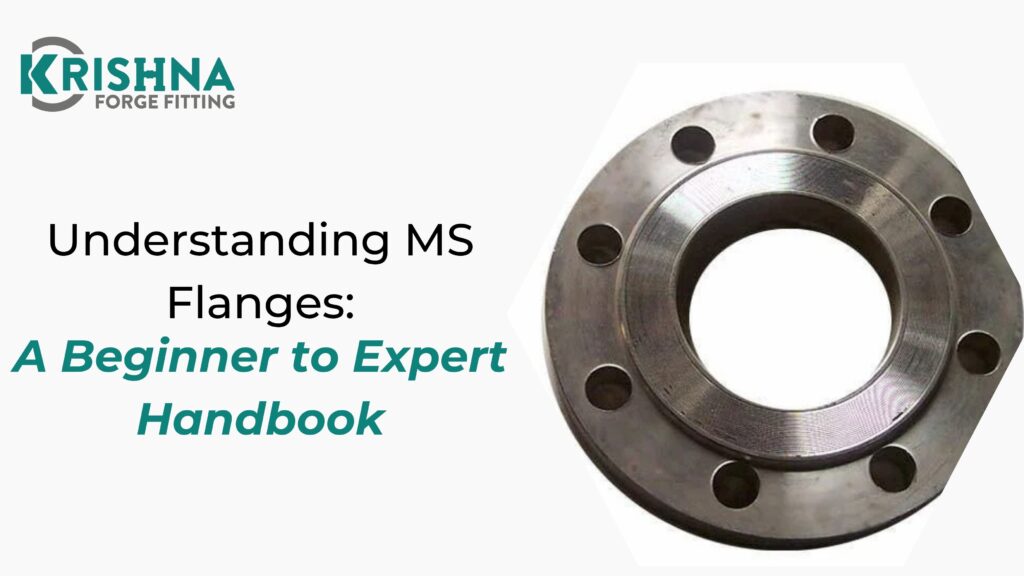
Get to know Flanges. The guardians of safety, efficiency, and continuity in oil & gas, power, and process industries. The right Mild Steel (MS) flange ensures seamless flow, while the wrong one invites corrosion, vibration, and costly downtime. The difference? Acuity at the procurement stage.
This handbook equips engineers and buyers to make confident, cost-saving choices. Everything from flange types and material grades to pressure ratings, installation, and quality checks.
What Makes MS Flanges Different
Material Composition
MS flanges contain low carbon content (typically under 0.25%), which gives them excellent weldability and machinability. The steel includes manganese for strength, small amounts of silicon for deoxidation, and controlled phosphorus and sulfur levels. This composition creates a cost-effective material that handles moderate temperatures and pressures without the premium cost of stainless steel.
Cost vs Performance Reality
Stainless steel flanges dominate the Indian market due to corrosion resistance. MS flanges, however, deliver 40-60% cost savings while maintaining structural integrity in non-corrosive environments. For projects with budget constraints and standard operating conditions, MS flanges offer the best value per rupee spent.
Critical Flange Types You Need to Know
Weld Neck Flanges
These feature a tapered hub that transitions smoothly from pipe to flange. The design distributes stress evenly, making them ideal for high-pressure systems above 600 PSI. Use them where temperature fluctuations exceed 200°C or where the system cannot tolerate failure.
Slip-On Flanges
Slip-ons slide over the pipe and require two fillet welds—one inside, one outside. They cost less than weld necks and install faster. Choose them for low-pressure applications under 300 PSI where ease of alignment matters.
Blind Flanges
Blind flanges seal pipe ends completely. They enable future expansion, allow inspection access, and facilitate pressure testing. Every piping system needs them for maintenance shutdowns and system isolation.
Socket Weld and Threaded Options
Socket weld flanges suit small-bore, high-pressure lines where space is tight. Threaded flanges eliminate welding requirements for quick installations in low-pressure, low-temperature settings. Both serve specialized needs but represent less than 20% of typical flange orders.
Pressure Ratings That Actually Matter
ASME B16.5 defines seven pressure classes: 150, 300, 400, 600, 900, 1500, and 2500. Class 150 handles up to 270 PSI at room temperature but drops to 180 PSI at 260°C. Most industrial applications fall into Class 150 or 300 ranges.
Here’s the uncomfortable truth: over-specifying pressure class wastes money. Under-specifying causes catastrophic failures. Calculate maximum operating pressure, add a 10-15% safety margin, and select the appropriate class.
Installation Best Practices That Prevent Failures
The Alignment Rule
Flange faces must sit parallel within 0.5mm across the diameter. Misalignment creates uneven gasket compression, leading to leaks within months. Use precision measuring tools, not visual estimates.
Bolt Tightening Sequence
Tighten bolts in a star pattern, working from opposite sides. Apply torque in three stages: 30%, 60%, then 100% of specification. This prevents warping and ensures even gasket compression. Incorrect bolting practices cause the majority of flange failures in industrial operations.
Gasket Selection
Match gasket material to the medium flowing through pipes. Use compressed asbestos-free sheets for steam, PTFE for chemicals, and spiral-wound metal gaskets for high temperatures. Wrong gasket choice negates every other precaution.
Quality Verification Checklist
Inspect these elements before accepting delivery:
- Material test certificates confirming ASTM A105 or equivalent specifications
- Dimensional accuracy within ASME B16.5 tolerances
- Surface finish free from pitting, cracks, or deep tool marks
- Protective coating (paint or galvanizing) applied evenly
- Manufacturer’s heat number stamped on the flange body
Request third-party inspection reports for critical applications. The cost is negligible compared to failure consequences.
Frequently Asked Questions
Q: What’s the typical lifespan of an MS flange in industrial service?
A: MS flanges last 15-25 years in non-corrosive environments with proper installation and maintenance. Protective coatings extend service life by preventing surface oxidation. Systems exposed to moisture or chemicals require regular inspection every 2-3 years.
Q: Can MS flanges handle high-temperature applications?
A: MS flanges work reliably up to 350°C in continuous service. Beyond this temperature, material properties degrade and pressure ratings drop significantly. For applications above 400°C, consider alloy steel alternatives.
Q: How do I calculate the correct flange size for my piping system?
A: Match flange nominal pipe size (NPS) to the pipe outer diameter. A 4-inch pipe requires a 4-inch flange. Verify bolt hole diameter and pitch circle diameter match on both mating flanges. Mismatched dimensions make assembly impossible.
Conclusion
MS flanges represent the intersection of cost efficiency and structural reliability in industrial piping systems. Selection comes down to three factors: operating conditions, installation quality, and manufacturer credibility. Get these right, and systems run for decades without intervention. Get them wrong, and failures compound faster than maintenance teams can respond.
Review your current flange specifications against pressure requirements and installation protocols outlined here. Contact us with specific application details to receive technical recommendations.
Krishna Forge is an ISO-certified manufacturer and exporter of forged flanges and industrial fittings. Our products comply with industry standards such as ASME B16.5 and ASTM A105, ensuring reliable performance and dimensional accuracy. Every flange undergoes rigorous inspection for material integrity and dimensional precision before dispatch. We supply forged flanges in a wide range of pressure classes and sizes to meet diverse industrial applications.
Request a technical consultation and quote at krishnaforge.com or call our engineering team to discuss your project requirements. We provide material certificates, third-party inspection arrangements, and custom coating options for specialized applications.
