
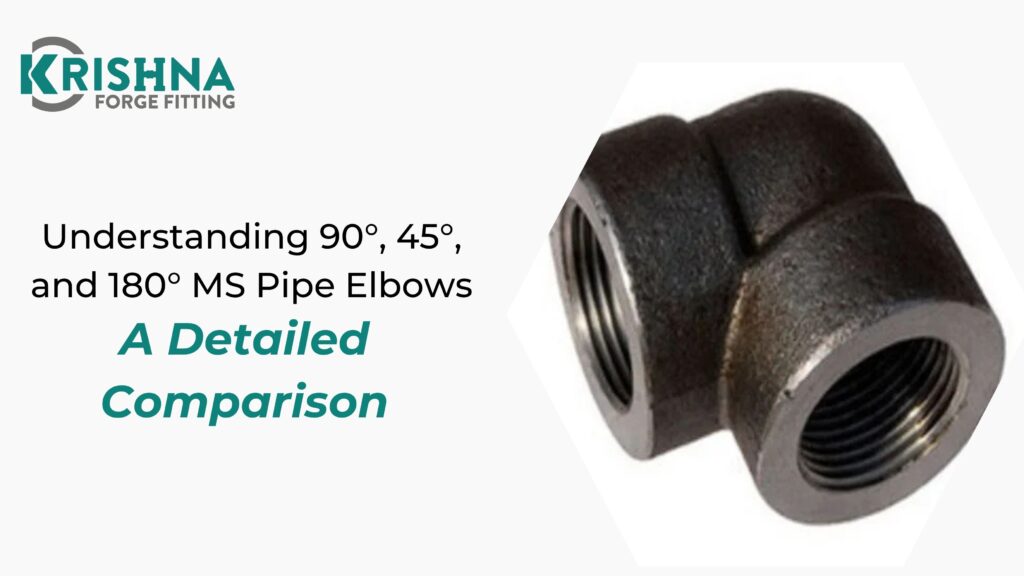
Most piping system failures trace back to one mistake: picking the wrong elbow angle. Engineers often default to 90° elbows without considering how a 45° alternative could cut pressure drop by 40% or how a 180° return bend eliminates three connection points that become leak risks. MS pipe elbows aren’t interchangeable parts—each angle creates distinct flow patterns, pressure losses, and installation requirements.
The difference between long radius and short radius versions adds another layer. A long radius 90° elbow has a center-to-face distance of 1.5 times the nominal pipe size, while short radius measures just 1.0 times. That seemingly small gap translates into measurably different turbulence levels and system efficiency. This guide breaks down when to use 45°, 90°, and 180° MS elbows based on flow dynamics, space constraints, and pressure handling capacity.
What Makes Each Elbow Angle Different
45° Elbow Characteristics
The 45° elbow creates the gentlest directional change in piping systems. It generates the lowest pressure drop among all three angles because fluid encounters minimal turbulence through the gradual curve. The smooth flow path reduces wear on pipe walls and extends service life in systems handling abrasive materials.
These elbows often pair together to achieve custom angles. Two 45° elbows positioned strategically can replace a single 90° while maintaining superior flow characteristics. The trade-off comes in installation space—they require more linear distance than sharper angles.
90° Elbow Specifications
The 90° elbow handles right-angle turns and comes in two radius types. Long radius (LR) versions offer smoother flow with a bend radius of 1.5D, while short radius (SR) versions save space with a tighter 1.0D curve. The LR option suits applications where pressure drop matters; SR fits tight installations where space dictates design.
The weakest structural point sits at the inside radius where material experiences maximum stress. ASME B16.9 standards allow wall thickness to thin by up to 12.5% during the forming process, which explains why some manufacturers supply one schedule thickness higher than specified.
180° Return Elbow Functions
The 180° elbow reverses flow direction completely, creating a U-turn within the piping system. It replaces what would otherwise require multiple fittings—a combination that would introduce additional joints and leak points. This single-piece construction reduces installation time and improves system integrity.
Heat exchangers commonly use 180° return bends in tube bundles where compact routing matters more than pressure optimization. The complete flow reversal generates the highest pressure drop of all three angles, but the space savings and reduced connection count often justify this trade-off.
Pressure Drop and Flow Performance
Flow efficiency separates these three angles in measurable ways. The 45° elbow causes minimal disturbance, making it ideal for viscous fluids or systems operating near maximum pressure capacity. Testing shows it maintains the most laminar flow patterns.
The 90° LR elbow produces moderate pressure losses while the 90° SR version generates noticeably higher turbulence due to its tighter bend. When switching from LR to SR, expect increased erosion potential and flow noise in high-velocity applications.
The 180° configuration creates the greatest flow disruption as fluid must completely reverse direction. Secondary flow patterns develop inside the bend, creating regions of recirculation. Systems using 180° elbows need adequate pump capacity to overcome these losses.
Space and Installation Requirements
Space availability often dictates elbow selection more than flow optimization. The 45° elbow demands the most linear space but allows routing around obstacles without sharp turns. It gives designers flexibility in congested piping corridors.
The 90° SR elbow wins on compactness, fitting into tight spots where equipment spacing limits options. Industrial facilities with dense pipe racks favor this configuration despite the flow penalty. The 90° LR elbow balances space and performance for general applications.
The 180° return bend delivers maximum space efficiency when creating parallel pipe runs. A single 180° elbow occupies less space than routing separate pipes and eliminates the welding required for multi-fitting assemblies.
Selecting the Right Elbow for Your Application
Material compatibility starts the selection process. MS elbows handle standard water, oil, and gas applications across industrial sectors. For corrosive environments, stainless steel or alloy versions provide necessary protection.
Pressure ratings must match system requirements. Calculate total pressure drop including all fittings—multiple 45° elbows might actually create less total loss than one 90° SR when considering the complete flow path.
Maintenance accessibility matters for long-term operations. Systems requiring frequent inspection benefit from configurations that allow easier access to critical measurement points.
Manufacturing Standards and Quality
ASME B16.9 governs dimensions and tolerances for factory-made buttwelding fittings, while ASME B16.11 covers forged fittings. These standards ensure elbows mate properly with pipe sections and maintain pressure ratings throughout the system.
Wall thickness at the weld line location receives specific attention in standards because this area experiences concentrated stress during operation. Quality manufacturers verify minimum wall thickness exceeds specifications after forming processes thin the material.
Frequently Asked Questions
Q: When should I choose a long radius over a short radius 90° elbow?
A: Use long radius when minimizing pressure drop matters more than saving space. LR elbows reduce turbulence and erosion in high-velocity systems. Switch to SR only when physical constraints make LR installation impossible.
Q: Can I use two 45° elbows instead of one 90° elbow?
A: Yes, and it often improves flow performance. Two 45° elbows positioned correctly create less total pressure drop than a single 90° elbow while providing routing flexibility. The installation requires more space and an additional fitting.
Q: Why does the inside radius represent the weakest point?
A: Material thins at the inside radius during the forming process while simultaneously experiencing maximum stress from internal pressure. This combination creates the failure initiation point if pressure exceeds design limits.
Q: Do 180° elbows require special installation procedures?
A: They need adequate support because the complete flow reversal creates higher reaction forces. Position drain points at the lowest bend location to prevent liquid accumulation during shutdowns.
Q: How much pressure drop should I expect from each elbow type?
A: A 45° elbow typically causes 0.35-0.40 velocity heads of pressure loss, a 90° LR elbow about 0.75 velocity heads, and a 180° return bend approximately 1.5 velocity heads. Actual values depend on Reynolds number and specific geometry.
Conclusion
Choosing between 45°, 90°, and 180° MS elbows requires balancing flow efficiency against space constraints and installation practicality. The 45° delivers superior flow with minimal pressure penalty, the 90° provides versatile directional change in standard or compact forms, and the 180° enables space-efficient reversals while reducing connection points.
Contact us to specify the right elbow angles for your next piping project.
Krishna Forge manufactures precision MS pipe elbows in 45°, 90° (LR and SR), and 180° configurations that meet ASME B16.9 and B16.11 standards. Our elbows maintain consistent wall thickness and dimensional accuracy across carbon steel, stainless steel, and alloy steel grades.
Every elbow ships with full traceability documentation including material certificates, dimensional reports, and pressure rating verification. Our technical team provides application support to help specify the optimal elbow configuration for your flow requirements, space constraints, and operating conditions.
Request detailed specifications and pricing at krishnaforge.com or connect with our engineering team to discuss your piping system design. We deliver reliable directional fittings for demanding industrial applications.
