
Introduction
Most procurement delays in Gujarat’s industrial sector trace back to a single mistake—choosing fittings suppliers based on price alone. A 2024 industry survey of 200 manufacturing facilities in Rajkot revealed that 67% experienced project delays due to supplier issues: late deliveries, wrong specifications, missing certifications, or substandard materials that failed inspection. The cost of these delays exceeded the initial savings by 3-5 times when factoring in shutdown extensions, expedited shipping, and rework.
Rajkot’s position as Gujarat’s industrial manufacturing hub creates unique demands. Facilities need suppliers who maintain inventory locally, understand ASME and ASTM specifications, provide material traceability, and deliver on committed schedules. The difference between a transactional vendor and a strategic supplier shows up in uptime, compliance pass rates, and total cost of ownership. This guide explains what separates leading industrial fittings suppliers from the rest and how to evaluate capabilities that determine long-term project success.
What Defines a Leading Supplier
Quality Systems Beyond Certificates
ISO certification appears on every supplier’s website, but the real differentiator sits in daily manufacturing controls. Leading suppliers maintain dimensional inspection records for every batch, conduct hardness testing on forged components, and retain samples tied to heat codes for traceability audits.
The gap between claimed capabilities and actual practice emerges during third-party inspections. Suppliers without robust internal quality systems fail 40-60% of inspector visits, creating costly project delays while they scramble to produce compliant documentation.
Inventory Depth and Lead Time Reliability
Local inventory separates regional leaders from order-takers who dropship from distant warehouses. Maintaining stock in Rajkot eliminates 7-14 day transit delays and allows same-day fulfillment for urgent requirements. Emergency shutdowns and breakdown maintenance don’t wait for shipping schedules.
Lead time accuracy matters more than quoted delivery speed. A supplier who consistently delivers on promised dates—even if those dates are longer—creates more project value than one who quotes fast but ships late.
Product Range and Technical Capability
Comprehensive Forged Fitting Portfolio
Industrial facilities need multiple fitting types from a single source to consolidate procurement and ensure compatibility. A complete range includes:
- Elbows: 45°, 90° (LR/SR), 180° in sizes 1/8″ to 4″
- Tees and Crosses: Equal and reducing configurations
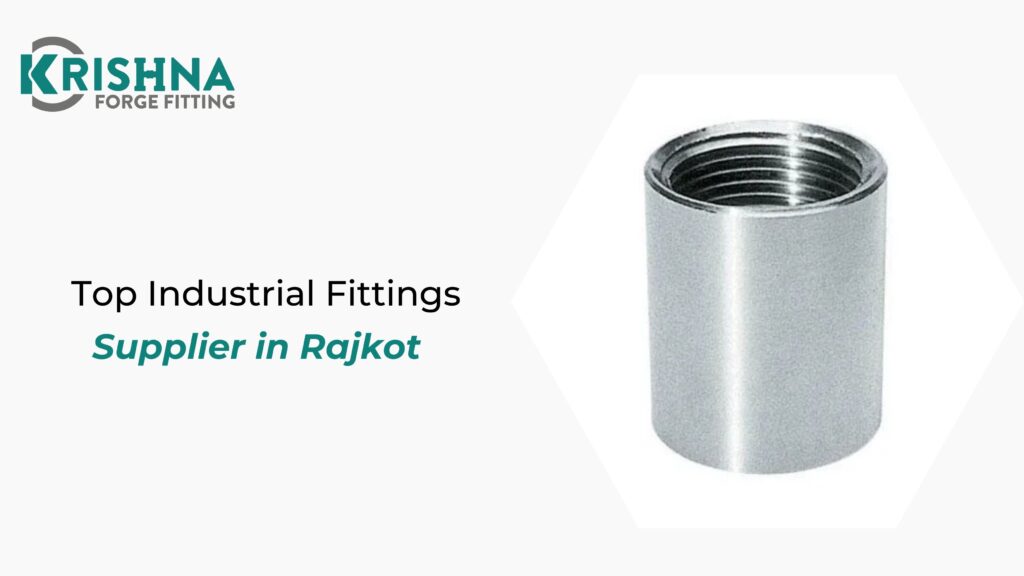
- Couplings: Full and half, threaded and socket weld
- Nipples: Close, hex, barrel, reducing, and long nipples
- Caps and Plugs: Threaded and socket weld terminations
- Unions: For maintenance access points
Material versatility across carbon steel (A105), stainless steel (304/316/316L), duplex, and alloy grades allows one supplier to serve diverse process requirements without material compatibility concerns.
Pressure Class and Schedule Availability
Class 2000 through Class 9000 forged fittings handle the full spectrum of industrial pressure requirements. Suppliers maintaining inventory across multiple classes prevent project delays when specifications exceed standard Class 3000 ratings. Schedule variations (40, 80, 160) must match pipe schedules for proper fit-up and pressure rating continuity.
Standards Compliance and Documentation
Manufacturing to International Codes
ASME B16.11 governs forged fittings dimensions and pressure ratings. Suppliers manufacturing to this standard ensure compatibility with piping components from any global source. ASTM material specifications (A105, A182, A350) define chemical composition and mechanical properties that determine service suitability.
Compliance claims mean nothing without documentation. Material Test Certificates (MTCs) must trace back to heat codes marked on each fitting. Third-party inspection acceptance demonstrates that quality systems withstand external scrutiny.
Traceability from Heat to Installation
Complete traceability answers critical questions during commissioning and maintenance: What heat lot? What mill? What mechanical properties? This documentation prevents costly shutdowns when inspectors question material suitability during audits. Suppliers who can’t produce heat-specific test reports within hours create project risk.
Industries Served and Application Knowledge
Rajkot’s industrial diversity spans oil and gas equipment manufacturing, chemical processing, power generation components, and general manufacturing. Leading suppliers understand application-specific requirements:
Oil & Gas: Sour service materials, NACE compliance for H2S environments, exotic alloys for offshore
Chemical Plants: Corrosion resistance verification, material compatibility with process fluids
Power Generation: High-temperature alloy selection, creep-resistant grades for steam service
Water Treatment: Chloride resistance, sanitary finishes for potable water
Application knowledge prevents specification errors that create field failures. A supplier who asks about operating conditions and fluid compatibility adds more value than one who simply quotes what you request.
Delivery Reliability and Logistics
Geographic proximity to major industrial zones in Rajkot, Jamnagar, and Ahmedabad enables responsive delivery. Suppliers with dedicated logistics can execute same-day emergency deliveries within 50 kilometers and next-day service across Gujarat.
Export packing capabilities matter for EPC contractors executing international projects. Proper preservation, wooden case packing, and customs documentation prevent overseas delays. Suppliers experienced in export documentation save weeks during project mobilization.
Technical Support and Engineering Services
Pre-Purchase Application Assistance
Leading suppliers help buyers select the right fitting type, material grade, and pressure class before purchase orders issue. This front-end support prevents the costly cycle of wrong specifications, returns, and reorders that plague projects working with order-taking vendors.
Pressure-temperature calculations, material compatibility verification, and connection type selection determine whether fittings perform reliably or create maintenance problems. Access to technical expertise differentiates strategic suppliers from commodity vendors.
Post-Delivery Support
Installation guidance, torque specifications, and leak testing recommendations help field teams avoid common errors. Suppliers who stay engaged through commissioning build long-term relationships that simplify future projects.
Frequently Asked Questions
Q: What certifications should I verify before selecting a supplier?
A: Require ISO 9001 quality certification and ask for sample Material Test Certificates. Verify they manufacture to ASME B16.11 standards and can provide dimensional inspection reports. Request references from customers in your industry who can confirm delivery reliability and documentation quality.
Q: How quickly can you supply custom or non-standard fittings?
A: Standard catalog items ship from inventory within 1-3 days. Custom materials, special sizes, or exotic alloys require manufacturing lead times of 4-8 weeks depending on complexity. Emergency orders for breakdown situations receive priority handling with expedited production.
Q: Do you provide material certificates and traceability documentation?
A: Every shipment includes Material Test Certificates showing chemical composition, mechanical properties, and heat treatment details traceable to heat codes marked on fittings. Third-party inspection reports are available on request for critical service applications requiring additional verification.
Q: What payment and credit terms do you offer for established customers?
A: New customers typically start on advance payment or delivery-against-payment terms. After establishing payment history through 3-4 orders, credit terms of 30-45 days become available based on order volume and creditworthiness assessment.
Q: Can you handle export orders with proper documentation?
A: We regularly supply EPC contractors executing international projects with complete export documentation including commercial invoices, packing lists, certificates of origin, and material traceability packages. Export packing follows ISPM 15 standards for fumigated wooden cases.
Conclusion
Supplier selection determines whether your piping projects finish on schedule with compliant materials or suffer delays, rework, and compliance failures. Evaluate technical capability, inventory depth, documentation quality, and application knowledge—not just price. The few percentage points saved by choosing cheaper suppliers get erased by a single delivery delay or inspection failure.
Request a supplier capability assessment and sample documentation package from our team.
Krishna Forge Fitting operates as a leading industrial fittings manufacturer and supplier based in Rajkot, Gujarat. We maintain comprehensive inventory of ASME B16.11 forged fittings in carbon steel, stainless steel, and alloy steel grades from Class 2000 through Class 9000 pressure ratings.
Our manufacturing facility produces elbows, tees, couplings, nipples, caps, plugs, and unions with complete dimensional inspection, material testing, and heat code traceability. Every fitting ships with Material Test Certificates and dimensional reports meeting ASME and ASTM specifications.
We serve oil and gas, chemical processing, power generation, and manufacturing facilities across Gujarat and India with same-day delivery in Rajkot, next-day service across Gujarat, and nationwide distribution. Our technical team provides application support, material selection guidance, and pressure-temperature calculations to ensure proper specification.
Contact Krishna Forge for reliable industrial fittings supply at krishnaforge.com or visit our Rajkot facility to discuss your project requirements, review our quality documentation, and establish a supplier relationship built on technical capability and delivery reliability.
