
Introduction
Most procurement teams source industrial elbows by filtering catalog listings for the lowest price per unit, then discover the real cost six months later when fittings crack under thermal cycling, corrode in aggressive service, or arrive with forged mill test certificates and no actual material traceability. Maharashtra hosts dozens of elbow suppliers, but the gap between a distributor who stocks commodity fittings and a manufacturer who engineers for your exact pressure, temperature, and fluid conditions determines whether your piping system runs for five years or fifteen.
This guide explains what separates credible industrial elbow suppliers from resellers, how material and manufacturing choices affect long-term performance, and the questions you should ask before signing a purchase order. You will learn the standards that matter, the quality checks that reveal supplier capability, and why proximity to a Maharashtra-based manufacturer cuts lead time and gives you direct access to technical support when specifications need clarification. Whether you manage EPC projects, maintain refinery infrastructure, or procure components for power plants, the selection framework stays the same.
What Are Industrial Elbows?
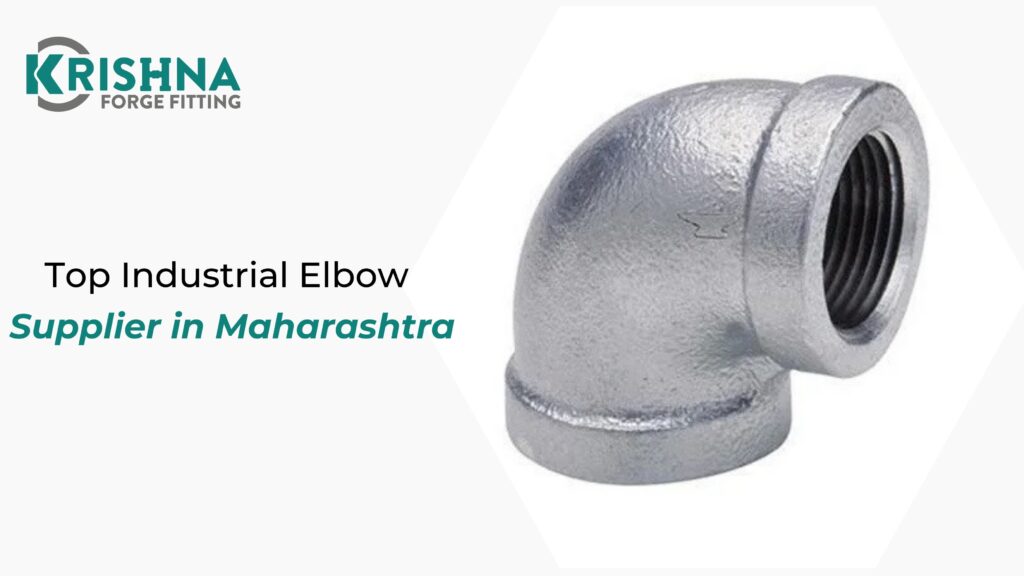
Industrial elbows change the direction of fluid flow in piping systems without sharp turns that create pressure drop and turbulence. A 90° elbow makes a right-angle turn; a 45° elbow offers a gentler deflection that cuts friction loss.
Long radius vs short radius
Long-radius elbows (LR) have a centerline radius of 1.5 times the nominal pipe diameter; short-radius (SR) elbows use 1.0 times diameter. LR elbows reduce pressure drop by 30–50% compared to SR at the same flow rate, but they need more installation space. Short-radius elbows fit tight layouts where every centimeter counts—offshore modules, skid-mounted equipment, retrofit projects.
Materials and Manufacturing Standards
Material selection by service
- Stainless steel 304/316L: resists chlorides, acids, and seawater; standard for chemical processing and marine applications
- Carbon steel A234 WPB: general service up to 400 °C; the workhorse for oil, gas, water, and steam lines
- Alloy steel A234 WP11/WP22: high-temperature hydrocarbon and steam service above 540 °C
- Duplex/super duplex: combines stainless corrosion resistance with twice the strength; offshore and subsea environments
Buyers who skip material verification discover mismatches when the first corrosion leak appears. A 316L elbow costs 40% more than 304, but 304 fails in three years when chloride concentration exceeds 200 ppm.
Standards that define quality
ASME B16.9 governs dimensions, tolerances, and pressure-temperature ratings for buttweld elbows. ASTM A403 covers stainless wrought fittings; A234 defines carbon and alloy steel specifications. These aren’t bureaucratic paperwork—they specify wall thickness, bend radius, and the heat treatment that gives elbows their mechanical properties.
Maharashtra suppliers who manufacture in-house control the full process and can certify compliance. Distributors source from unknown mills and cannot verify heat numbers or chemistry.
Manufacturing Process and Quality Control
How elbows are made
- Billet selection: raw material arrives with mill certificates; chemistry is lab-verified against ASTM specs.
- Hot forming: billets are heated to 1100 °C and pressed or forged into elbow geometry; seamless elbows are mandrel-bent from pipe.
- Heat treatment: normalizing or quench-tempering to achieve target hardness and impact toughness.
- Machining and beveling: ends are cut to precise bevel angles for welding.
- Testing: dimensional checks, hardness tests, and NDT (radiography, ultrasonic, dye penetrant) per project spec.
Suppliers who skip heat treatment or substitute cheaper alloys save $5 per fitting and create failure points that cost $50,000 in downtime.
Applications by Industry
Oil and gas projects specify heavy-wall carbon and alloy-steel elbows for high-pressure pipelines, offshore risers, and refinery units where NACE compliance and sour-service ratings are mandatory. Power generation needs P11/P22 alloy elbows for superheated steam at 565 °C; carbon steel would creep and rupture. Chemical processing demands 316L, Hastelloy, or lined elbows for acids, caustics, and corrosive slurries that attack carbon steel. Pharmaceuticals and food processing require electro-polished stainless elbows with Ra < 0.8 µm to prevent bacterial growth and contamination.
Why Maharashtra Suppliers Matter
Maharashtra’s industrial corridor—Mumbai, Pune, Nashik, Aurangabad—concentrates steel mills, forging plants, and precision machining clusters. Sourcing locally cuts lead time from eight weeks (imported stock) to two weeks (domestic manufacture). When specifications need clarification or material substitutions require engineering sign-off, you get same-day responses instead of email chains across time zones.
Transport costs drop when elbows ship 300 km instead of 8000 km. Suppliers in Maharashtra understand Indian project timelines, payment terms, and the documentation requirements for RDSO, ONGC, and government tenders.
Quality Assurance Checklist
Before you issue a purchase order, verify the supplier can deliver:
- Material traceability: heat numbers traceable to the steel mill; chemistry and mechanical test reports
- Dimensional compliance: actual measurements vs ASME B16.9 tolerance tables
- NDT certificates: radiography or ultrasonic reports if your spec requires them
- Third-party inspection: access for your QA team or TPI agency to witness tests
Suppliers who refuse inspection access or delay MTC delivery are signaling quality problems.
FAQs
Q: What is the difference between seamless and welded elbows?
A: Seamless elbows are hot-formed from seamless pipe; no weld seam. Welded elbows are fabricated from plate or ERW pipe; they have a longitudinal weld. Seamless handles higher pressure and cyclic stress; welded suits lower-class service where cost matters more than fatigue life.
Q: How do I know if I need long radius or short radius elbows?
A: Use long radius when pressure drop matters and you have installation space. Short radius fits tight layouts but increases energy loss by 40–60% at the same flow velocity. For high-flow systems, always prefer long radius unless physical constraints force short radius.
Q: What documentation should I receive with my order?
A: Demand a mill test certificate (MTC) with heat number, material chemistry, mechanical properties (tensile, yield, elongation, hardness), and hydrostatic test results if applicable. Request dimensional inspection reports and NDT certificates when your project spec requires them. Missing documentation means you cannot verify compliance with ASME or ASTM standards.
Q: Can I use stainless steel 304 instead of 316L to save cost?
A: Only if your fluid has low chloride content (below 50 ppm) and temperature stays under 60 °C. Above those limits, 304 suffers pitting and stress-corrosion cracking; 316L’s molybdenum addition provides resistance. The 40% cost difference disappears when you factor in early replacement and system downtime.
Conclusion
Choose your elbow supplier by verifying manufacturing capability, material traceability, and standards compliance—not by sorting spreadsheets for the lowest unit price. Request MTCs, dimensional reports, and inspection access before you commit. A Maharashtra-based manufacturer gives you faster lead times, local technical support, and the accountability that comes from face-to-face relationships.
Krishna Forge manufactures ASME B16.9 buttweld elbows and ASME B16.11 forged elbows in carbon, stainless, and alloy steel from our Maharashtra facility. Every fitting ships with full material traceability, dimensional inspection reports, and the mechanical test data you need to meet project specs. We supply EPC contractors, refineries, power plants, and chemical processors across India with elbows engineered for your exact pressure, temperature, and service conditions.
Need industrial elbows with guaranteed compliance and fast delivery? Contact Krishna Forge at krishnaforge.com for technical data sheets, material certifications, and quotes on 90°, 45°, long-radius, and short-radius elbows that meet ASME and ASTM standards the first time.
