Pick the wrong elbow, and you find out at commissioning, when a 3,000 PSI header weeps at 40 bar and the shift stops. Threaded and socket weld elbows look almost identical in a catalogue photo, share the same standard, and sit in the same size range — yet they fail in completely different ways.
This guide sorts them out: how each joint actually seals, what pressure classes and sizes you get, where each one leaks, and a five-point check you can run before you raise the next purchase order. Krishna Forge has been forging both for industrial buyers since day one, so the comparison is built on what comes back from the field.
What a Threaded Elbow Is
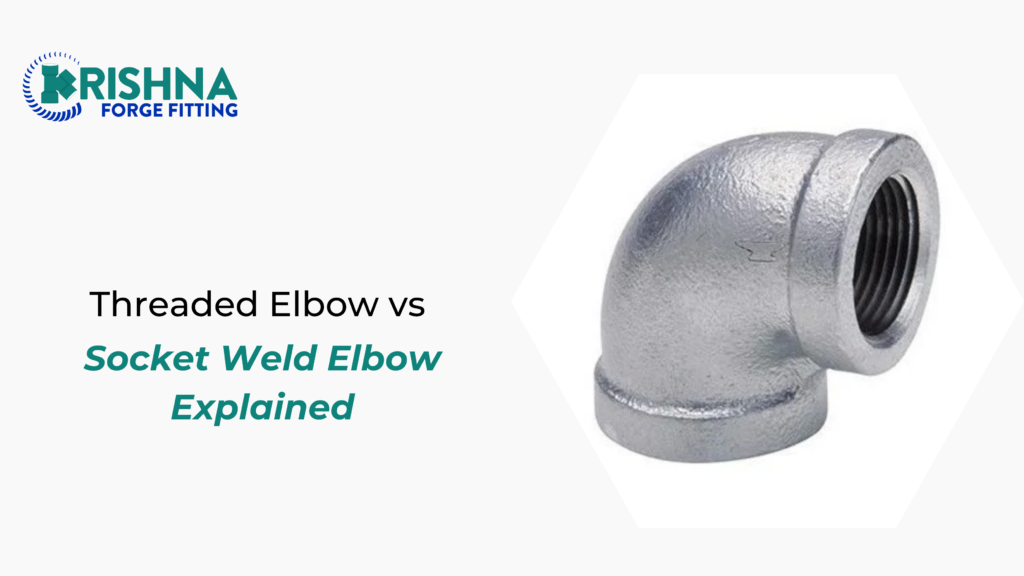
A threaded elbow is a forged 45° or 90° fitting with tapered female threads cut into each end. The pipe is threaded, sealed, and screwed in. No welder, no hot work permit, no post-weld cleanup.
How the Joint Seals
The seal comes from metal-to-metal contact between two tapered threads — NPT to ASME B1.20.1, or BSPT where the spec calls for it — helped along by PTFE tape or a pipe dope. Tighten it and the taper wedges. The thread does the sealing; the sealant only fills the spiral leak path.
Where You See It
- Utility air, water and low-pressure gas lines
- Instrument hook-ups and gauge tappings
- Sprinkler and irrigation headers
- Skids and packages that must be broken down and reshipped
The big advantage is that a threaded joint can be undone. On lines you dismantle for cleaning, seasonal shutdown, or transport, that matters more than any pressure number.
What a Socket Weld Elbow Is
A socket weld elbow has a bore counterbored at each end. The pipe slides into the recess and a fillet weld is laid around the outside where the pipe meets the fitting face.
How the Joint Seals
The fillet weld seals it. The socket does the alignment work, which is why socket weld joints go together faster than butt welds — no bevelling, no root gap, no purge on most carbon steel jobs. Weld metal also cannot run into the bore and choke flow, which is a real problem with poorly fitted butt welds.
The 1/16″ Gap Rule
Push the pipe to the bottom of the socket, then pull it back about 1/16″ (1.6 mm) before tacking. ASME B31.1 spells this out. The gap lets the pipe expand without loading the weld root in tension when the line heats up. Fitters who skip it are the reason socket welds crack in service, not the fitting.
Threaded vs Socket Weld Elbow: Quick Comparison
| Point | Threaded Elbow | Socket Weld Elbow |
| Standard | ASME B16.11 | ASME B16.11 |
| Pressure classes | 2000, 3000, 6000 | 3000, 6000, 9000 |
| Usual size range | 1/8″ to 4″ | 1/8″ to 4″ |
| Joint made by | Fitter with wrenches | Certified welder |
| Dismantling | Easy | Cut it out |
| Leak path | Thread spiral | None, if weld is sound |
| Weak point | Reduced wall at thread root | Crevice at the gap |
| Inspection | Visual, pressure test | MPI or dye penetrant |
Pressure Class and Size Limits
Both fittings live under ASME B16.11 and both stop at NPS 4 in normal supply. Above that, buttweld takes over. Class ratings are where they part company.
- Threaded: Class 2000, 3000 and 6000
- Socket weld: Class 3000, 6000 and 9000
Here is the part buyers miss. Cutting an NPT thread removes the wall. That is why threaded piping is normally specified in Schedule 80 or heavier — Schedule 40 pipe threaded to 1/2″ leaves a root wall thin enough to be a design problem, not a preference. A Class 3000 threaded elbow on Schedule 40 pipe is not a Class 3000 joint. The fitting is only as strong as the thread you cut into the pipe next to it.
Installation, Time and Skill
Threaded wins on speed and access, every time.
- No hot work permit, so it goes in on a live plant with far less paperwork
- No welder, no power, no gas
- Rework is a wrench turn, not a grinder
Socket weld wins on everything downstream of installation.
- One-pass fillet on small bore, typically minutes per joint
- Self-aligning socket keeps the elbow square without a fit-up gauge
- No thread sealant to squeeze out and contaminate the process
A pattern worth noting from plant maintenance logs: threaded joints fail most often on lines nobody touches, because the sealant hardens and the thread relaxes through thermal cycling. Socket welds fail most often on lines that vibrate, because the fillet sits right at a stress riser. Neither failure is about the fitting quality. Both are about matching the joint to the service.
Leak Risk, Corrosion and Fatigue
Three things drive the decision on critical service.
Crevice Corrosion
The 1/16″ expansion gap inside a socket weld joint is a dead space. In chloride service, seawater, or anything that concentrates, that crevice is where pitting starts. Threaded joints have the same issue in the unengaged thread turns. If your fluid is aggressive and the line is permanent, buttweld is the honest answer.
Fatigue
Socket weld joints carry a stress intensification factor of about 2.1 compared with a smooth butt weld. On a reciprocating compressor discharge or a vibrating small-bore tapping, that number decides the service life. Small-bore connections are a well-documented contributor to loss-of-containment events in hydrocarbon plants — most of them at the first joint off the header, and most of them fatigue, not corrosion.
Leak Path
A threaded joint always has a spiral leak path. Sealant closes it. Heat, vibration and time reopen it. For flammable or toxic service, many specs require the thread to be seal welded, which gets you the labour cost of welding and the crevice of a thread. That combination is usually the sign you should have specified socket weld from the start.
Cost: Fitting Price vs Installed Cost
Threaded elbows and socket weld elbows of the same class and size cost roughly the same to buy. The difference is downstream.
- Threaded installed cost is low upfront and creeps up with retorquing, sealant, and leak callbacks.
- Socket weld installed cost carries the welder, the consumables, and the NDT, then flattens out for the life of the line.
Buyers who price only the fitting get a shock at the third shutdown. Buyers who price the joint make better calls.
How to Choose: A 5-Point Check
- Will this line ever be dismantled? Yes → threaded. No → socket weld.
- What is the design pressure and temperature? Above Class 3000, or cyclic thermal duty → socket weld.
- Is the fluid flammable, toxic, or aggressive? Yes → socket weld, and check whether your spec even allows small-bore threaded.
- Does the line vibrate? Rotating equipment nearby → socket weld with proper bracing, and keep the unsupported length short.
- Can you get a hot work permit here? No → threaded, and specify Schedule 80 pipe.
Common Mistakes That Cause Joint Failure
- Bottoming the pipe in the socket with no expansion gap
- Threading Schedule 40 pipe on a Class 3000 line
- Over-tightening a threaded elbow and splitting the hub
- Using PTFE tape on an oxygen or high-purity line without checking compatibility
- Mixing NPT fittings with BSPT pipe threads because they “looked close enough”
- Skipping the material test report and finding out the grade was never A105
FAQs
Can I use a threaded elbow at 3000 PSI? The Class 3000 fitting is rated for it, but the joint may not be. The governing limit is the pipe wall left after threading and the temperature. Check the pressure-temperature table in ASME B16.11 for your material and grade, and confirm your pipe schedule supports the thread.
Is a socket weld elbow stronger than a threaded elbow? For static pressure, both are rated conservatively and both hold. For fatigue, vibration, and thermal cycling, socket weld is clearly better because there is no thread root cutting into the wall and no mechanical seal to relax.
Why is 4 inch the practical upper limit? ASME B16.11 covers forged fittings through NPS 4. Above that, socket depths and fillet sizes become impractical and buttweld fittings to ASME B16.9 take over on both cost and integrity.
Do I need a purge for socket welding carbon steel? Generally no for carbon steel. Stainless steel is a different matter — back purging protects the root from sugaring, and on service lines that carry product, it is worth insisting on.
Can I convert a threaded line to socket weld later? Yes, but you cut and re-prep every joint. It is cheaper to specify correctly at the design stage than to retrofit during a turnaround.
The Bottom Line
Threaded elbows buy you access. Socket weld elbows buy you integrity. Decide which one the line actually needs, then match the pipe schedule and pressure class to it — that single step removes most of the joint failures seen in small-bore piping.
Krishna Forge forges both. We manufacture threaded and socket weld elbows in 45° and 90°, in mild steel, stainless steel and GI, across the size and class range industrial buyers ask for — with the raw material checks, dimensional control and testing that keep a joint doing its job for years, not months.
Tell us the line: pressure, temperature, fluid and size. Send your specification to Krishna Forge and get a quote with the right elbow on it the first time.
