A pipe socket is the most ordered and least specified fitting in Indian industry. Orders arrive reading “1 inch socket, 100 nos” with no material, no thread standard and no pressure class, and whatever the supplier has in the rack ships out. Half the time it works. The other half produces cross-threaded joints, galvanic corrosion at a brass-to-steel junction, or a socket that strips under a pressure it was never made for.
This guide explains what a pipe socket is, the types in circulation, how SS, brass and MS compare, and what to put on an order so the right part arrives. Krishna Forge Fitting forges MS and SS pipe sockets at Shapar, Rajkot.
What a Pipe Socket Is
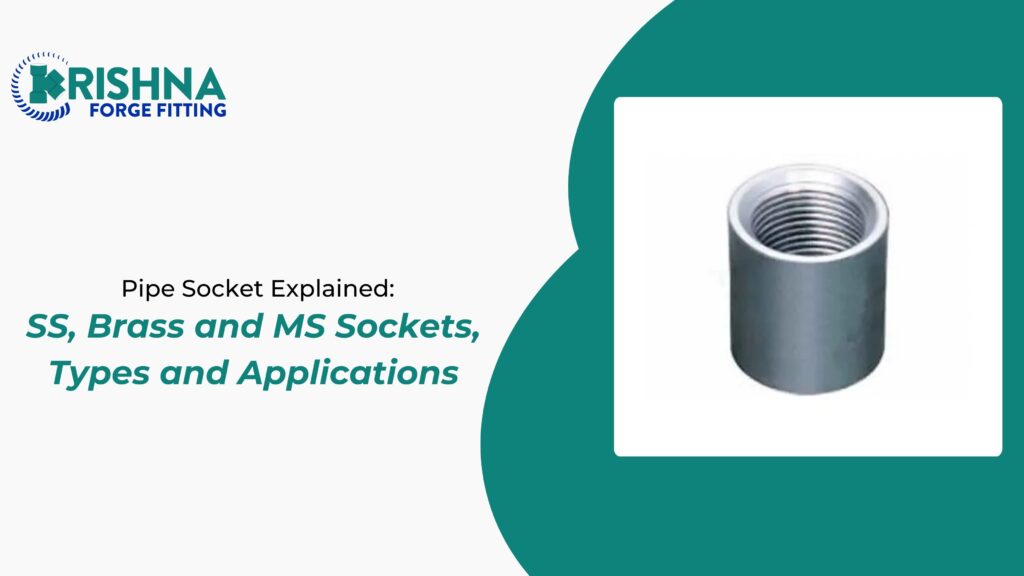
A pipe socket is a short sleeve that joins two pipe ends in line. The connection is female at both ends — either internal threads, usually BSP or NPT, or machined counterbores for socket welding.
In most of the Indian market the words “socket” and “coupling” are used for the same part. In the ASME-governed world the catalogue name is coupling, and the standard is ASME B16.11 for forged socket weld and threaded fittings from NPS 1/8 to 4.
The job is simple: extend a run, repair a damaged length, or connect pipe to a nipple, a valve or a piece of equipment.
Types of Pipe Socket
Full Socket
Female connection at both ends, same nominal size. The standard item. Joins two pipes of equal diameter in line.
Half Socket
One female connection; the other end is plain or bevelled and gets welded onto the outside of a larger pipe or a vessel wall over a drilled hole. That makes a small-bore branch for a gauge, a thermowell, a vent, a drain or a sample point.
Reducing Socket
Different nominal sizes at each end, so the line steps down without a separate reducer. One part, one joint, less length.
Hex Socket
A hexagonal outside profile instead of a round one, so a spanner grips it properly during tightening. Common in instrument and utility piping where sockets are made up and broken repeatedly.
Slip or Repair Socket
No internal shoulder, so it slides fully along one pipe and then back over the joint. Lets you insert a replacement section into a fixed run without springing the line apart.
By End Connection
Threaded sockets — BSP to ISO 7-1 or NPT to ASME B1.20.1. No welding, no hot work permit, removable with a spanner.
Socket weld sockets — the pipe sits in a counterbore and is fillet welded outside. Permanent, stronger, far better under vibration. Leave approximately 1.5 mm of root gap between the pipe end and the socket shoulder before welding, or thermal expansion will crack the fillet.
Butt weld sockets — plain ends welded directly, used in heavier fabrication work.
Materials: SS, Brass and MS
Mild Steel and Carbon Steel Sockets
The volume product. Forged MS and carbon steel sockets carry plumbing, utility water, compressed air, gas lines, hydraulic circuits, structural work and sprinkler risers. ASTM A105 is the pressure-service forging grade; IS 2062 and similar cover general structural material.
Strong, weldable, and the cheapest route to a given pressure rating. They rust, so they come black, galvanised or painted, and the surface condition should be stated on the order.
Galvanised Iron Sockets
MS sockets with a zinc coating, used in fire lines, plant water and outdoor utility runs. Zinc gives sacrificial protection as long as the coating is intact — which is why threading a galvanised socket and then welding it defeats the purpose.
Stainless Steel Sockets
SS 304 and SS 316, forged to ASTM A182 F304/F304L and F316/F316L, in sizes from 1/8″ to 4″.
SS 304 handles demineralised water, food contact and mild chemical duty. SS 316 contains molybdenum and resists chlorides — seawater, coastal air, bleach dosing, brines — that pit 304. The low-carbon L grades resist sensitisation at weld heat-affected zones, so specify them when the socket will be welded and then sit in a corrosive fluid.
Brass Sockets
Brass machines easily, seals well on thread, does not spark, and resists ordinary water corrosion without a coating. It belongs in low-pressure water, gas metering, instrument air and fixture connections.
It does not belong in high-pressure or high-temperature service, and dezincification in certain water chemistries can leave a porous, weak socket that looks intact from outside. Where that risk exists, dezincification-resistant brass is the specification.
Choosing Between Them
| Service | Material |
| Plumbing, utility water, air, structural | MS, often galvanised |
| Fire sprinkler risers | MS or GI |
| Steam, hydraulic oil, high pressure | Carbon steel, forged, Class 3000/6000 |
| Demineralised or treated water | SS 304 |
| Chemical, coastal, chloride service | SS 316 |
| Food, dairy, pharma | SS 304/316 |
| Low-pressure water and gas metering | Brass |
The Joint That Corrodes Quietly
A brass socket on a galvanised steel pipe is one of the most common mixed-metal joints in Indian plumbing and one of the most reliable ways to produce a leak in a few years. The two metals sit far enough apart galvanically that, with water as the electrolyte, the steel corrodes at the junction while both parts look healthy from outside.
Where the metals have to meet, use a dielectric fitting or a transition piece and keep the junction dry. This is not an exotic failure mode; it is the usual explanation when a line leaks precisely at the one fitting that was a different metal.
Sizes and Pressure Classes
Forged sockets to ASME B16.11 run NPS 1/8 to 4, in Class 2000, 3000 and 6000 for threaded ends and Class 3000, 6000 and 9000 for socket weld. Class 3000 covers most standard process and utility work.
Indian trade sizes are usually quoted in inches or millimetres — 15 mm, 20 mm, 25 mm and so on — which map to 1/2″, 3/4″ and 1″. Confirm which convention the quotation uses before comparing prices.
The class is a dimensional designation. Actual working pressure comes from the pressure–temperature rating for the material at the operating temperature, and it falls as temperature rises.
Applications
- Plumbing and building services — water supply, risers, fixture connections
- Fire sprinkler systems — MS and GI risers and distribution
- Water treatment plants — SS sockets throughout, 304 or 316 by chemistry
- Steel plants — utility and cooling water headers, heavy-wall socket weld
- Fertiliser and chemical units — SS matched to the specific corrodent
- Boilers, heat exchangers and condensers — forged carbon steel at Class 3000 and above
- General fabrication and OEM assembly — MS to drawing
Ordering Checklist
Put all seven on the purchase order:
- Nominal size, stated in inches or mm consistently
- Socket type — full, half, reducing, hex, slip
- End connection — threaded or socket weld
- Thread standard — BSP or NPT (they are not interchangeable, and both are in circulation in India)
- Material grade in full — MS, GI, A105, SS 304, SS 316, brass
- Pressure class or schedule
- Surface condition — black, galvanised, painted, bare
FAQs
Is a pipe socket the same as a coupling? In common Indian usage, yes — both describe a sleeve with female connections at each end that joins two pipes. In ASME catalogues the part is listed as a coupling under B16.11.
What is the difference between a full socket and a half socket? A full socket has a female connection at both ends and joins two pipes in line. A half socket has one female connection and a plain end that welds onto a header, creating a branch outlet.
Can I use BSP and NPT threads together? No. The thread angles and pitches differ. The joint may feel tight on assembly but will not seal reliably. Check which standard the existing pipework uses before ordering.
Are brass sockets suitable for industrial pressure lines? Generally no. Brass suits low-pressure water, gas metering and instrument work. For pressure, temperature or vibration, use forged carbon steel or stainless.
What is the gap required before welding a socket weld joint? About 1.5 mm between the pipe end and the socket shoulder. The pipe must not bottom out, or thermal expansion stress concentrates in the fillet weld and cracks it.
Order Pipe Sockets From the Manufacturer
Krishna Forge Fitting manufactures and exports pipe sockets in mild steel, stainless steel and GI, in threaded and socket weld ends, alongside industrial fittings, elbows, tees, couplings, half couplings, unions, nipples, forged flanges, forged end caps and universal joint crosses. We forge and machine in house at Shapar, Veraval, Rajkot, Gujarat, and supply water treatment plants, sprinkler systems, steel plants, fertiliser units, boilers, heat exchangers and condensers. MS job work to draw is available.
