
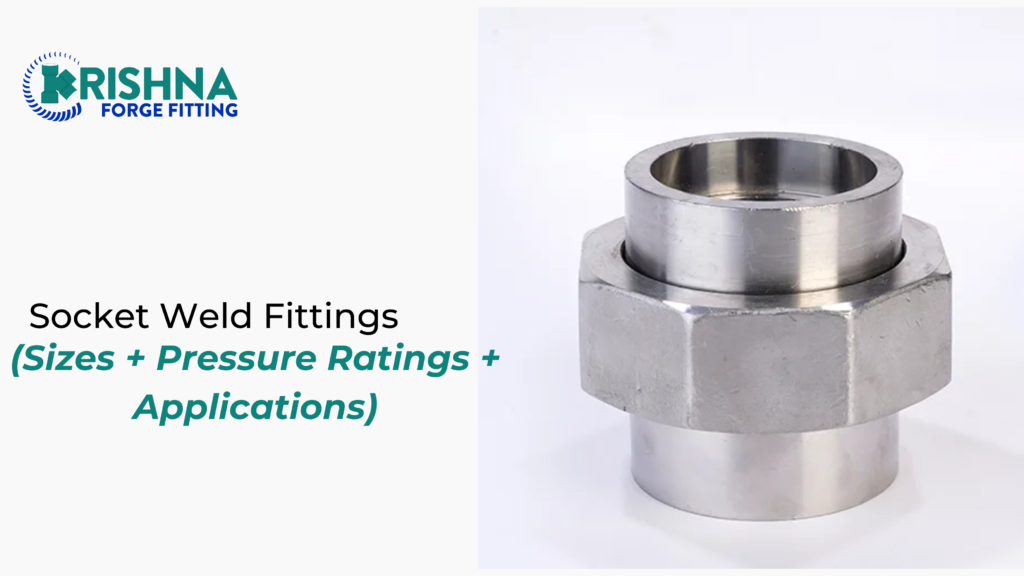
Socket weld fittings almost never fail because the fitting was weak. They fail because a fitter bottomed the pipe out in the socket, welded it solid, and the joint had nowhere to expand. That single skipped step — a 1.6 mm gap — causes more socket weld cracks than every metallurgical problem combined. This guide covers what socket weld fittings are, the sizes and classes they come in, how the ratings work against pipe schedules, exactly how the joint has to be made, how it gets inspected when radiography is off the table, and the services where socket weld is the wrong choice.
What a Socket Weld Fitting Is
A forged body with a machined recess — the socket — bored to accept the pipe outside diameter with a small clearance. The pipe slides in, stops short of the shoulder, and gets fillet-welded around the outside.
How the Joint Is Made
- Cut and clean the pipe end — square, deburred, no bevel needed
- Insert fully to the shoulder
- Withdraw 1.6 mm and hold the position
- Tack in at least two, ideally four points
- Fillet weld all round
No bevel prep. No root pass. No backing. That is why socket weld is fast.
Socket Weld vs Threaded vs Butt Weld
| Feature | Socket weld | Threaded | Butt weld |
| Size range | NPS 1/8 – 4 | NPS 1/8 – 4 | NPS 1/2 – 48 |
| Joint strength | High | Moderate | Highest |
| Leak paths | None through the joint | Through the threads | None |
| Fatigue life | Moderate | Low | Highest |
| Bore | Small internal step | Step at thread | Smooth |
| Hot work needed | Yes | No | Yes |
| Radiography possible | No | N/A | Yes |
The Full Type Range
- 90° and 45° elbows — direction change
- Equal and reducing tees — branch takeoffs
- Crosses — four-way junctions
- Full couplings — straight joins
- Half couplings — branch connections welded onto a run
- Reducer inserts — size change inside an existing socket, covered by MSS SP-79
- Caps — line ends
- Unions — three-piece, for planned dismantling
- Reducing couplings — direct size change
Reducer inserts are worth knowing about. They let you drop a size inside an existing socket without a separate reducing fitting — useful in retrofits where you cannot move the run.
Sizes Available
Size Range by Class
| Class | Size range |
| 3000 | NPS 1/8 to 4 |
| 6000 | NPS 1/8 to 2 |
| 9000 | NPS 1/8 to 2 |
There is no Class 2000 socket weld fitting. There is no socket weld fitting above NPS 4 in ASME B16.11. Above 4 inch, the design shifts to butt weld.
If a supplier offers you a 6-inch socket weld tee, ask what standard it is made to. It is not B16.11.
Socket Bore, Depth and Wall
The standard fixes three things you should verify on receipt:
- Socket bore — sized to the pipe OD with defined clearance. Too tight and the pipe will not enter; too loose and the fillet has to bridge a gap
- Socket depth — enough to give proper engagement plus the expansion gap
- Body wall thickness — must equal or exceed the matching pipe schedule
Measure the wall on a sample from every lot. Thin walls are the most common quiet substitution in this product.
Pressure Ratings
Class 3000, 6000, 9000
The class is not a PSI value. It is a wall-thickness family that ties the fitting to a pipe schedule.
Matching the Pipe Schedule
| Class | Matching schedule |
| 3000 | Sch 80 / XS |
| 6000 | Sch 160 |
| 9000 | XXS |
Match the class to the schedule of the pipe you are welding to. A Class 9000 fitting on Sch 80 pipe does not make the joint stronger — it creates a stiffness step and moves the fatigue point into the pipe wall just outside the fillet.
Temperature Derating by Grade
Actual allowable pressure comes from the pressure-temperature tables for the specific grade. Rough shape of it:
- A105 carbon steel — strong at ambient, loses roughly a third of its allowable between 200°C and 425°C
- F304/F316 stainless — lower at ambient than carbon steel, holds much better above 400°C
- F11, F22, F91 chrome-moly — built for sustained high temperature in power and refinery service
- A350 LF2 — impact tested down to −46°C
Materials and Grades
- ASTM A105 — carbon steel, general service
- ASTM A350 LF2 — low temperature carbon steel
- ASTM A182 F304 / F304L / F316 / F316L — stainless
- ASTM A182 F11, F22, F5, F9, F91 — alloy
- ASTM A182 F51 / F53 — duplex and super duplex
Specify the L grades where post-weld cooling is uncontrolled. Standard F304 can sensitise in the heat-affected zone and fail by intergranular attack in service that F304L handles indefinitely.
Installation — Where the Joint Is Actually Won or Lost
The 1.6 mm Expansion Gap
Insert the pipe fully, pull it back 1/16 inch, then weld.
The reason is thermal. Weld metal shrinks as it cools. If the pipe is hard against the socket shoulder, that shrinkage has nowhere to go and puts the fillet root into tension the moment it solidifies. Add operating thermal cycles and it cracks — usually at the root, where nothing can see it.
Fitters skip this because the gap feels wrong and because a bottomed pipe holds itself in place. Use a gap ring or a purpose-made spacer clip. It takes seconds and it is the difference between a joint that lasts and one that does not.
Minimum Fillet Weld Size
ASME B31.1 sets the minimum fillet leg at 1.09 times the nominal pipe wall thickness, and the throat at not less than 0.707 times that.
Undersized fillets are common because a small fillet looks neat. The joint’s entire strength lives in that fillet. Measure it with a gauge, not by eye.
Fit-Up and Alignment
- Pipe end square within tolerance — a skewed cut leaves an uneven gap around the circumference
- Deburr the inside — burrs shed into the line and lodge in valve seats
- Tack at four points, not one — a single tack lets the pipe swing out of square as the weld shrinks
- Keep the pipe axis true; a socket weld tolerates very little angular misalignment
Common Site Errors
- No expansion gap — the top failure cause
- Undersized fillet
- Welding over an unclean or oily socket
- Reusing a fitting from a cut-out joint with a distorted socket
- Excessive heat input on thin-wall stainless, causing distortion and sensitisation
Inspection — You Cannot Radiograph a Fillet
This is a real constraint and it changes how you assure quality.
A fillet weld has no through-thickness geometry that radiography can meaningfully read. So the accepted methods are:
- Visual inspection — fillet size, profile, undercut, uniformity
- Magnetic particle (MPI) — for ferritic materials
- Liquid penetrant (DPT) — for stainless and non-magnetic grades
- Ultrasonic — occasionally, on thicker sections, with limitations
Because the weld cannot be volumetrically examined, the codes lean hard on procedure: qualified WPS, qualified welders, and controlled fit-up. Quality gets built in at fit-up, not caught afterward.
That is why the gap matters so much. There is no inspection step downstream that will find a missing one.
The Honest Limitations
Crevice Corrosion
The expansion gap and the annular clearance between pipe OD and socket bore form a crevice. Stagnant fluid sits there. In chloride-bearing service, in seawater, and in any medium that concentrates by evaporation, that crevice initiates pitting.
There is no way to design it out. It is inherent to the joint.
Fatigue Performance vs Butt Weld
A socket weld joint has a stress concentration at the fillet toe and an internal geometric step at the socket shoulder. Butt welds have neither. In cyclic service — reciprocating compressor discharge lines, vibrating small-bore connections, thermally cycling steam traps — socket weld joints have measurably shorter fatigue life.
Small-bore socket weld connections attached to vibrating equipment are one of the most frequently reported piping failure modes in process plants. Support them properly or use butt weld.
Where Socket Weld Should Not Be Used
- Nuclear and radioactive service, where the crevice cannot be decontaminated
- Food, pharmaceutical and hygienic piping — the crevice and internal step cannot be cleaned or drained
- Highly corrosive service where crevice attack is the governing mechanism
- Severe cyclic and vibrating lines without dedicated bracing
- Anywhere the code requires full volumetric examination of every weld
Applications by Industry
- Oil and gas — process piping, drains, vents, sample and instrument connections
- Refineries and petrochemical — small-bore hydrocarbon lines, chrome-moly high-temperature service
- Power plants — boiler feed, blowdown, soot blower and steam trap piping
- Chemical processing — dosing skids, reagent lines in stainless and duplex
- Hydraulics — high-pressure circuits above 300 bar
- Fire protection — deluge and sprinkler branch piping
- Shipbuilding and offshore — compact, high-integrity small-bore systems
Ordering Checklist
- Fitting type and shape
- Nominal size (both sizes on reducing items)
- Class — 3000, 6000 or 9000
- Material grade and ASTM specification
- Standard — ASME B16.11, plus client spec
- Matching pipe schedule, so we can verify wall thickness
- Certification level — EN 10204 3.1 or 3.2 — and any third-party inspection
FAQs
Why exactly 1.6 mm? It is the clearance that reliably prevents bottoming under fit-up force while staying small enough not to weaken engagement. ASME B31.1 states approximately 1/16 inch. Some specs allow 1.5 to 3 mm — follow yours.
Can I weld a socket weld fitting to a pipe of a different schedule? Only if the wall thicknesses are compatible and the fitting class matches the heavier of the two. A thickness mismatch at a fillet creates a stress riser.
Do socket weld joints need post-weld heat treatment? Depends on grade and thickness. Chrome-moly grades like F11, F22 and F91 usually require it. Carbon steel small-bore typically does not. Follow the code and the WPS.
Can a socket weld fitting be reused? Not recommended. Cutting the joint out distorts the socket and the bore rarely returns to tolerance. The fitting costs less than the failure.
Is socket weld cheaper than butt weld? For small bore, yes — no bevel prep, no root pass, no radiography, faster fit-up. Above NPS 2 the economics flip and butt weld becomes both cheaper and better.
Conclusion
Socket weld fittings are the right answer for high-pressure small-bore piping, and they are only as good as the fit-up. Match the class to the schedule, hold the 1.6 mm gap, size the fillet to 1.09 times the pipe wall, and keep them out of hygienic, nuclear and severely corrosive service.
If you are building a socket weld fitting schedule, send us the line list with pipe schedules and we will return classes, grades and quantities against it.
About Krishna Forge
Krishna Forge manufactures socket weld forged fittings to ASME B16.11 in Classes 3000, 6000 and 9000, NPS 1/8 to 4, across carbon steel, stainless, alloy, low-temperature and duplex grades. Socket bore, depth and body wall are gauged against the class on every lot, and each piece carries a heat number traceable to its mill certificate.
Send us your socket weld requirement for a quote.
