You send an enquiry for 50 pipe sockets. What arrives is labelled couplings. Somebody is wrong — or nobody is, and the two words describe the same fitting in different trade dialects. That ambiguity costs real money in rejected deliveries and delayed shutdowns.
This guide sets out what each term actually means, the one case where “socket” is genuinely a different thing, the four coupling types you should know by name, and a way to write your enquiry so the right part ships the first time. Krishna Forge manufactures both, under both names.
What a Pipe Coupling Is
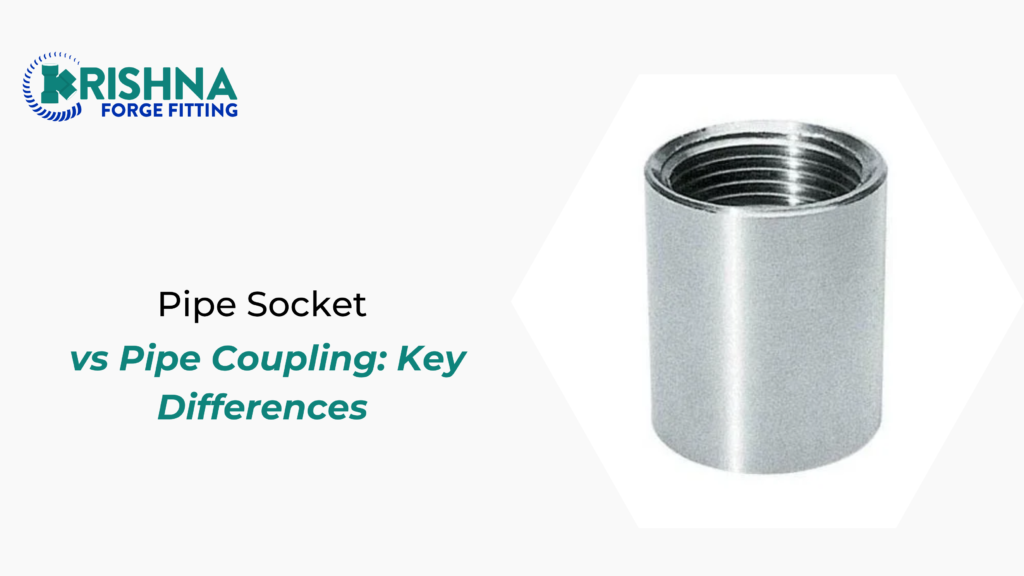
A pipe coupling is a short cylindrical fitting that joins two pipes end to end in a straight line, keeping the same axis and, usually, the same bore.
It does three jobs:
- Extends a pipe run beyond a single length
- Changes pipe size when it is a reducing type
- Repairs a damaged section without replacing the whole run
In forged form it is manufactured to ASME B16.11 — carbon steel to ASTM A105, stainless to ASTM A182 grades F304/F304L or F316/F316L.
What a Pipe Socket Is
A pipe socket is a short cylindrical fitting that joins two pipes end to end in a straight line, keeping the same axis and bore.
That is not a typo. Read the two definitions again.
The Answer Most Guides Avoid: They Are Usually the Same Part
In the overwhelming majority of catalogues, purchase orders and site conversations, pipe socket and pipe coupling refer to the same component. Suppliers who publish comparison pages listing “key differences” between them are, more often than not, manufacturing a distinction to fill a search query.
The naming split runs along geography and trade habit:
- Coupling dominates North American practice and ASME standard language
- Socket dominates UK, Indian, Middle Eastern and Australian plumbing and pipework usage
- Socket is also common in India for the threaded MS and GI fittings sold through hardware and irrigation channels
So when a buyer in Rajkot asks for a 1″ MS socket and a spec written to ASME calls for a 1″ Class 3000 full coupling, they may well be asking for the identical forging.
Knowing that saves you the argument. What matters next is the specification, not the noun.
Where the Two Words Genuinely Mean Different Things
Socket as a Feature, Not a Fitting
“Socket” also names the recessed bore in a socket weld fitting — the counterbore the pipe slides into before the fillet weld goes on. In that sense every socket weld elbow, tee and coupling has sockets. A socket weld coupling has two. A half coupling has one.
So the sentence “the socket depth is 12 mm” is about a feature. The sentence “send me 20 sockets” is about a part. Context does the work, and misreading it is where errors creep in.
Regional and Trade Usage
Plumbing supply in some markets uses “socket” strictly for the plain female-threaded straight connector, and reserves “coupling” for compression, push-fit and mechanical joints. Under that convention:
- Socket = threaded straight connector, screwed joint
- Coupling = mechanical connector using seals, grip rings, or clamps
If your supplier works to that convention and you work to ASME, you will talk past each other. Ask once, at enquiry stage.
Types of Couplings and Sockets
Full Coupling
Connections on both ends — threaded, socket weld, or one of each. This is the standard pipe-to-pipe joiner and the part most people mean by either word.
Half Coupling
Connection on one end only; the other end is plain, for welding onto a pipe, header or vessel wall. Used for branch connections, drains, vents, instrument tappings and pressure gauge points. If you need to tap a running line, this is the fitting.
Reducing Coupling
Joins two different pipe sizes in a single fitting, with a stepped internal profile. Cheaper and shorter than a coupling plus a bush, and it keeps the joint count down — which matters, because every joint is a potential leak path.
Repair or Slip Coupling
Built without the internal stop ring found in a standard coupling, so it slides fully onto one pipe and then back over the joint. That lets you close a gap in a fixed run without cutting anything back. Handy for repairs in tight spaces where the pipe cannot be sprung apart.
Threaded vs Socket Weld Ends
The end connection matters far more to performance than the name on the box.
| Point | Threaded | Socket Weld |
| Joint made by | Fitter | Certified welder |
| Pressure classes | 2000, 3000, 6000 | 3000, 6000, 9000 |
| Dismantling | Unscrew it | Cut it out |
| Hot work permit | Not needed | Needed |
| Leak path | Thread spiral | None if the weld is sound |
Threaded suits utility lines, irrigation, and anything you plan to take apart. Socket weld suits pressure, temperature and vibration.
Standards, Classes and Sizes
- Standard: ASME B16.11 for forged threaded and socket weld couplings
- Threads: NPT to ASME B1.20.1, or BSP where specified
- Sizes: NPS 1/8″ through NPS 4″ in normal supply
- Classes: 2000, 3000 and 6000 threaded; 3000, 6000 and 9000 socket weld
- Materials: ASTM A105 carbon steel, ASTM A182 F304/F316 stainless, plus MS and GI for utility and irrigation duty
One point buyers overlook: a Class 3000 threaded coupling assumes the pipe can carry an NPT thread without dropping below its design wall. Threading Schedule 40 pipe on a high-pressure line puts the weak point outside the fitting, in the pipe.
Coupling vs Union vs Nipple
Three fittings, constantly confused, easily separated:
- Coupling / socket — female threads both ends, joins two male-threaded pipes, permanent-ish
- Nipple — male threads both ends, joins two female fittings, and used to gain a short length
- Union — three pieces with a rotating nut, joins two pipes so they can be separated later without turning either pipe
The tell is this: if the line will ever be broken for maintenance and neither pipe can rotate, you need a union, not a coupling. Fitters who use couplings where unions belong end up cutting pipe at every service interval.
How to Order Without Getting the Wrong Part
Write the enquiry so the noun does not carry the weight:
- Fitting function — full coupling, half coupling, reducing coupling
- End connection — threaded NPT, threaded BSP, or socket weld
- Size — NPS, and both sizes if reducing
- Class — 2000 / 3000 / 6000 / 9000
- Material and grade — A105, F304L, F316L, MS, GI
- Standard — ASME B16.11
- Documentation — material test report, if required
Send that line and it does not matter whether your supplier calls it a socket or a coupling. The specification is unambiguous.
FAQs
Is a pipe socket the same as a pipe coupling? In most industrial and plumbing usage, yes — they are two names for the same straight female connector. The exception is when “socket” refers to the counterbore feature of a socket weld fitting, or when a supplier uses a local convention that reserves “coupling” for mechanical joints. Specify the end type, size, class and material and the ambiguity disappears.
What is the difference between a full coupling and a half coupling? A full coupling has connections on both ends and joins two pipes. A half coupling has one connection and a plain end for welding onto a pipe, header or vessel — it is a branch fitting, not a joiner.
Can a coupling change pipe size? Yes, with a reducing coupling. It handles two different sizes in one fitting, which is shorter and creates fewer joints than a coupling plus a reducing bush.
When should I use a union instead of a coupling? Whenever the joint needs to be broken later and neither pipe can be rotated — pump connections, strainers, instruments, and any equipment that comes out for service. A coupling in that position means cutting pipe.
Do sockets and couplings come in stainless steel? Yes. Forged stainless couplings are normally ASTM A182 grade F304/F304L or F316/F316L, made to the same ASME B16.11 dimensions as the carbon steel versions.
The Bottom Line
Stop arguing about the word. A socket and a coupling are, in nearly every practical case, the same fitting. What changes performance is the end connection, the pressure class, the material grade and whether you need a full, half, reducing or repair type. Get those four right and the label on the carton is irrelevant.
Krishna Forge manufactures pipe sockets and couplings in full, half and reducing configurations — threaded and socket weld, in mild steel, stainless steel and GI — with raw material checks, dimensional control and inspection on every batch. Whatever your drawing calls it, we make it.
Send your enquiry with size, class, material and end type. Get a quote from Krishna Forge and take the guesswork out of your next order.
