
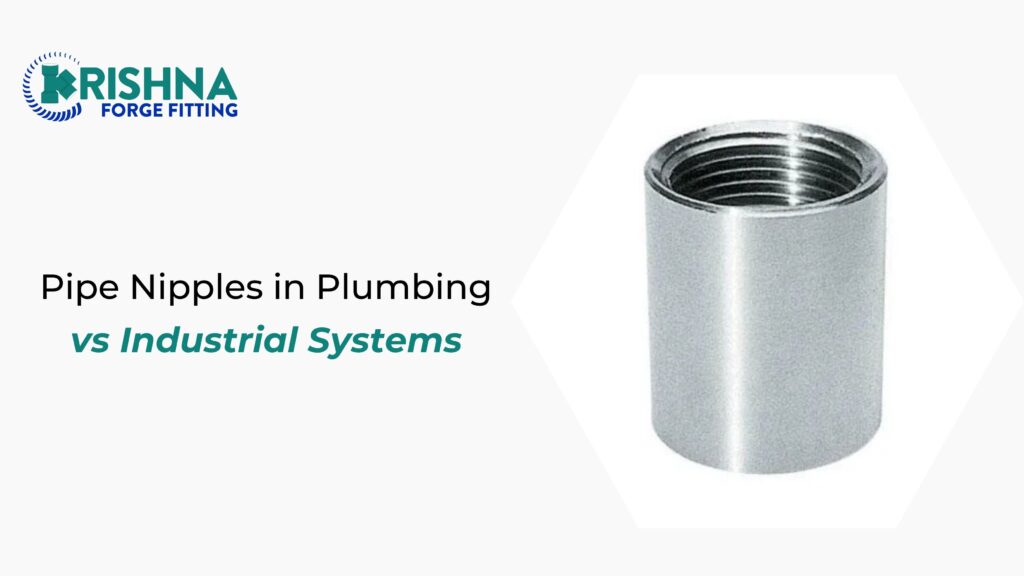
A pipe nipple looks like the least important part on any drawing. It’s a few inches of threaded pipe, nothing more, and that’s exactly why so many buyers order the wrong one. The same word covers a part rated for 150 psi under a kitchen sink and a part rated for 3,000 psi inside a refinery — the difference between a part that lasts fifty years and one that cracks under its first pressure spike.
We forge both ends of that spectrum, which puts us in a useful position: we see the mistakes buyers make before they make them. This piece breaks down what a pipe nipple actually is, how the plumbing and industrial versions diverge, and what to check before ordering either one.
What Is a Pipe Nipple
A pipe nipple is a short length of pipe used to join two fittings, valves, or pieces of equipment. Most carry male threads on both ends, though plain and beveled ends exist for welded connections. Length gets measured end to end, threads included.
A few end-type terms show up constantly across spec sheets:
- TBE (threaded both ends) — the standard configuration for connecting two female fittings
- TOE (threaded one end) — one threaded end, one plain or beveled end, often welded in place
- PBE (plain both ends) — no threads at all, made for socket-weld connections
- BBE (beveled both ends) — prepped for butt-weld joints in high-pressure runs
Get the end type wrong and the nipple simply won’t mate with what’s already installed — a cheap mistake, but a common one.
Pipe Nipples in Plumbing Systems
Where They Show Up
Residential and light commercial plumbing leans on pipe nipples constantly — water supply lines, fixture hookups, drain assemblies, water heater connections. The jobs are short-run, low-pressure, and repetitive across thousands of nearly identical installs.
Materials That Dominate Here
- Brass and copper — favored for potable water because they resist corrosion and carry natural antimicrobial properties
- PVC and CPVC — lightweight, cheap, and easy to install in residential and irrigation lines
- Galvanized steel — chosen where moisture exposure is a factor, such as outdoor or irrigation systems
Typical Performance Range
Standard residential plumbing nipples handle pressures up to around 150 psi, in sizes mostly between ½ inch and ¾ inch. The engineering bar here is modest by design — the system doesn’t need to survive a chemical plant, it needs to survive forty years of ordinary household use without leaching anything into the water supply.
Pipe Nipples in Industrial Systems
Where They Show Up
Industrial use looks nothing like plumbing use. Oil refineries, chemical processing plants, power stations, compressed air networks, and hydraulic assemblies all lean on pipe nipples, but the loads they carry are an order of magnitude higher than anything a house sees.
Materials That Dominate Here
- Carbon steel — the workhorse for pressure and heavy mechanical load
- Stainless steel (often grade 316) — brought in wherever corrosion resistance has to match the pressure demand, particularly in chemical service
- Alloy steel — reserved for the most demanding temperature and pressure combinations
Seamless vs. Welded: The Detail That Actually Matters
This is where industrial nipples split hardest from their plumbing counterparts. A welded nipple has a visible seam running the length of the pipe — that seam is a structural weak point, and it caps pressure tolerance well below what a seamless nipple can handle. Seamless construction removes that weak point entirely, which is why refineries, chemical plants, and power stations specify it as a baseline requirement rather than an upgrade.
Key Differences Between Plumbing and Industrial Pipe Nipples
Laid side by side, the two categories diverge on almost every meaningful spec:
- Pressure rating: residential tops out near 150 psi; industrial nipples routinely run into the thousands
- Material grade: brass and PVC dominate plumbing; carbon and stainless steel dominate industrial
- Construction: plumbing rarely needs seamless; industrial treats it as standard for anything critical
- Governing standards: plumbing follows plumbing code and ASTM material specs; industrial process piping answers to ASME B31.3 and related codes
- Cost of failure: a plumbing leak means a service call; an industrial failure can mean a shutdown, an evacuation, or worse
The Uncomfortable Pattern in Procurement
Here’s what doesn’t get said often enough: a large share of industrial buyers still order pipe nipples the way they’d order plumbing parts — by size and thread type alone, without checking wall thickness schedule or seam construction. That habit works fine until a batch rated for moderate service gets installed on a high-pressure line, at which point the failure looks random when it isn’t. It’s a spec-sheet problem wearing a mechanical-failure costume.
Types of Pipe Nipples by Design
Regardless of which system they end up in, most nipples fall into a short list of design categories:
- Barrel nipple — threaded both ends, plain middle section, the baseline type
- Close nipple — no unthreaded section at all, used where space is tight
- Hex nipple — hexagonal center section for wrench grip during install or removal
- Reducer (swage) nipple — different thread sizes on each end, used to step down pipe diameter
- Weld nipple — beveled, unthreaded ends built for welded, leak-resistant joints
- Right-left hand nipple — opposite thread directions on each end, common in gas piping where unions aren’t allowed
- Grooved nipple — built for groove-style couplings in commercial and industrial construction
How to Choose the Right Pipe Nipple
- Match the material to what’s flowing through it — potable water calls for brass or copper; corrosive chemicals call for stainless steel.
- Confirm the pressure and temperature rating against your actual operating conditions, not just the pipe’s nominal size.
- Check thread standard compatibility before ordering — a mismatched thread standard won’t seal no matter how much tape gets wrapped around it.
- Decide between seamless and welded construction based on how critical the line actually is, not just on cost.
- Reference the applicable code for your industry — ASME B31.3 for process piping, relevant plumbing codes for residential work — and buy to that spec, not around it.
FAQs
Can a plumbing-grade pipe nipple be used in an industrial system? Generally no. Plumbing nipples are rated for far lower pressure and often use materials like brass or PVC that can’t handle industrial chemical exposure or thermal cycling.
What’s the real difference between a seamless and a welded nipple? A welded nipple has a visible seam that acts as a structural weak point, capping its pressure tolerance. A seamless nipple has no such seam, giving it meaningfully higher pressure resistance.
Why do industrial nipples need to reference ASME B31.3? ASME B31.3 governs process piping design and material selection for industries handling hazardous or high-pressure fluids. Buying to this standard ensures wall thickness, material, and construction match the system’s actual demands.
Is stainless steel always the right industrial choice? Not always — carbon steel handles plenty of high-pressure, non-corrosive applications at a lower cost. Stainless steel earns its price tag where corrosion resistance and pressure both matter at once.
How does thread mismatch cause failure even when the nipple “fits”? A nipple can screw into a fitting and still fail to seal if thread standards don’t match — NPT and BSP threads look similar but aren’t interchangeable. The mismatch shows up as a slow leak that worsens under vibration.
Conclusion
A pipe nipple is a small part carrying a large decision. Plumbing systems and industrial systems ask completely different things of it — pressure tolerance, material grade, seam construction, code compliance — and treating the two as interchangeable is where failures start. Get the spec right at the order stage, and the part disappears into the system exactly as it should.
At Krishna Forge, we forge pipe nipples built to the standard the application actually demands, whether that’s a residential water line or a high-pressure process system. If you’re specifying nipples for your next project, talk to our team or browse our catalog to match the right part to the right job.
