
Introduction
Pipe end caps are among the most underspecified components in industrial piping, yet they sit at some of the highest-risk points in the entire system. Termination ends experience the full static pressure of the line with no flow relief—meaning any failure concentrates completely at the cap. A 2025 analysis of small-bore piping incidents in process plants found that 23% of unplanned leaks originated at pipe end closures, most from caps selected without regard to pressure class, material compatibility, or thermal cycling behavior.
The pipe end cap market is growing from USD 1.2 billion in 2024 as industries increasingly specify forged caps over cast and fabricated alternatives—driven by demonstrated performance differences in demanding service. The right cap protects pipe internals from corrosion and contamination, contains pressure safely across decades of thermal cycling, and keeps systems commissioning-ready after months of construction exposure. This guide covers every major industrial use, the right cap type for each, and the selection criteria that prevent costly failures.
What Pipe End Caps Do
A pipe end cap fits over the outside of a pipe end to create a sealed closure. Four core functions define their industrial value:
- Pressure containment: Seals live process lines at dead ends and future tie-in points
- Contamination control: Blocks ingress of dirt, moisture, and debris during construction and shutdown
- Corrosion protection: Isolates pipe internals from atmospheric moisture and chemical exposure
- System testing: Creates temporary pressure boundaries for hydrostatic and pneumatic testing
The cap attaches through threading, socket welding, or butt welding. Each method determines pressure capability, permanence, and installation time.
Types of Pipe End Caps
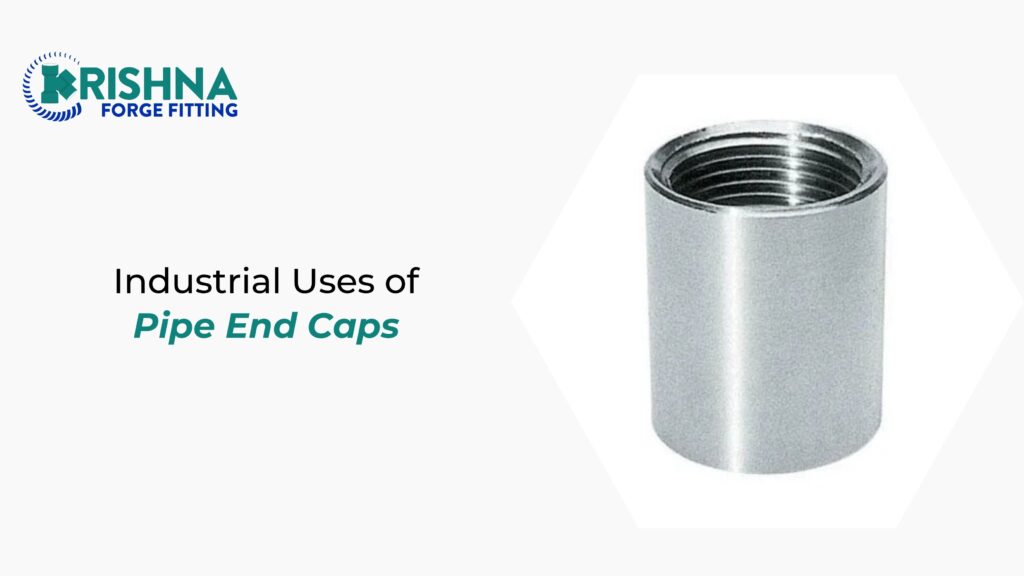
Threaded Pipe Caps
NPT-threaded caps install and remove without welding equipment. They suit maintenance access points, test connections, and temporary closures requiring periodic removal. Pressure capability maxes out at Class 3000 (3000 PSI at ambient temperature) in sizes up to 2-inch.
Socket Weld Pipe Caps
Socket weld caps accept pipe insertion for fillet welding, creating permanent seals in small-bore high-pressure lines. Class ratings reach 6000 PSI. The 1/16-inch expansion gap between pipe end and shoulder prevents weld shrinkage cracking.
Butt Weld Pipe Caps
Full-penetration butt weld caps suit large-diameter and extreme pressure-temperature service. They require beveled pipe ends and qualified welding procedures, but deliver structural integrity matching the pipe wall itself. ASME B16.9 governs these from 1/2-inch to 24-inch.
Temporary Protective Caps
Plastic, rubber, and composite caps protect pipe ends during shipping, storage, and construction. They prevent physical damage and debris ingress but carry no pressure rating for process service.
Industrial Uses of Pipe End Caps
Pipeline Sealing During Construction
Long construction timelines leave open pipe ends exposed for months. Without proper caps, pipe internals accumulate scale, weld slag, sand, and moisture that contaminate the system at startup and damage control valves and instrumentation. Forged steel end caps on carbon steel pipe prevent internal oxidation throughout extended construction phases.
Pressure Testing and Commissioning
Hydrostatic testing requires temporary sealed closures at all open ends before introducing test medium. Threaded caps provide rapid installation and removal across multiple test cycles without thread damage that causes replacement. Butt weld caps create permanent closures for lines that won’t require future branch connections.
Maintenance Shutdowns and Isolation
Planned turnarounds require isolating sections of operating piping for maintenance. Threaded or socket weld caps create positive closures faster than installing blind flanges at every isolation point. They eliminate the gasket replacement cycle that flanged isolation requires at every maintenance interval.
Dead-End Closure in Operating Lines
Future tie-in points, spare nozzles, and expansion headers need permanent pressure-rated closures during normal operation. These caps handle full system pressure continuously for years. Forged construction eliminates the micro-porosity in cast alternatives that develops into leak paths under sustained pressure and thermal cycling.
Corrosion and Contamination Protection
In chemical plants and offshore platforms, open pipe ends develop corrosion pits within weeks of exposure to chloride-laden atmospheres. Caps prevent the atmospheric attack that creates stress corrosion cracking initiation points. Stainless steel 316 caps eliminate this risk in marine and chemical environments.
Applications Across Industries
Each industry uses pipe end caps for specific reasons that drive different specification requirements:
- Oil & Gas: Wellhead isolation, future connection blanks, pigging launcher/receiver end closures; sour service requires NACE-compliant materials
- Chemical Processing: Dead-end closures on corrosive fluid headers; 316L stainless prevents chloride pitting in acid service
- Power Generation: High-alloy F91 caps on superheated steam headers during phased construction; thermal cycling demands forged grain structure
- Water Treatment: Stainless caps on chlorinated water distribution dead ends; carbon steel develops through-wall pitting within 2-3 years of chlorine exposure
- Pharmaceutical: Electropolished 316L caps maintain sanitary conditions during equipment changeovers; traceable documentation meets FDA requirements
- HVAC and Utilities: Threaded caps on test and drain connections; low-pressure service permits standard carbon steel without special alloys
- Agriculture and Irrigation: Temporary plastic caps during seasonal shutdowns; permanent threaded caps on manifold branch points
Pipe Cap vs Related Components
Buyers frequently confuse pipe caps with plugs and blind flanges. The practical differences determine which suits each application:
| Component | Attaches To | Disassembly | Best Use |
| Pipe Cap | Outside of pipe end | Remove by thread or cut | Sealing pipe ends directly |
| Pipe Plug | Inside female fitting | Unthread from socket | Closing female-threaded openings |
| Blind Flange | Flanged face | Unbolt | Frequent-access closures on flanged systems |
Blind flanges cost 3-5 times more per closure point than forged pipe caps. For permanent or infrequent-access dead ends, caps deliver equivalent pressure containment at significantly lower installed cost. Use blind flanges only where regular bolt-apart access is genuinely needed.
Materials for Service Conditions
Material selection determines corrosion resistance and thermal performance:
- Carbon Steel A105: Standard hydrocarbons, water, gas service to 400°F—the default for most process applications
- Stainless Steel 316/316L: Chloride resistance, acid service, marine environments; 15+ year service life where carbon steel fails in 18-24 months
- Alloy Steel F11/F22/F91: High-temperature steam above 800°F; creep resistance maintained through decades of power plant operation
- Duplex 2205/Super Duplex 2507: Offshore sour service; combines chloride resistance with tensile strength exceeding standard stainless
Standards and Pressure Classes
ASME B16.11 governs forged threaded and socket weld caps. Class ratings at 100°F:
- Class 2000: 2000 PSI—instrument connections, sampling points, low-pressure utilities
- Class 3000: 3000 PSI—oil and gas gathering, standard process piping
- Class 6000: 6000 PSI—high-pressure injection and wellhead service
- Class 9000: 9000 PSI—extreme service in small bore only
Temperature derating reduces these values significantly—Class 3000 at 600°F handles 1440 PSI, a 52% reduction. Always verify against material-specific pressure-temperature charts.
Frequently Asked Questions
Can a pipe cap be used permanently in high-pressure service?
Yes, provided the cap’s pressure class and material grade match operating conditions including temperature derating and surge pressure. Socket weld and butt weld caps create permanent metallurgical bonds equal in strength to the pipe. Threaded caps in permanent high-pressure service should include thread-locking compound and periodic inspection for thread wear.
Why does a forged cap outperform a fabricated or cast equivalent?
Forging compresses grain structure, eliminating the porosity and internal voids that develop in cast caps during solidification. This non-porous structure prevents fluid migration through the cap body and resists the micro-crack formation that causes cast caps to fail under repeated pressure cycling. Forged caps consistently show 26% higher tensile strength and 37% better fatigue resistance than cast equivalents in the same material.
When should I choose a pipe cap over a blind flange?
Use pipe caps for permanent or semi-permanent closures where bolt-apart access isn’t required. The compact one-piece design eliminates gasket failure points and reduces installed cost by 3-5 times compared to blind flanges. Use blind flanges only where regular disassembly for inspection or system expansion is planned.
Do temporary plastic caps provide any protection in outdoor storage?
Plastic caps protect against debris ingress and minor physical damage during short-term outdoor storage. They don’t prevent internal corrosion from atmospheric moisture in humid environments. For carbon steel pipe stored outdoors beyond 4-6 weeks, use vapor-phase corrosion inhibitor paper inside the pipe and weather-resistant end caps to prevent rust formation that contaminates the system at commissioning.
Conclusion
Pipe end caps protect termination points across every phase of industrial piping—construction, commissioning, operation, and maintenance. Match cap type to access requirements, pressure class to operating conditions including surges, and material grade to process chemistry and temperature. Wrong selections at these apparently minor fittings create the leaks and contamination incidents that delay startups and interrupt production.
Contact our engineering team for certified pipe cap specifications matched to your service conditions.
Krishna Forge Fitting manufactures ASME B16.11 forged pipe caps in threaded and socket weld configurations across Class 2000 through Class 9000 pressure ratings. Our butt weld caps meet ASME B16.9 standards in sizes from 1/2-inch to 24-inch across carbon steel A105, stainless steel 304/316/316L, duplex 2205/2507, and alloy steel grades F11, F22, and F91.
Every cap ships with Material Test Certificates tied to heat codes, dimensional inspection reports, and hardness test results. We maintain inventory across standard pressure classes with custom materials and protective coatings available for specialized service. Our technical team provides pressure-temperature verification, material compatibility guidance, and installation recommendations for your specific operating conditions and applicable codes.
Order certified forged pipe caps with complete traceability at krishnaforge.com or contact our team to discuss your termination and isolation requirements. We deliver reliable end closures for critical industrial piping systems.
