
Introduction
Flow through a tee fitting’s branch outlet creates three times more pressure drop than flow through the run. That K-factor difference—20 versus 60—surprises most engineers who assume branching impact remains negligible. In systems moving thousands of gallons per hour, this pressure differential compounds across multiple junctions, forcing pumps to work harder and consuming excess energy.
Tee fittings create the branching points that make complex piping networks function. They distribute process fluids, gases, and slurries across refineries, chemical plants, power generation facilities, and water treatment operations. Yet material selection errors, wrong tee type specifications, and improper installation cause 30-40% of industrial piping failures. Manufacturing data tracking nearly 100,000 fittings shows a 1.83% defect rate, with three-quarters of failures traced to specification mistakes made before installation begins.
This guide examines equal versus reducing tee applications, material compatibility requirements, pressure drop calculations, and installation protocols that prevent branching point failures.
Equal Tee Design and Function
Uniform Flow Distribution
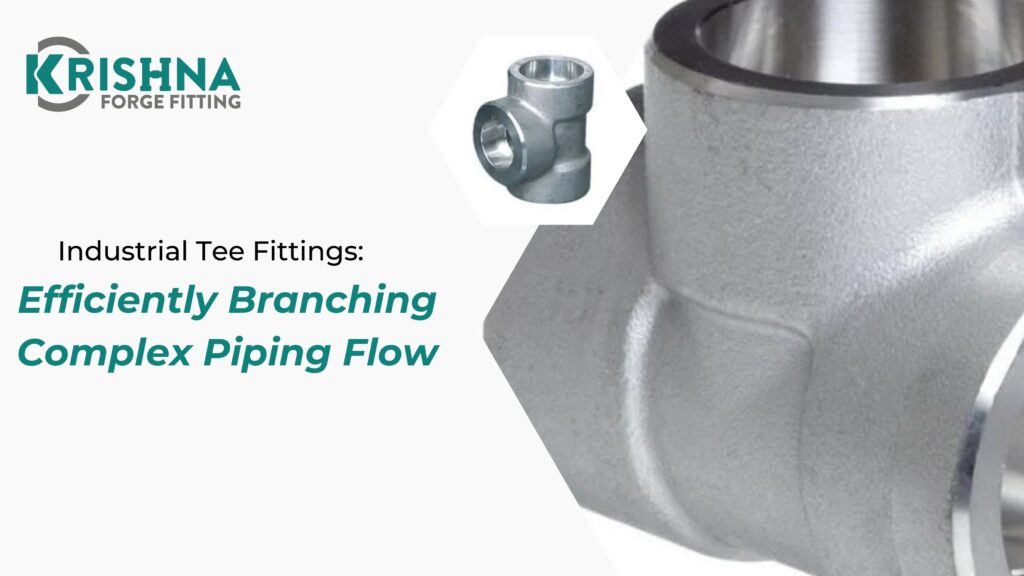
Equal tees maintain identical diameter across all three outlets. The run continues straight through while the branch extends perpendicular at the same size. This design preserves flow velocity and pressure consistency at the junction.
Use equal tees where branch flow requirements match or approach main line capacity. Distribution manifolds, parallel processing lines, and balanced cooling systems require equal tees to maintain system equilibrium.
Installation Simplicity
Equal tees simplify installation because all connections use the same pipe size, gaskets, and welding procedures. Fewer components reduce assembly time by 20-30% compared to systems mixing different sizes. This uniformity cuts inventory requirements and eliminates confusion during field installation.
Reducing Tee Applications
Controlled Flow Splitting
Reducing tees feature a smaller branch outlet than the main run diameter. The size reduction controls flow distribution, manages pressure differentials, and eliminates separate reducer fittings.
Specify reducing tees where branch flow needs are 50% or less of main line capacity. Instrumentation taps, sample lines, and auxiliary equipment connections typically use reducing tees. The integrated reduction consolidates components, cutting potential leak points by 30-40%.
Pressure Management
The smaller branch outlet naturally restricts flow, creating pressure drop that protects downstream equipment from excessive pressure. This built-in regulation eliminates dedicated orifice plates or control valves in many applications.
Pressure Drop Considerations
Flow Direction Impact
Flow through the tee run generates a K-factor of 20. Flow diverted into the branch jumps to K-factor 60. Calculate pressure drop using the formula: ΔP = K × (ρV²/2), where ρ is fluid density and V is velocity.
For water at 2 m/s velocity through a 2-inch branch, pressure drop reaches 120 Pa compared to 40 Pa through the run—a threefold difference. In systems with ten branch takeoffs, cumulative pressure loss forces pump upgrades that consume thousands of dollars annually in excess energy.
System Design Implications
Position tee branches strategically to minimize pressure drop accumulation. Route high-flow streams through tee runs rather than branches. Group branch takeoffs near pump discharge where pressure margins allow losses.
Material Selection
Carbon Steel for General Service
Carbon steel tees meeting ASTM A234 specifications handle most industrial applications operating below 400°C. Grades WPB and WPC provide adequate strength at the lowest material cost. These materials suit water, steam, air, and non-corrosive process fluids.
Stainless Steel for Corrosive Environments
Chemical processing, food production, and pharmaceutical manufacturing require stainless steel tees. Grade 304 resists most organic chemicals and maintains sanitary surfaces. Grade 316 adds molybdenum for superior chloride resistance in marine and coastal installations.
Material incompatibility between pipes and fittings causes galvanic corrosion that creates leak paths within months. Match tee material to pipe grade precisely.
Connection Methods
Butt Weld Tees
Butt weld tees fuse directly to pipe ends through full-penetration welding. This method handles the highest pressures and temperatures while providing the strongest joint. Large-diameter systems above 4 inches almost exclusively use butt weld connections.
The permanent bond eliminates mechanical threads that loosen over time. Systems requiring 20+ year service life without maintenance favor butt weld construction.
Socket Weld and Threaded Options
Socket weld tees suit small-bore, high-pressure lines below 4 inches. The recessed socket simplifies alignment and cuts installation time versus butt welding. Threaded tees allow disassembly for maintenance but handle lower pressures than welded alternatives.
Choose connection type based on pressure requirements, system size, and maintenance philosophy.
Installation Best Practices
Alignment Requirements
Misaligned tees create stress concentration points that accelerate fatigue failures. Use alignment tools to ensure branch outlets extend perpendicular to the run within ±2 degrees. Forced alignment during welding introduces residual stresses that cause premature cracking.
Flow Direction Verification
Mark intended flow direction on tees during installation. Reversing flow orientation changes pressure drop characteristics and can overload branch piping designed for lower velocities. This simple verification step prevents costly commissioning delays.
Welding Quality Control
Poor weld quality accounts for 40-50% of tee fitting failures in industrial service. Under-penetration, porosity, and improper heat treatment create weak points that rupture under pressure. Inspect critical welds through radiography or ultrasonic testing before pressurization.
Common Specification Mistakes
Procurement teams selecting fittings solely on price ignore material compatibility, pressure ratings, and dimensional accuracy. A tee costing 30% less but failing within two years costs more than premium options through production downtime and emergency repairs.
Overlooking branch pressure drop in system hydraulic calculations undersizes pumps and creates flow deficiencies. Always account for K-factor differences when modeling systems with multiple branch takeoffs.
Frequently Asked Questions
How do I calculate pressure drop across tee fittings?
Use the K-factor method: ΔP = K × (ρV²/2). Flow through the tee run has K = 20, while branch flow has K = 60. Multiply by fluid density (kg/m³) and velocity squared (m/s), then divide by two. This formula applies to all Newtonian fluids in turbulent flow.
When should I choose equal tees over reducing tees?
Select equal tees when branch flow requirements match or approach run pipe capacity. Use reducing tees when branch flow needs are 50% or less of main line flow. Equal tees maintain uniform pressure distribution, while reducing tees provide built-in flow control.
What causes most tee fitting failures in industrial systems?
Material incompatibility causes 30-40% of failures through galvanic corrosion. Poor installation practices including misalignment and inadequate welding account for another 40-50%. Wrong pressure class specification and overlooked environmental factors contribute the remainder. Most failures trace to specification errors made before installation.
Can I use carbon steel tees for corrosive chemical applications?
Carbon steel corrodes rapidly in acidic, alkaline, or chloride-containing environments. For corrosive service, specify stainless steel grades 304L or 316L based on chemical compatibility. Consult corrosion resistance charts to verify material performance with specific process fluids. Protective coatings extend carbon steel life in mildly corrosive conditions but require reapplication every 2-3 years.
Conclusion
Tee fittings create the branching points that enable complex piping networks to function efficiently. Select equal versus reducing tees based on flow distribution needs, calculate pressure drop using K-factors, match materials to service conditions, and verify installation alignment. Request technical specifications for your application from experienced manufacturers.
Krishna Forge Fitting manufactures precision forged tee fittings in equal and reducing configurations meeting ASME B16.9 and ASTM A234 specifications. We supply butt weld, socket weld, and threaded tees from ½ inch to 24 inches in carbon steel (A234 WPB) and stainless steel grades (304, 316) for industrial, petrochemical, power generation, and process applications.
Our forging process creates uniform grain structure and dimensional accuracy for pressure classes from 150# through 2500#. Quality control includes dimensional verification, material certification, hydrostatic testing, and non-destructive examination before shipment.
Contact our engineering team at krishnaforge.com for tee fitting specifications, pressure drop calculations, material selection guidance, and application-specific recommendations. We provide complete technical support for complex piping system design and installation.
