Introduction
A petrochemical plant in Surat installed short-radius 90-degree elbows on a high-velocity slurry line to save 15% on fitting costs. Within four months, erosion had eaten through three elbows at the outer bend radius, causing two unplanned shutdowns and ₹28 lakh in emergency repairs. The root problem wasn’t the material or the pressure rating—it was selecting a short-radius elbow in a high-velocity abrasive application where long-radius geometry was the only safe choice.
Industry data shows that 38% of piping system failures in processing plants originate from incorrect fitting selection rather than material defects or installation errors. Elbows, tees, and couplers each solve specific flow routing problems, and substituting one type for another—or selecting the wrong geometry within a type—creates turbulence, erosion, and pressure loss that compound over time. This guide covers exactly when to use each fitting type, which connection method matches your pressure class, and how material selection determines service life.
Elbows: Changing Flow Direction
Elbows redirect flow at fixed angles. The geometry you choose determines pressure drop, erosion rate, and installation footprint.
90-Degree Elbows
Long-radius elbows (radius = 1.5× pipe diameter) generate 40% less pressure drop than short-radius elbows (radius = 1× pipe diameter) at equivalent flow velocities. The gradual curve reduces turbulence and erosion at the outer bend. Use long-radius 90-degree elbows on:
- High-velocity fluid lines above 3 m/s
- Abrasive slurry and particle-laden services
- Gas and steam systems where pressure drop is critical
- Lines requiring pigging or internal inspection tools
Short-radius elbows save space in congested piping layouts where flow velocity stays below 2 m/s and the media is clean. They cost 20-25% less and fit tighter equipment arrangements, but they accelerate erosion in anything abrasive.
45-Degree Elbows
A 45-degree elbow generates roughly 60% of the pressure drop of a 90-degree elbow for the same pipe size and flow rate. Where your routing allows a gradual direction change rather than a sharp 90-degree turn, two 45-degree elbows with a straight pipe section between them outperform a single 90-degree fitting on erosion-sensitive lines. Offshore pipelines and power plant steam headers use this configuration specifically to extend fitting service life.
Tees: Creating Branch Connections
Tees split or combine flow streams. The decision between tee types and orientations carries real hydraulic consequences.
Equal Tees
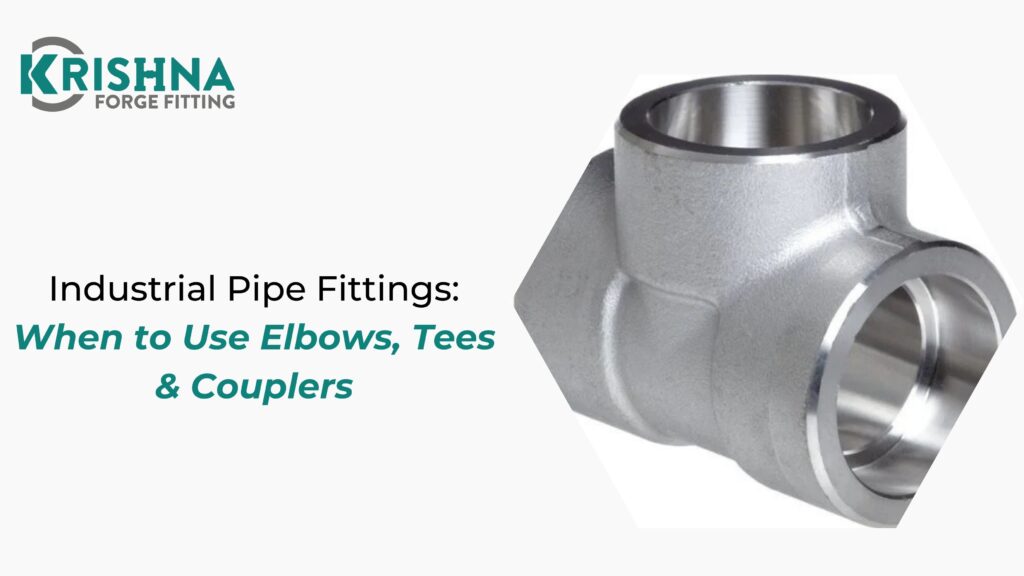
Equal tees branch to the same pipe diameter as the run pipe. Flow entering the branch connection faces a sharp directional change that creates turbulence and a pressure drop two to three times higher than a straight run. Use equal tees for:
- Distribution headers supplying multiple branch lines
- Low-velocity systems where pressure drop is manageable
- Balanced flow splits requiring equal distribution
Reducing Tees
Reducing tees drop the branch outlet to a smaller diameter. They’re the right choice when the branch line carries lower flow volume than the main run—chemical injection points, instrument taps, and secondary process feeds. Avoid using reducing tees backward (smaller run, larger branch) as this creates back-pressure that disrupts main flow.
Tee vs Elbow Decision
Here’s the contrarian insight most piping engineers overlook: a tee used as a 90-degree turn (run capped, flow through branch) generates 30-50% more pressure drop than a long-radius elbow making the same direction change. If you don’t need a branch connection, use an elbow. Using a tee as a turn because it’s in stock wastes pumping energy and accelerates fitting wear.
Couplers: Joining Pipe Sections
Couplers connect pipe sections and determine maintenance access, pressure limits, and leak risk at every joint.
Threaded Couplings
NPT threaded couplings assemble without welding, making them fast to install and easy to disassemble for maintenance. Pressure limits cap at Class 3000 for small bore sizes (DN50 and below). They’re the standard choice for instrument lines, low-pressure utility systems, and anywhere maintenance access drives the design. The trade-off: vibration loosens threaded joints over time without thread sealant or locking compound.
Socket Weld Couplings
Socket weld couplings accept pipe into a recessed socket and weld at the socket mouth. The socket positions the pipe automatically during fit-up, simplifying alignment. Pressure capability reaches Class 6000 for small bore high-pressure service. The internal crevice between pipe end and socket bottom traps corrosive residue in chemical service—a limitation that butt weld fittings eliminate.
Butt Weld Couplings
Butt weld fittings provide the smoothest internal bore and highest structural integrity of any connection method. The weld joins pipe ends directly without internal crevices or recesses. They handle the full pressure capability of the pipe itself, making them the default choice for:
- High-pressure service (Class 600 and above)
- High-temperature steam and process lines
- Corrosive media where crevice corrosion is a concern
- Critical lines where leak risk carries safety or environmental consequences
Installation requires precise end preparation and qualified weld procedures, adding cost that threaded or socket weld fittings avoid.
Material Selection
Material determines chemical compatibility, temperature limits, and long-term performance under cyclic loading.
Carbon steel (ASTM A234 WPB):
- General service: steam, water, petroleum at moderate temperatures
- Temperature range: -29°C to 427°C
- Cost-effective for most industrial piping
Stainless steel (316/316L):
- Corrosive media, food and pharmaceutical processing, chloride environments
- Temperature range: -196°C to 816°C
- 3-4× the cost of carbon steel, but necessary where corrosion matters
Duplex and alloy steels:
- Offshore, subsea, and highly corrosive chemical service
- Pressure ratings equal to or exceeding carbon steel at higher temperatures
- Specify when standard stainless fails due to pitting or stress corrosion cracking
Pressure Ratings and Safety Factors
ANSI/ASME pressure classes (150, 300, 600, 900, 1500, 2500) define maximum working pressure at a reference temperature. Pressure capacity drops as temperature rises. A Class 300 stainless steel fitting rated for 51 bar at 38°C drops to 34 bar at 400°C.
Apply a minimum 4:1 safety factor between burst pressure and working pressure. For systems subject to pressure surges or water hammer, increase this margin to 6:1. Fittings on pump discharge lines experience surge pressures 2-3 times steady-state operating pressure during valve closure—design for that peak, not the average.
FAQs
Can I use a tee fitting as a 90-degree elbow to save inventory space?
Yes, but it costs you in pressure drop and efficiency. A tee used as a 90-degree turn generates 30-50% more resistance than a properly sized long-radius elbow. For low-flow, low-velocity systems this is acceptable. For high-velocity process lines, the energy penalty and increased turbulence make it the wrong choice.
When should I choose socket weld over butt weld fittings?
Socket weld fittings suit small-bore high-pressure lines (DN50 and below) where precise alignment is difficult and welding a full butt joint is impractical. For larger bore lines and anywhere internal crevice corrosion is a concern, butt weld fittings are the better option. The cost difference narrows at larger sizes anyway.
What causes premature elbow failure in slurry lines?
Short-radius geometry, insufficient wall thickness at the outer bend, and flow velocities above 3 m/s are the three main causes. Switch to long-radius elbows, specify Schedule 80 or heavier wall for abrasive service, and keep velocities below 2.5 m/s. Some slurry applications use target tees or replaceable wear inserts at direction changes instead of standard elbows.
Conclusion
Select elbows, tees, and couplers based on flow velocity, media type, and pressure class—not on what’s in stock or which fitting costs least. Long-radius elbows prevent erosion on fast-moving streams. Butt weld couplings eliminate crevice leak points on critical lines. Reducing tees control branch flow without disrupting main line pressure.
Review your most maintenance-intensive fittings this week and verify the geometry and material match your actual operating conditions.
Rainbow Technocast manufactures precision investment cast pipe fittings—elbows, tees, couplings, reducers, and flanges—in carbon steel, stainless steel grades through super duplex, and specialty alloys for industrial, oil and gas, chemical, and power generation applications. Our castings deliver tight dimensional tolerances, full material traceability, and pressure-tested integrity that prevents the fitting failures that shut down production lines and drain maintenance budgets.
Visit rainbowtechnocast.com to request technical datasheets, material certifications, and fitting quotations for your piping requirements. Let’s build reliability into your flow systems.
