Introduction
Piping systems fail at the connections, not the pipe. An elbow with the wrong radius creates turbulence that erodes the wall in months. A tee with insufficient pressure rating becomes a rupture point under surge conditions. A coupling installed on the wrong schedule pipe leaks from day one.
Industrial pipe fittings—elbows, tees, and couplings—connect, redirect, branch, and join pipe runs across every process industry. These components account for a fraction of system material cost but determine whether a pipeline runs reliably for decades or requires repeated emergency maintenance. Studies of piping failures consistently identify joint and fitting selection errors as the leading root cause—ahead of pipe defects, operating errors, and maintenance failures.
This guide covers the types, materials, connection standards, and selection criteria for elbows, tees, and couplings. You’ll learn which fitting type suits specific pressure and flow conditions, how material grade determines service life, and what installation practices prevent costly rework.
Types of Pipe Elbows
Elbows redirect flow at controlled angles. The three key variables are angle, radius, and end connection type.
90° and 45° Elbows
90° elbows make the most common directional change in piping systems. Long radius (LR) 90° elbows have a centerline radius of 1.5 times the nominal pipe diameter. This gradual turn reduces pressure drop and limits erosion in high-velocity or particulate-bearing flows.
Short radius (SR) 90° elbows use a 1.0D centerline radius. They fit tight spaces but increase turbulence, pressure drop, and wear rate. Use SR elbows only where space constraints leave no alternative—not as a default cost-saving substitution.
45° elbows suit gentle directional changes where a full 90° turn would create excessive pressure loss. They’re common in piping layouts where routing allows gradual transitions.
180° Return Bends
Return bends reverse flow direction entirely. They’re used in heat exchangers, condensate returns, and piping arrangements where space prohibits two 90° elbows with a straight run between them.
Reducing Elbows
Reducing elbows change both direction and pipe size in a single fitting, eliminating the need for a separate elbow-plus-reducer combination. They suit tight layouts in skid-mounted equipment.
Types of Pipe Tees
Tees create branch connections at 90° to the main run. The branch diameter and angle determine which type applies.
Equal and Reducing Tees
Equal tees have matching diameters on all three outlets. Reducing tees have a smaller branch, eliminating the need for a separate reducer fitting downstream. In most piping systems, the branch carries less flow than the run—reducing tees optimise this differential.
Lateral and Barred Tees
Lateral tees branch at 45° instead of 90°, reducing turbulence at the junction. Barred tees include internal bars welded across the branch opening to prevent pipe inspection tools (pigs) from entering the branch during pipeline cleaning operations.
Types of Pipe Couplings
Couplings join two pipe ends in the same line. They differ in connection method, bore compatibility, and pressure rating.
- Full couplings: Connect two pipes of the same diameter end-to-end
- Half couplings: Weld to vessel or pipe walls to create small bore branch outlets
- Socket weld couplings: Insert pipe into a recessed socket; fillet weld seals the joint for high-pressure small bore lines
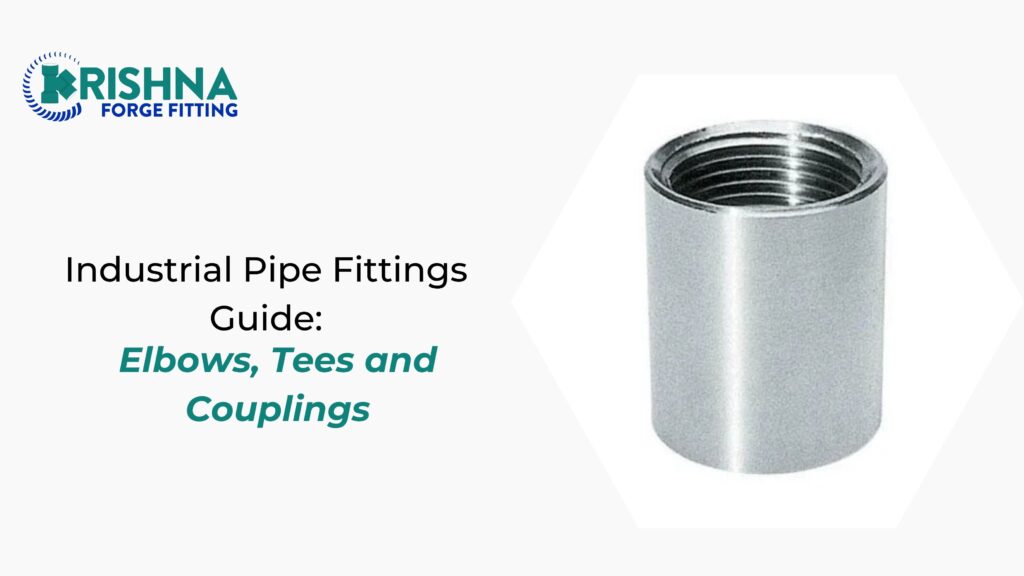
- Threaded couplings: Allow disassembly without cutting; limited to lower-pressure, non-cyclic applications
- Union couplings: Three-piece fittings that enable complete disconnection and reconnection without pipe rotation
Connection Types and Standards
Butt weld fittings governed by ASME B16.9 provide the strongest, most reliable connections for large bore and high-pressure piping. Full penetration welds create joint strength equal to or greater than the pipe itself.
Socket weld and threaded fittings follow ASME B16.11. Socket welds suit small bore high-pressure lines (typically NPS 2 and below). Threaded fittings work for utility services and instrumentation connections where welding is impractical.
Seamless fittings have no longitudinal weld seam, making them stronger and more consistent than welded construction. For high-pressure and cyclic service, seamless is the correct specification—welded fittings can fail at the seam under fatigue loading.
Materials for Industrial Fittings
Carbon steel (ASTM A234 WPB for butt weld, ASTM A105 for socket weld and threaded) handles the majority of oil and gas, power generation, and general industrial applications. It’s strong, weldable, and cost-effective across a wide temperature range.
Stainless steel grades—304 and 316—resist corrosion in chemical processing, food production, and marine environments. Type 316 adds molybdenum, giving it superior resistance to chloride pitting compared to 304. The cost premium over carbon steel is 50-70% but eliminates corrosion-driven replacement cycles.
Alloy steel (P5, P9, P11, P22) handles elevated temperatures in refineries and power plants. Ductile iron and PVC fittings serve low-pressure water and drainage systems.
Selection Criteria
Getting fitting selection right requires four inputs: pressure rating, temperature, flow characteristics, and media compatibility.
Pressure and Temperature
Pressure ratings decrease as temperature rises. A fitting rated for 720 PSI at 100°F may only handle 480 PSI at 500°F. Always use actual operating temperature to de-rate the fitting—not ambient conditions.
Flow Characteristics
Long radius elbows maintain flow velocity better than short radius. In slurry or erosive flow, short radius elbows fail 3-5 times faster than long radius equivalents due to concentrated wall impingement.
Corrosion Compatibility
Match fitting material to the fluid’s corrosion profile. Chlorides attack standard 304 stainless; specify 316. Acids require alloy or lined fittings. Galvanic corrosion accelerates at junctions between dissimilar metals—use consistent metallurgy throughout.
Installation Best Practices
- Deburr and clean pipe ends before fitting assembly; contamination causes weld defects and premature failures
- Verify alignment before tack welding; misaligned fittings concentrate stress and accelerate fatigue cracking
- Follow qualified welding procedures for material grade and wall thickness; over-welding adds residual stress, under-welding leaves incomplete penetration
- Thread with correct engagement depth and apply appropriate sealant; under-engagement on threaded fittings strips threads under pressure
- Pressure test before commissioning; leak paths that appear minor at atmospheric pressure become failures under operating pressure
Applications by Industry
Oil and gas operations specify carbon and alloy steel fittings for wellheads, flowlines, and process piping. Long radius elbows dominate where sand and particulates are present.
Chemical and petrochemical plants use stainless and exotic alloy fittings for acid lines, solvent systems, and high-temperature reactors. Fitting material selection follows fluid compatibility charts, not general corrosion ratings.
Water treatment and HVAC systems use ductile iron, galvanised steel, and PVC fittings. Material choice depends on water chemistry—chlorinated water requires different materials than untreated groundwater.
Power generation plants specify alloy steel fittings for high-temperature steam lines where carbon steel creeps under sustained heat.
Conclusion
Elbows, tees, and couplings determine how well a piping system handles pressure, temperature, flow, and corrosion over its service life. Radius selection affects erosion rate. Tee type determines branch flow distribution. Coupling design determines whether maintenance requires pipe cutting or simple disassembly.
Specify fittings based on actual operating conditions—pressure, temperature, flow velocity, and fluid chemistry. Match material grade to media and pipe metallurgy. Follow ASME B16.9 and B16.11 standards to ensure fit-up and performance.
Review your piping specifications today and verify that elbow radius, tee configuration, and coupling type match your actual operating conditions. If they don’t, the next failure is already in progress.
Krishna Forge manufactures precision-forged elbows, tees, and couplings in carbon steel, stainless steel (304, 316), alloy steel, and duplex grades. Our fittings meet ASME B16.9 and B16.11 standards with seamless and welded construction options across all pressure classes. Built for oil and gas, chemical processing, power generation, and heavy industry, our fittings deliver dimensional accuracy, full material traceability, and verified pressure ratings that support leak-free installation from day one.Need forged pipe fittings with confirmed material certifications and precise dimensions? Visit krishnaforge.com to review elbow, tee, and coupling specifications, material grades, and custom manufacturing options. Get fittings that fit right, seal tight, and perform under the conditions your system actually demands.
