
Introduction
Most piping system failures don’t start with the pipe. They start with the fitting. Wrong elbow radius creates turbulence that erodes the wall. Mismatched reducers trap debris and cause blockages. Caps rated for the wrong pressure become projectiles during overpressure events.
Industrial fittings account for 20-30% of total piping system cost but determine 80% of maintenance headaches. One undersized tee creates a bottleneck that limits throughput across the entire line. One corroded coupling triggers a cascade shutdown and emergency repairs.
This guide explains the types of industrial fittings—elbows, tees, caps, reducers, couplings, and crosses—and how each one functions in piping systems. You’ll learn which materials suit specific environments, how selection criteria prevent failures, and what installation practices extend fitting life. By the end, you’ll know exactly which fitting type, material, and configuration your system requires—and how to specify it correctly to avoid rework and downtime.
Types of Industrial Fittings
Elbows: Changing Flow Direction
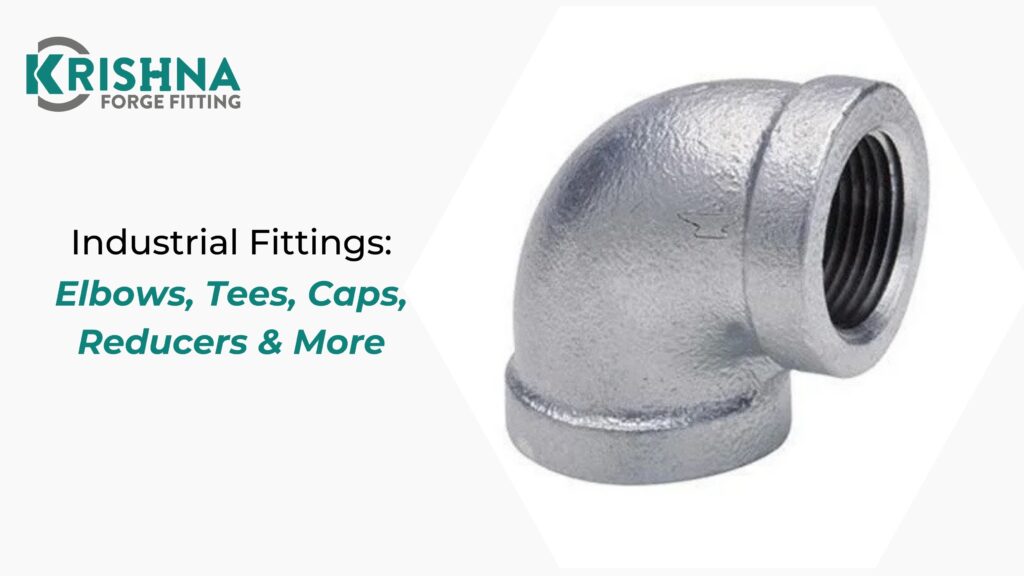
Elbows redirect flow at angles, typically 90° or 45°. Long radius elbows have a centerline radius equal to 1.5 times the pipe diameter, creating gradual turns that reduce pressure drop and erosion. Short radius elbows (radius = 1.0 times diameter) fit tight spaces but increase turbulence and wear.
Use long radius elbows for high-velocity fluids, slurries, and any application where pressure drop matters. Short radius elbows suit low-pressure water lines and situations where space constraints override efficiency.
Tees: Splitting or Combining Flow
Tees create branch connections at 90° to the main run. Standard tees have equal diameters on all three outlets. Reducing tees have a smaller branch outlet, eliminating the need for a separate reducer.
Flow distribution in tees is rarely equal. The branch takes less flow than the run unless explicitly designed otherwise. Account for this when sizing downstream equipment.
Caps: Terminating Pipe Runs
Caps seal pipe ends permanently or temporarily during maintenance. Butt weld caps suit high-pressure applications. Socket weld and threaded caps work for small bore lines where full penetration welds are impractical.
Caps also function as test points. Many systems install capped outlets for future expansion or instrument connections.
Reducers: Transitioning Pipe Sizes
Concentric reducers maintain centerline alignment—fluid velocity increases smoothly through the smaller diameter. Eccentric reducers keep one side flat, preventing gas pockets in horizontal lines or drainage issues in sloped runs.
Using the wrong reducer type creates operational problems. Concentric reducers in steam lines trap condensate. Eccentric reducers in vertical lines cause asymmetric flow patterns that accelerate wear.
Couplings: Connecting Pipe Sections
Couplings join pipes of the same diameter without changing direction or size. Full couplings connect two pipes. Half couplings attach instruments or small branches to larger pipes.
Threaded couplings allow disassembly. Welded couplings provide leak-proof permanent connections for critical service.
Crosses: Four-Way Branching
Crosses split flow in three directions from a main run. They’re less common than tees because they concentrate stress at the intersection. Use crosses only when layout constraints prevent multiple tees.
Material Selection for Industrial Fittings
Carbon steel fittings dominate oil and gas, power generation, and general industrial piping due to strength and low cost. ASTM A234 WPB is the standard grade for butt weld fittings.
Stainless steel grades—304, 316, duplex, and super duplex—resist corrosion in chemical processing, food production, and marine environments. Type 316 costs 40-60% more than carbon steel but eliminates corrosion-related downtime in chloride environments.
Alloy steel fittings (ASTM A234 WP5, WP9, WP11) handle high temperatures in refineries and power plants. Brass and bronze suit water systems and instrumentation. PVC, CPVC, and HDPE work for low-pressure water distribution but fail completely in high-temperature or high-pressure applications.
Material mismatches accelerate failure. Stainless steel fittings on carbon steel pipe create galvanic couples that corrode the carbon steel preferentially.
How to Select the Right Fitting?
Start with compatibility. Match fitting material to pipe material unless isolation is intentional. Verify the fitting can handle your operating pressure and temperature—ratings drop as temperature rises.
Check dimensional standards. ASME B16.9 governs butt weld fittings. ASME B16.11 covers socket weld and threaded fittings. Using fittings from different standards creates fit-up problems and leak paths.
Corrosion resistance determines longevity. Acidic environments attack carbon steel. Chlorides pit stainless steel. Specify materials with documented compatibility for your specific fluid.
Ease of installation affects total cost. Threaded fittings install faster than welded fittings but can’t handle high pressure. Socket welds suit small bore lines. Butt welds provide the strongest, most reliable connections for critical service.
Selection Checklist
- Fluid type, concentration, temperature, pressure
- Pipe material and schedule
- Space constraints (long vs. short radius)
- Maintenance access requirements
- Standards compliance (ASME, ASTM, API)
Installation Best Practices
Deburr pipe ends before assembly. Burrs create turbulence, trap contaminants, and prevent full engagement in socket fittings.
Align fittings accurately before welding. Misalignment concentrates stress and accelerates fatigue failures. Use alignment clamps and verify with levels or lasers.
Follow welding procedures qualified for the material and wall thickness. Over-welding adds residual stress. Under-welding leaves incomplete penetration. Both cause premature failure.
Inspect joints visually at minimum. Use radiography or ultrasonic testing for critical service. Pressure test before commissioning to verify integrity.
Common Applications by Industry
Oil and gas operations use carbon steel and alloy steel fittings rated for extreme pressure and temperature. Long radius elbows minimize erosion from sand-laden fluids.
Chemical processing demands stainless steel and exotic alloys. Hastelloy and Inconel fittings resist acids and corrosive gases that destroy carbon steel in days.
Water and wastewater systems use ductile iron, PVC, and lined carbon steel fittings. Material choice depends on water chemistry—chlorinated water requires different materials than raw sewage.
HVAC and construction projects typically specify black steel, galvanized steel, or copper fittings based on fluid type and building codes.
Conclusion
Industrial fittings are not interchangeable. Elbow radius affects pressure drop. Reducer orientation prevents gas binding. Material grade determines corrosion rate. Each decision compounds across the system.
Specify fittings based on operating conditions, not convenience or cost alone. Match materials to pipe and fluid chemistry. Follow dimensional standards to ensure fit-up. Verify pressure-temperature ratings before procurement.
The right fitting prevents failures. The wrong fitting guarantees them.
Ready to specify industrial fittings that match your system requirements? Review your current piping specifications and verify material compatibility, pressure ratings, and dimensional standards.
Krishna Forge manufactures precision-forged industrial fittings—elbows, tees, caps, reducers, couplings, and crosses—in carbon steel, stainless steel, alloy steel, and specialty materials. Our fittings meet ASME B16.9, ASME B16.11, and ASTM material standards with full traceability and dimensional verification. Built for oil and gas, chemical processing, power generation, and heavy industry, our fittings deliver leak-proof connections under extreme pressure and temperature.Need industrial fittings with verified material properties and precise dimensions? Visit krishnaforge.com to review technical specifications, material options, and custom forging capabilities. Get fittings that fit right, seal tight, and last—reducing installation time and eliminating premature failures.
