
Introduction
Directional change points in piping systems fail 2-3 times more frequently than straight runs, and 65% of these failures trace back to incorrect elbow selection. A 2025 failure analysis study of 300 industrial facilities revealed that engineers routinely specify short radius elbows to save space without considering how the tighter bend creates 40% higher pressure drop and doubles erosion rates compared to long radius alternatives. The cost of replacing a failed elbow during emergency shutdown exceeds the price difference between correct and incorrect specification by 10-15 times.
Industrial elbow fittings redirect flow through 45°, 90°, or 180° angles while managing pressure drop, turbulence, and material stress. The combination of elbow angle, radius type, connection method, and material grade determines whether the fitting performs reliably for decades or creates recurring maintenance problems. ASME B16.9 and B16.11 standards define dimensional tolerances and pressure ratings across sizes from 1/2-inch to 48-inch, but specification requires understanding how each variable affects flow characteristics and structural integrity. This guide explains the types, sizes, and materials that determine elbow performance in demanding industrial applications.
Elbow Types and Flow Characteristics
90° Long Radius Elbows
Long radius (LR) 90° elbows feature a centerline radius of 1.5 times the nominal pipe diameter (1.5D). This gradual curve reduces turbulence and pressure drop compared to tighter bends. The smooth flow path minimizes erosion in systems handling abrasive fluids or solids-laden slurries.
ASME B16.9 defines LR as the standard configuration for most industrial applications. The center-to-face dimension equals the nominal diameter—a 6-inch LR 90° elbow measures 6 inches from centerline to end face.
90° Short Radius Elbows
Short radius (SR) 90° elbows bend at 1.0D radius, creating a more compact footprint. This space savings comes with performance penalties: 40% higher pressure drop and increased erosion potential at the inside radius where velocity concentrates. SR elbows suit tight installations where space constraints make LR installation impossible.
The sharper curve creates secondary flow patterns that persist for 10-15 pipe diameters downstream. Plan straight runs after SR elbows before flow measurement points or control valves where turbulence affects accuracy.
45° Elbows
The 45° elbow creates the gentlest directional change and lowest pressure drop of all angles. Two 45° elbows positioned in series produce less total pressure loss than a single 90° while providing routing flexibility around obstacles. The gradual curve extends service life in high-velocity or erosive applications.
Center-to-face dimensions measure smaller than 90° elbows—a 4-inch 45° elbow spans approximately 2 inches versus 4 inches for the 90° LR equivalent. This requires more linear space but delivers superior flow characteristics.
180° Return Bends
The 180° elbow reverses flow direction completely in a U-turn configuration. It replaces multiple fittings with a single component, eliminating leak points and reducing installation time. Heat exchangers commonly use 180° bends in tube bundles where compact routing matters more than pressure optimization.
Connection Methods for Different Applications
Butt Weld Elbows
Butt weld elbows require beveled pipe ends for full-penetration welding that creates joints equal in strength to straight pipe. ASME B16.9 governs dimensions from 1/2-inch through 48-inch sizes. These elbows dominate large-diameter, high-pressure applications where structural integrity justifies the beveling and welding requirements.
Seamless butt weld elbows offer superior strength through continuous grain structure without longitudinal welds. Welded versions cost less but create potential failure planes at weld seams under cyclic loading.
Threaded Elbows
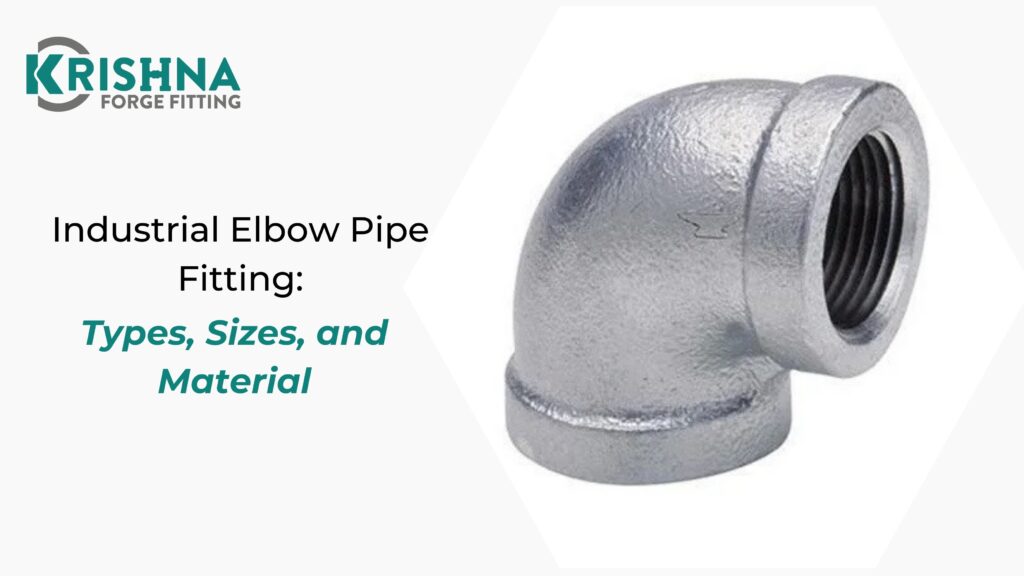
Forged threaded elbows per ASME B16.11 install without welding equipment, making them ideal for maintenance access points and temporary installations. NPT threads create tapered interference that forms the seal. Pressure capability tops out at Class 3000 (3000 PSI at ambient temperature) in sizes 1/2-inch to 2-inch.
Vibration loosens threaded connections over time. Avoid threaded elbows on pumps, compressors, and reciprocating equipment unless mechanical locking methods prevent loosening.
Socket Weld Elbows
Socket weld elbows feature internal shoulders that control pipe insertion depth for single-pass fillet welding. This design suits small-bore high-pressure lines from 1/2-inch to 2-inch where installation speed and leak prevention outweigh the benefits of full-penetration welds. Class ratings reach 6000 PSI in forged configurations.
Size Range and Dimensional Standards
Industrial elbows span 1/2-inch to 48-inch nominal pipe sizes with schedule variations from SCH10 through SCH160. Wall thickness increases with schedule number—SCH40 represents standard weight while SCH80 provides extra-strong construction for higher pressure service.
Center-to-end dimensions scale proportionally with size:
- 2-inch LR 90° elbow: 2-inch (50mm) center-to-face
- 6-inch LR 90° elbow: 6-inch (150mm) center-to-face
- 12-inch LR 90° elbow: 12-inch (300mm) center-to-face
Reducing elbows change diameter through the bend—specified as “6×4” where inlet measures 6-inch and outlet reduces to 4-inch. This eliminates a separate reducer fitting while introducing flow velocity changes that require hydraulic calculation.
Material Selection for Service Conditions
Carbon Steel Options
ASTM A234 WPB butt weld elbows handle hydrocarbon, water, and gas service to 400°F. Forged carbon steel A105 threaded and socket weld elbows suit similar conditions in smaller sizes. Carbon steel costs 30-40% less than stainless alternatives but corrodes in acidic or chloride environments.
Stainless Steel Grades
Type 316/316L stainless steel resists chloride pitting, acidic corrosion, and oxidation at elevated temperatures. The molybdenum content provides superior corrosion resistance compared to 304 in marine and chemical applications. Type 321 handles high-temperature service through titanium stabilization that prevents chromium carbide precipitation.
Alloy Steel for High Temperature
Chromium-molybdenum alloy steels (F11, F22, F91) maintain strength above 800°F where carbon steel loses mechanical properties. Power generation steam systems operating above 1000°F require P91 or P92 materials that resist creep deformation during decades of continuous high-temperature exposure.
Duplex for Corrosion and Strength
Duplex and super duplex elbows combine corrosion resistance with mechanical strength exceeding standard stainless steel. Offshore platforms use super duplex in seawater systems where both chloride resistance and pressure capability matter equally. The material costs 3-4 times standard stainless but eliminates the corrosion failures that plague 316 in aggressive environments.
Pressure Ratings and Standards Compliance
ASME B16.9 butt weld elbows don’t carry class ratings—pressure capability derives from pipe schedule and material grade. A SCH80 elbow handles higher pressure than SCH40 in the same material due to increased wall thickness.
ASME B16.11 forged elbows use class ratings (2000, 3000, 6000, 9000) that indicate pressure capability at temperature. Class 3000 threaded elbows handle 3000 PSI at 100°F but only 1440 PSI at 600°F—a 52% reduction from temperature derating.
Industry Applications and Performance Requirements
Oil and gas facilities use heavy-wall alloy steel elbows in sour gas service where hydrogen sulfide creates stress corrosion cracking. Chemical plants specify 316L elbows with extra corrosion allowance for acidic streams. Power plants employ P91 elbows in superheated steam lines operating at 1050°F and 2400 PSI.
Water treatment systems use 316 stainless elbows in chlorinated water where carbon steel develops pitting within 2-3 years. Food processing requires electropolished stainless elbows with sanitary certification for product contact surfaces.
Frequently Asked Questions
When should I choose long radius over short radius elbows?
Specify long radius unless space constraints make it physically impossible. The pressure drop reduction and erosion resistance justify LR in 95% of applications. Use SR only when equipment spacing or structural limitations prevent LR installation, and accept the performance penalties.
Can I use threaded elbows in high-pressure systems?
Threaded elbows max out at Class 3000 ratings (3000 PSI at ambient temperature) and sizes typically stop at 2-inch. Above these limits, specify socket weld or butt weld elbows. Never use threaded connections in vibrating service regardless of pressure—they loosen and leak.
What material grade suits hydrogen service?
Carbon steel becomes brittle in hydrogen environments above 200 PSI and 400°F. Specify austenitic stainless steel (316, 321) or nickel alloys (Monel, Inconel) for hydrogen service. Consult API 941 for material selection guidance specific to your pressure-temperature conditions.
How do I calculate pressure drop through elbows?
Each 90° LR elbow equals approximately 30 equivalent pipe diameters of straight pipe for friction loss calculations. SR elbows measure 50-60 equivalent diameters. Use the Darcy-Weisbach equation with equivalent length method, or consult CRANE TP-410 for K-factors specific to your Reynolds number.
Do seamless elbows justify the cost premium?
Seamless elbows eliminate the longitudinal weld seam that becomes a failure initiation point in cyclic loading. For critical service with thermal cycling or pressure surges, the 20-30% premium delivers substantially longer service life. Standard low-cycle applications perform adequately with welded elbows.
Conclusion
Elbow selection determines flow efficiency, erosion rates, and service life in piping systems. Specify long radius for flow optimization, match material to process chemistry and temperature, and use connection methods appropriate for pressure and maintenance requirements. The few minutes spent on proper specification prevent years of recurring maintenance problems.
Contact our technical team for elbow specifications matching your operating conditions and system requirements.
Krishna Forge Fitting manufactures industrial pipe elbows meeting ASME B16.9 and B16.11 standards in 45°, 90° LR/SR, and 180° configurations across sizes from 1/2-inch to 48-inch. Our elbows span butt weld, threaded, and socket weld connection types in carbon steel A234 WPB/A105, stainless steel 304/316/316L/321, duplex, and alloy steel grades including F11, F22, and F91.
Seamless forged elbows undergo dimensional inspection verifying center-to-end measurements, wall thickness, and ovality within ASME tolerances. Every elbow ships with Material Test Certificates showing chemical composition, mechanical properties, and heat treatment records with full heat code traceability.
Our manufacturing process includes hot forging for grain structure optimization, precision machining for dimensional accuracy, and controlled heat treatment cycles. We maintain inventory in standard long radius configurations with short radius, reducing, and custom angles available on request.
Order certified pipe elbows with complete documentation at krishnaforge.com or contact our engineering team to discuss your directional change requirements, flow optimization needs, and material selection for corrosive or high-temperature service. We deliver reliable elbow fittings with technical support for demanding industrial piping systems.
