
Introduction
Socket weld failures occur at a rate of two to three per plant annually in industrial facilities. Analysis of 2,399 nuclear piping failures between 1970 and 2001 identified 108 cases directly attributed to socket weld joint problems. Most engineers blame installation errors, but data tells a different story: 75.7% of failures trace back to specifying the wrong fitting for the application before installation even begins.
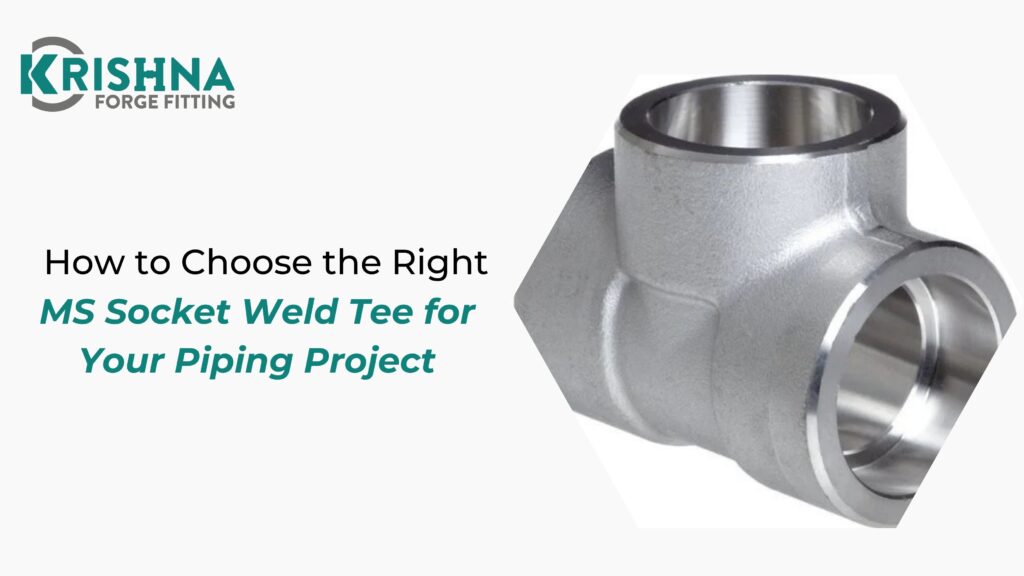
MS socket weld tees handle pressures from 3,000 to 9,000 PSI in piping systems below 4 inches. They cut installation costs by 20-35% compared to butt weld alternatives while maintaining leak-tight performance. But selecting the correct pressure class, material grade, and tee configuration determines whether joints last decades or fail within months.
This guide walks through size matching, pressure rating verification, material selection, and application-specific considerations that prevent costly specification errors.
Understanding System Requirements
Pressure and Temperature Parameters
Match the fitting pressure class to maximum operating pressure plus a safety margin. Class 3000 handles up to 3,000 PSI, Class 6000 extends to 6,000 PSI, and Class 9000 reaches 9,000 PSI at ambient temperature. Temperature reduces these ratings—a Class 3000 fitting at 400°C handles only 60-70% of its ambient pressure capacity.
Calculate peak pressure during startups, shutdowns, and transient conditions. Pressure surges during valve closures often exceed steady-state values by 200-300%. Under-specifying pressure class creates failure conditions that manifest as catastrophic leaks.
Size Compatibility
MS socket weld tees function reliably from ½ inch through 4 inches nominal pipe size. The socket bore diameter must match pipe outer diameter within +0.020 to -0.000 inches for sizes 1½ inches and smaller. Larger sizes allow +0.025 to -0.000 inch tolerance.
Verify pipe schedule matches socket depth specifications. Schedule 40 pipe requires different socket dimensions than Schedule 80. Mixing schedules creates gaps or interference that compromises weld quality.
Material Selection
Carbon Steel Grades
ASTM A105 carbon steel suits most general industrial applications operating below 350°C. This grade provides adequate corrosion resistance in non-aggressive environments at the lowest material cost.
For temperatures between 350-425°C, specify ASTM A350 LF2 grade to maintain strength at elevated temperatures. Standard A105 loses mechanical properties above 350°C, reducing safety margins.
Corrosion Considerations
Carbon steel corrodes rapidly in acidic, chloride, or moisture-rich environments. The socket design creates crevices between pipe end and socket shoulder that trap corrosive agents. Systems handling corrosive media require stainless steel alternatives or protective coatings applied before installation.
Chemical compatibility tables identify materials resistant to specific process fluids. Trusting assumptions about material resistance causes premature failures.
Equal vs Reducing Tee Selection
Equal Tee Applications
Equal tees maintain consistent diameter across all three outlets. Use them where branch flow equals or approaches run pipe flow. Equal tees minimize pressure drop and turbulence at the junction.
Manufacturing facilities, utility distribution networks, and parallel processing lines typically require equal tees. The uniform bore preserves flow velocity and system balance.
Reducing Tee Functions
Reducing tees feature a smaller branch outlet than the run pipe diameter. They control flow distribution, reduce branch velocity, and eliminate separate reducer fittings. This consolidation cuts installation points by 30-40%, reducing potential leak sources.
Specify reducing tees where branch flow requirements are 50% or less of run pipe capacity. Over-sizing branch outlets wastes material and increases fitting costs unnecessarily.
Critical Installation Parameters
Expansion Gap Requirements
Socket weld tees require a 1/16 inch (approximately 1.6mm) gap between pipe end and socket shoulder before welding. This gap prevents differential thermal expansion from inducing stress at the weld root during temperature changes.
Research shows gaps below 0.005 inches create peak stresses of 152 ksi at the weld root during thermal transients. Proper gap maintenance reduces this stress by 40-60%. Measure gap with feeler gauges before welding—visual estimation produces inconsistent results.
Dimensional Tolerance Verification
ASME B16.11 specifies center-to-bottom dimensions with tolerances ranging from ±0.03 inches for ⅛ and ¼ inch sizes to ±0.10 inches for 2½ through 4 inch fittings. Socket wall thickness must equal at least 1.09 times pipe wall thickness, with a minimum of 5/32 inch.
Request dimensional inspection reports before accepting delivery. Out-of-tolerance fittings cause alignment problems, weld defects, and premature failures.
Application-Specific Considerations
Vibration Environments
High-cycle fatigue from vibration represents the most common socket weld failure mode. Pumps, compressors, and reciprocating equipment generate vibrations that propagate through connected piping.
Install vibration dampers upstream of socket weld joints in high-vibration zones. Alternative connection methods like butt welds provide superior fatigue resistance where vibration cannot be eliminated.
Accessibility for Maintenance
Socket weld tees create permanent joints that require cutting for removal. Systems needing frequent reconfiguration or component replacement benefit from flanged or threaded connections instead.
Plan installation locations considering future access requirements. Welds in confined spaces complicate repairs and increase maintenance downtime.
Common Specification Mistakes
Procurement teams often select fittings based solely on initial purchase price. A fitting costing 30% less but failing within two years costs more than premium options lasting 20 years.
Mismatching pressure ratings saves minimal costs while creating catastrophic failure risks. Production shutdowns from leaks cost thousands of dollars per hour—far exceeding fitting price differences.
Ignoring application environment accelerates corrosion and reduces service life by 60-80%. Match material grade and protective coatings to actual operating conditions.
Frequently Asked Questions
How does temperature affect MS socket weld tee pressure ratings?
Elevated temperatures reduce carbon steel strength, lowering allowable pressure. ASME B16.11 provides pressure-temperature derating curves showing capacity reduction at specific temperatures. At 400°C, most carbon steel fittings handle only 60-70% of their room temperature pressure rating. Always consult pressure-temperature charts for your specific material grade and operating conditions.
What causes socket weld joint failures in high-pressure systems?
Insufficient expansion gap accounts for 40-50% of socket weld failures through thermal stress-induced cracking. Vibration-induced high-cycle fatigue causes another 30-40% of failures in systems with rotating equipment. Poor weld quality including inadequate penetration, porosity, or improper fillet profile creates immediate failure risk. Corrosion in the socket crevice contributes 10-20% of long-term failures in aggressive environments.
Can I use MS socket weld tees for corrosive chemical applications?
Carbon steel socket weld tees corrode rapidly in acidic, alkaline, or chloride-containing environments. The socket design creates crevices that trap corrosive agents, accelerating localized attack. For corrosive service, specify stainless steel grades (304L, 316L) or apply protective coatings before installation. Consult chemical compatibility charts to verify material resistance to specific process fluids.
What inspection methods verify socket weld tee quality after installation?
Socket welds use fillet welds that cannot be radiographically inspected. Surface examination methods include visual inspection for weld profile and defects, magnetic particle testing (MT) for ferromagnetic materials, and liquid penetrant testing (PT) for stainless steel. These methods detect surface-breaking defects but miss internal porosity. Quality depends on welder skill and procedure adherence more than post-weld inspection.
Conclusion
Proper MS socket weld tee selection requires matching pressure class to operating conditions, verifying size compatibility, choosing appropriate material grades, and accounting for application-specific factors like vibration and corrosion. Contact our technical team with your project specifications for fitting recommendations.
Krishna Forge Fitting manufactures precision forged MS socket weld tees meeting ASME B16.11 specifications in Class 3000, 6000, and 9000 pressure ratings. Our socket tees are available in sizes from ½ inch to 4 inches in both equal and reducing configurations using ASTM A105 carbon steel. We supply socket weld elbows, tees, couplings, caps, and unions for oil and gas, petrochemical, power generation, and industrial piping applications.
Quality control includes dimensional verification with calibrated gauges, socket depth inspection, and material certification before shipment. Each fitting receives material test reports documenting chemical composition and mechanical properties.Request technical specifications, pressure-temperature ratings, and material selection guidance at krishnaforge.com. Our engineering team provides project-specific recommendations for high-pressure piping systems.
