
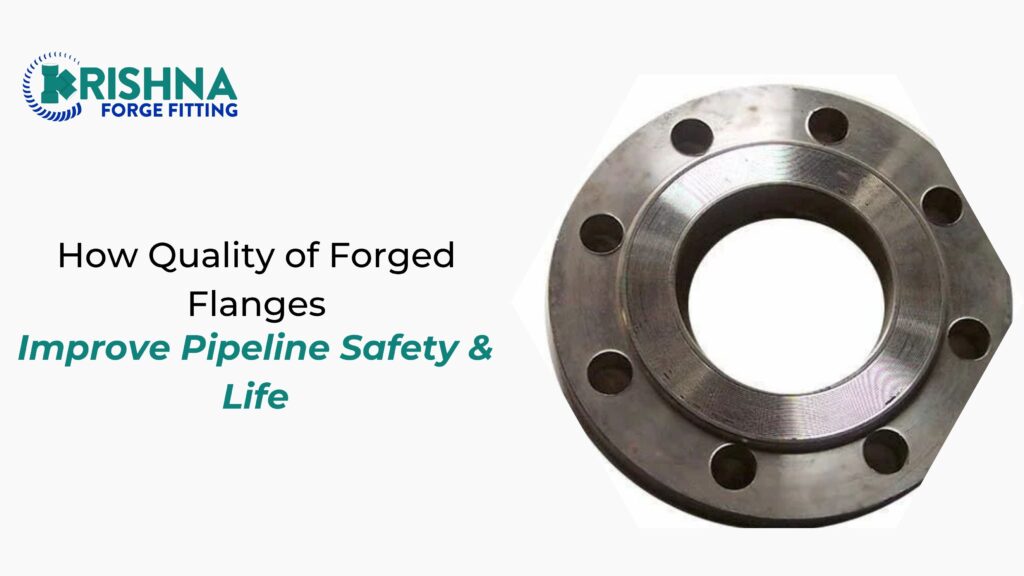
Flange failures account for up to 30% of all pipeline leaks in oil, gas, and chemical processing systems—and the majority trace back to substandard materials or casting defects in the flange body itself, not gasket failures or installation errors. Facilities that discover this pattern often find they’ve been replacing flanges every 5-8 years on lines designed for 25-year service life.
Forged flanges change this equation by eliminating the internal porosity, weak grain boundaries, and unpredictable material properties that plague cast alternatives. The forging process—compressing heated steel billets under controlled force—produces dense, defect-free components with mechanical properties that consistently exceed cast equivalents by 20-30%.
Here’s the counterintuitive part: most buyers focus on flange face finish and bolt hole accuracy while ignoring internal material quality that determines service life and failure risk. This guide explains how forging process variables drive safety and longevity, what quality checks matter, and how material, coating, and maintenance decisions interact to extend pipeline life.
The Forging Process Advantage
Grain Structure Refinement
When heated steel compresses under forging dies, the crystalline grain structure aligns along the flange’s stress flow paths. This alignment matches the direction that operating pressure and mechanical loads apply during service, creating resistance where the component needs it most.
Cast flanges solidify from liquid metal, producing random grain orientations that create weak planes regardless of where loads apply. Forged flanges exhibit 25-40% higher tensile strength and dramatically better impact resistance compared to cast equivalents in the same material grade.
Defect Elimination and Density
Porosity—microscopic voids from gas entrapment during casting solidification—concentrates stress and initiates fatigue cracks. A forged flange contains essentially no porosity because the compressive forging force collapses any voids and bonds them closed.
Material density in forged flanges reaches 98-99% of theoretical maximum. This density ensures consistent mechanical properties throughout the cross-section rather than the property gradients cast flanges exhibit between surface and core regions.
Heat Treatment and Stress Relief
Post-forging heat treatment normalizes the grain structure and relieves residual stresses introduced during deformation. Quench-and-temper treatment achieves specific strength and toughness combinations suited to pressure class requirements.
Skipping or inadequate heat treatment leaves residual tensile stresses that add to operating loads, effectively reducing pressure capacity below rated values. Request heat treatment records with time-temperature documentation rather than accepting material certifications that only list final mechanical properties.
Safety Benefits
Strength and Impact Resistance
Forged flanges in ASTM A105 carbon steel deliver minimum tensile strength of 70,000 PSI against 60,000 PSI for equivalent cast grades. This 17% strength advantage directly increases burst pressure margins and safety factors in high-pressure applications.
Impact resistance matters during pressure surges, water hammer events, and thermal shock that create stress spikes well above steady-state ratings. Cast flanges that perform adequately under stable conditions crack under these transient loads that forged components absorb without damage.
Fatigue and Pressure Containment
Pipeline flanges cycle through pressure fluctuations with every pump start, valve operation, and temperature change. Fatigue life—the number of stress cycles a component withstands before crack initiation—reaches 2-3X higher values in forged flanges compared to cast equivalents at the same stress amplitude.
This fatigue advantage explains why forged flanges remain the mandatory specification in ASME B31.3 process piping and API 6A wellhead applications. The standards recognize that cast alternatives cannot reliably survive the fatigue loading these services impose.
Leak Prevention and Seal Integrity
Flange face flatness determines gasket compression consistency across the sealing surface. Dense forged material machines to tighter flatness tolerances—within 0.001 inches across the full face—compared to cast flanges where surface porosity interrupts the machined surface and creates local low spots.
These surface interruptions reduce effective gasket contact area by 15-25%, requiring higher bolt torque to achieve equivalent sealing force. Over-torquing to compensate stresses bolts beyond yield, causing relaxation and eventual leak paths.
Lifespan Improvements
Extended Service Life
Documented field data from oil and gas installations shows forged flanges achieving 20-30 year service life in applications where cast equivalents required replacement at 8-12 years. The difference comes from fatigue resistance, corrosion behavior, and mechanical integrity rather than any single property.
The lifecycle cost calculation inverts the initial cost comparison. Forged flanges cost 15-25% more than cast alternatives but deliver 2-3X longer service intervals. Total ownership cost over a 25-year project favors forged flanges by a wide margin when replacement labor and downtime factor into the calculation.
Corrosion and Wear Resistance
Dense forged material presents fewer grain boundary sites where corrosive media penetrates and initiates pitting. Pitting in cast flanges can reduce wall thickness by 30% within 5 years in chlorinated water or mildly acidic service while forged equivalents show minimal degradation.
Stainless steel forged flanges (ASTM A182 F316L) combine the mechanical advantages of forging with inherent corrosion resistance for chemical processing and marine applications. The forged structure maintains chromium distribution uniformity that the casting process can disrupt through segregation during solidification.
Quality Assurance
Testing and Inspection Methods
Meaningful quality verification requires process documentation, not just finished-product testing:
- Ultrasonic testing (UT): Detects internal cracks, laminations, and inclusions before machining
- Magnetic particle inspection (MPI): Reveals surface and near-surface defects in ferromagnetic materials
- Hydrostatic pressure testing: Verifies structural integrity at 1.5X rated pressure with documented hold times
- Hardness testing: Confirms heat treatment effectiveness and material grade compliance
- Dimensional inspection: CMM verification of bore, face flatness, bolt circle, and raised face dimensions
Material Traceability
Full traceability connects each flange to its original heat of steel through chemical analysis and mechanical test records. Heat numbers stamped on flanges enable retrieval of mill certifications, forging records, heat treatment logs, and inspection results.
Flanges lacking heat number marking or traceable certifications cannot verify the material grade despite appearing dimensionally correct. In critical applications, accept only fully traceable flanges with material certifications from accredited testing laboratories.
Maintenance and Coating Synergy
Protective Coatings for Extended Life
External epoxy or polyurethane coatings protect forged flanges from atmospheric corrosion and soil contact in buried applications. Coating adhesion on forged surfaces outperforms cast surfaces because the denser substrate provides fewer porosity sites where coatings delaminate.
Fusion-bonded epoxy coatings applied at 300-400 microns deliver 15-20 year exterior protection in buried service. Internal linings in water service flanges use epoxy compounds that prevent red water contamination and maintain hydraulic capacity over decades of service.
Inspection Intervals
Forged flanges in critical service require periodic inspection that validates continued integrity:
- Annual: Bolt torque verification and visual leak inspection
- 5-year: Ultrasonic thickness measurement at corrosion-prone locations
- 10-year: Full NDT inspection and coating condition assessment
- On condition: Immediate inspection after pressure excursions above rated limits or pipe movement events
Frequently Asked Questions
What standards govern forged flange specifications?
ASME B16.5 covers forged steel pipe flanges in sizes up to 24 inches with pressure-temperature ratings from Class 150 through Class 2500. ASME B16.47 extends coverage to larger diameters. API 6A applies to wellhead and Christmas tree flanges in oil and gas service. Each standard specifies dimensional requirements, material grades, testing methods, and marking requirements.
Can I replace cast flanges with forged flanges without design changes?
Yes, in most cases. Forged and cast flanges in the same pressure class follow identical dimensional standards for bolt holes, face diameter, and raised face dimensions. Forged flanges in equivalent sizes and pressure classes install as direct replacements. Verify the material grade matches the original specification for temperature and corrosion service requirements.
How do I identify a forged flange from a cast flange visually?
Forged flanges typically show parting line marks from die contact and display a smoother, more uniform surface texture. Cast flanges often show evidence of sand mold texture, visible gate removal points, and slight surface roughness from solidification. Always verify through material certifications and heat number traceability rather than visual assessment alone.
Specify Forged Quality for Every Critical Joint
Forged flanges deliver measurable safety margins and service life extensions backed by material science, not marketing claims. Specify forged construction for pressure classes above ASME Class 300, applications with thermal cycling, and any service where flange failure consequences include environmental release, safety hazard, or production shutdown.
Request full material certifications, heat treatment records, and NDT documentation before accepting flanges for critical service—regardless of supplier claims or purchase price pressure.
Krishna Forge manufactures precision forged flanges in carbon steel, stainless steel, and alloy grades across ASME B16.5 pressure classes from 150 through 2500. Our integrated facility handles forging, heat treatment, machining, and hydrostatic testing with full material traceability from billet receipt through final shipment.
Every flange ships with mill certificates, heat treatment records, dimensional inspection reports, and hydrostatic test documentation. Our quality system meets ISO 9001:2015 with documented process controls at every stage.
Need forged flanges for your pipeline or process system? Contact our engineering team with your pressure class, material specification, size range, and volume requirements. We’ll provide technical recommendations with full quality documentation.
