Introduction
Pipe fitting failures in industrial systems rarely come from operating conditions alone. They come from mismatched standards—fittings bought to one specification installed in systems designed for another. A forged fitting rated to Class 3000 installed where the design calls for Class 6000. A buttweld fitting dimensioned per one revision of B16.9 that won’t align with pipe procured to a different edition. These mismatches cause installation delays, weld rejections, and pressure test failures that shut down commissioning for days.
ASME B16 standards define exactly how pipe fittings must be dimensioned, rated, marked, and tested. They’re not interchangeable, and choosing the wrong standard for your application isn’t a minor paperwork issue—it’s a structural decision that affects pressure containment at every joint.
This guide covers the four most critical B16 standards—B16.9, B16.11, B16.5, and supporting standards—explains what each governs, how pressure classes map to real-world service conditions, and how to build a specification framework that eliminates costly procurement errors.
ASME B16.9: Buttweld Fittings
ASME B16.9 covers factory-made wrought fittings joined by butt welding—elbows, tees, reducers, caps, and return bends. Size range spans NPS ½ through NPS 48. These fittings suit large-diameter piping where weld joint integrity and full-bore flow matter most.
Scope and Pressure Ratings
B16.9 doesn’t assign independent pressure ratings to fittings. Instead, fittings comply with the pressure-temperature ratings of the matching pipe. Wall thickness on B16.9 fittings must equal or exceed the nominal wall of the connecting pipe. This makes material and schedule selection—not the fitting standard itself—the primary pressure-rating driver.
Dimensions and Tolerances
Critical dimensions under B16.9 include center-to-end and end-to-end measurements, outside diameter at ends, and wall thickness. Tolerances on end diameters are tight—typically ±1.6mm for NPS 10 and below—because butt weld alignment depends directly on matching pipe OD. Dimensional non-compliance creates misalignment during fit-up, forcing costly field correction before welding.
Marking Requirements
Each B16.9 fitting must carry the manufacturer’s name or trademark, material grade, nominal pipe size, schedule or wall thickness, and heat number for traceability. Unmarked or incompletely marked fittings fail inspection on most industrial projects regardless of actual dimensional compliance.
ASME B16.11: Forged Fittings
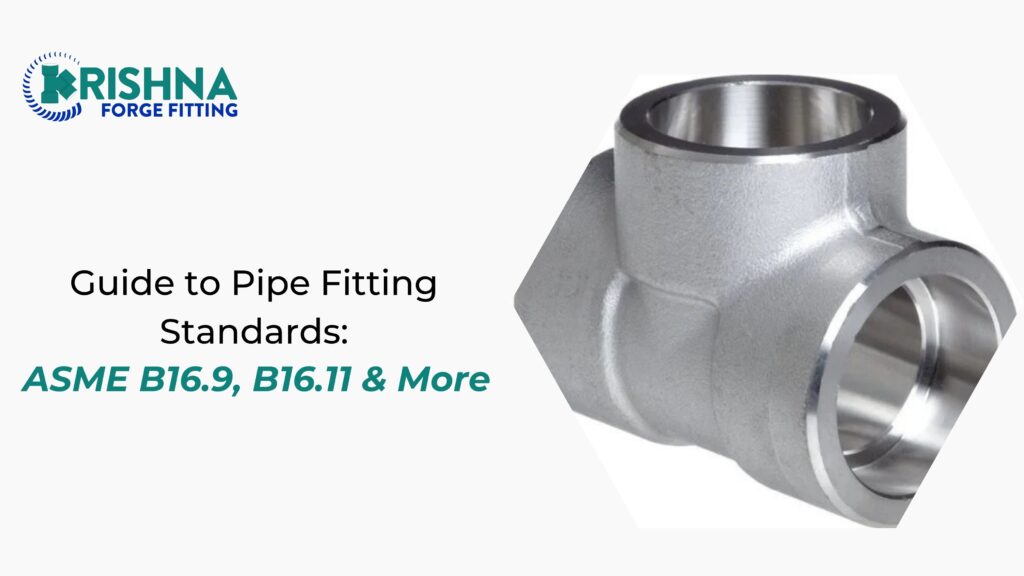
B16.11 covers socket-weld and threaded forged fittings in smaller sizes: NPS ⅛ through NPS 4. These fittings appear everywhere in instrument tubing, small-bore process lines, and high-pressure utility systems. The standard assigns four pressure classes: 2000, 3000, 6000, and 9000.
Pressure Classes and Their Meaning
Class 2000 suits threaded fittings only. Classes 3000 and 6000 cover both socket-weld and threaded configurations. Class 9000 applies exclusively to socket-weld fittings. Higher class numbers mean heavier wall thickness and higher allowable pressures—but most procurement teams over-specify Class 6000 where Class 3000 would meet design requirements, adding cost without benefit.
Here’s the uncomfortable fact: many plant specifications mandate Class 6000 across entire systems by default, regardless of actual design pressure. This habit doubles material cost in utility systems that operate at 150 psig.
Socket Weld vs. Threaded Connections
Socket-weld fittings accept pipe inserted into a recessed socket before welding. The socket depth provides alignment and initial joint strength before the weld is applied. Threaded fittings use NPT threads for mechanical connection. Socket-weld joints handle higher pressures with better fatigue resistance. Threaded joints suit temporary connections and low-pressure instrument lines where weld access is limited.
ASME B16.5: Flanges and Flanged Fittings
B16.5 governs flanges and flanged fittings from NPS ½ through NPS 24 across seven pressure classes: 150, 300, 400, 600, 900, 1500, and 2500. Each class has pressure-temperature ratings that vary by material group. A Class 300 carbon steel flange holds different pressure at 400°C than a Class 300 stainless flange at the same temperature.
Flange facing types affect gasket selection and bolting requirements:
- Raised face (RF): standard for most process service
- Flat face (FF): used with cast iron equipment to prevent flange distortion
- Ring-type joint (RTJ): high-pressure and high-temperature service above Class 600
Mismatching face types—bolting an RF flange to an FF flange—creates uneven gasket loading that causes immediate leakage. This happens more often than it should during equipment modifications.
Other Key B16 Standards
Several supporting standards complete the B16 framework:
- B16.3: Malleable iron threaded fittings, Classes 150 and 300
- B16.4: Gray iron threaded fittings, Classes 125 and 250
- B16.14: Ferrous pipe plugs, bushings, and locknuts with pipe threads
- B16.15: Cast copper-alloy threaded fittings, Classes 125 and 250
- B16.28: Wrought steel buttwelding short-radius elbows and returns
Each serves a specific material and pressure range. Using B16.3 malleable iron fittings in a system designed for B16.11 forged steel—a substitution that appears equivalent on casual inspection—puts Class 150 fittings in a Class 3000 service environment.
Material Specifications
B16 standards reference ASTM material specifications for chemistry and mechanical properties. Common pairings:
- B16.9 fittings: ASTM A234 (carbon/alloy steel), A403 (stainless steel), A420 (low-temperature service)
- B16.11 fittings: ASTM A105 (carbon steel forgings), A182 (stainless and alloy forgings)
- B16.5 flanges: ASTM A105 (carbon steel), A182 (alloy and stainless)
Material test reports must accompany certified fittings in process plant applications. Reports document heat chemistry, mechanical test results, and heat treatment. Projects rejecting fittings without full MTRs during receiving inspection create procurement delays that typically fall on suppliers, not engineering teams.
Pressure-Temperature Ratings
Pressure class doesn’t translate directly to a single allowable pressure. Allowable pressure decreases as temperature rises. A B16.5 Class 600 carbon steel WCB flange rated at approximately 99 bar at ambient temperature drops to around 66 bar at 400°C.
Design engineers specify pressure class based on the worst-case combination of maximum operating pressure and maximum operating temperature—not either condition individually. Specifying class from pressure alone, then discovering that temperature derate brings the flange below design pressure, requires costly re-procurement.
Selection Guide: B16.9 vs B16.11
| Aspect | B16.9 Buttweld | B16.11 Forged |
| Size Range | NPS ½–48 | NPS ⅛–4 |
| Connection Type | Butt weld | Socket weld / Threaded |
| Pressure Rating | Matches pipe schedule | Class 2000–9000 |
| Wall Thickness | Per pipe schedule | Per pressure class |
| Typical Use | Large-bore mainlines | Small-bore, high-pressure |
| Radiography | Required on welds | Not always required |
Frequently Asked Questions
Can B16.9 and B16.11 fittings be used in the same piping system?
Yes—different line sizes and pressure requirements within one system routinely use both standards. The critical requirement is that each fitting matches the standard and pressure class specified for that specific line designation. Mixing standards within a single line is non-compliant.
What’s the difference between Class 3000 and Class 6000 B16.11 fittings?
Class 6000 fittings have heavier walls and higher allowable pressures. For carbon steel A105 material, Class 3000 socket-weld fittings suit systems up to approximately 103 bar at ambient temperature. Class 6000 extends this significantly. Use the project’s line class specification—not general preference—to determine which class applies.
Do B16 fittings require third-party inspection?
Third-party inspection is project-specific, not mandated by the B16 standards themselves. Critical service applications in oil and gas, power generation, and chemical plants typically require mill inspection and material certification. Commodity services in utilities may accept manufacturer certification alone.
Conclusion
Pipe fitting standards aren’t administrative requirements—they’re engineering specifications that determine how joints behave under pressure, temperature, and cyclic loading. Getting specifications right at the procurement stage prevents the costly fit-up rejections, material substitutions, and pressure test failures that delay commissioning.
Review your current line class specifications against these standards today, then source fittings from suppliers who provide full compliance documentation with every shipment.
Krishna Forge Fittings manufactures pipe fittings to ASME B16.9 and B16.11 standards with complete material traceability, dimensional compliance, and certified test reports. Our precision casting and forging capabilities cover carbon steel, stainless steel, and alloy grades across the full range of pressure classes—delivered with the documentation your projects require.
Contact Rainbow Technocast now to discuss your pipe fitting requirements. We’ll confirm the correct standard, pressure class, and material specification for your service conditions—eliminating the procurement errors that stall projects. Visit https://krishnaforge.com/ or reach out directly—let’s get your specifications right from the start.
