
Introduction
Most procurement specs list “forged fittings and flanges per ASME standards” without understanding what forging actually does to the metal—or how shortcuts in the manufacturing chain create components that pass dimensional checks but fail under cyclic stress, thermal shock, or corrosive attack within three years. Cast components look identical on a drawing and cost 25% less, but their grain structure is random and porous; forging aligns grain flow with stress lines and compresses out voids, delivering mechanical properties that welding and machining cannot replicate.
This guide walks through the complete manufacturing process—from raw billet to certified fitting—and explains which steps separate reliable components from catalog commodities. You will learn how material selection, forging temperature, heat treatment, and inspection protocols determine whether a flange seals for twenty years or leaks after two. Whether you engineer piping systems for refineries, power plants, or chemical facilities, knowing how fittings and flanges are actually made lets you write better specs and identify suppliers who control quality instead of reselling imported stock.
What Are Forged Fittings & Flanges?
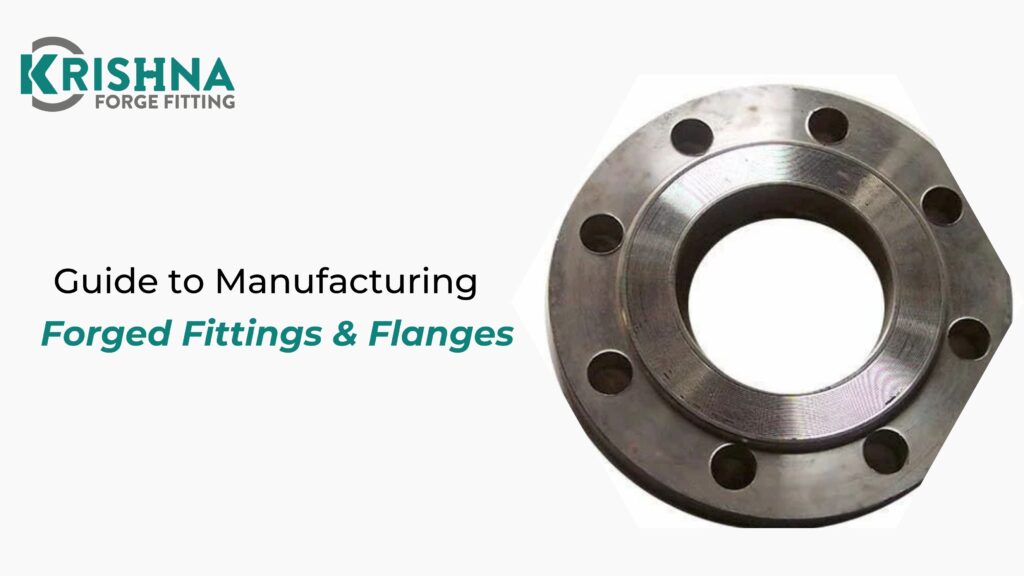
Forged fittings—elbows, tees, couplings, caps—connect and redirect pipe runs. Flanges bolt pipes to valves, pumps, and vessels. Both are shaped by compressing heated steel billets under extreme mechanical force, refining grain structure and eliminating the porosity and inclusions that cause premature failure.
Why forging matters
Cast fittings pour molten metal into molds; cooling creates internal voids and weak spots. Fabricated flanges weld plate sections together; weld seams concentrate stress and corrode faster than parent metal. Forged components start as solid billets and are mechanically worked—no seams, no porosity, grain flows in the direction of applied stress.
High-pressure systems (Class 2500+), cyclic thermal loads, and corrosive environments expose the difference. A cast flange cracks at the bolt hole; a forged flange flexes and recovers.
Materials and Standards
Material selection
- Carbon steel (A105, A350 LF2): general service; handles pressure and temperature up to 400 °C
- Stainless steel (A182 F304/F316): resists acids, chlorides, and high-temperature oxidation
- Alloy steel (A182 F11/F22/F91): superheated steam and hydrogen service above 540 °C
The cheapest option is carbon steel; the most expensive is exotic alloys like Hastelloy or Inconel. Buyers who downgrade material to hit a budget discover the true cost when corrosion or creep failure shuts down operations.
Standards that define quality
ASME B16.11 governs forged fittings (socket-weld and threaded, NPS ⅛–4). ASME B16.5 covers flanges NPS ½–24 in pressure classes 150 through 2500. These standards specify dimensions, tolerances, pressure-temperature ratings, and the material grades that meet mechanical requirements.
Manufacturing Process
Step-by-step production
- Raw material verification: billets arrive with mill certificates; chemistry is lab-tested against ASTM specs.
- Heating: billets reach forging temperature (1050–1250 °C for carbon steel) in controlled furnaces.
- Forging: hydraulic presses apply 3000–10,000 tons of force, compressing the billet into dies shaped like flanges or fittings. Open-die forging suits simple shapes; closed-die (impression forging) produces complex geometries with tight tolerances. Ring rolling forms flange blanks by rotating and compressing a pierced billet.
- Trimming: excess material (flash) is sheared off; rough surfaces are cleaned.
- Machining: CNC lathes, drills, and mills cut bolt holes, grooves, facing surfaces, threads, and sockets to final dimensions. Tolerances are ±0.4 mm for Class 3000 fittings.
- Heat treatment: normalizing relieves stress; quenching and tempering adjust hardness and toughness to meet ASTM mechanical specs.
- Surface finishing: shot blasting, pickling, or electro-polishing removes scale and oxidation.
- Marking: class, material grade, heat number, and manufacturer ID are stamped per ASME requirements.
Manufacturers who skip heat treatment or substitute cheaper alloys save $8 per flange and create components that fail hydrostatic tests or crack under thermal cycling.
Quality Control and Testing
Inspection protocols
- Dimensional checks: calipers, micrometers, and CMM machines verify bore diameter, wall thickness, bolt-hole spacing, and facing flatness against ASME tolerance tables
- Mechanical testing: hardness (Brinell, Rockwell), tensile strength, yield strength, elongation, and impact toughness (Charpy V-notch) confirm material meets ASTM minimums
- Non-destructive testing (NDT): ultrasonic, magnetic-particle, or dye-penetrant inspection detects internal flaws and surface cracks
- Hydrostatic testing: flanges are pressure-tested to 1.5× rated pressure
Suppliers who refuse third-party inspection or delay mill test certificates are signaling quality problems.
Applications by Industry
Oil and gas projects demand NACE-compliant forged flanges and fittings for sour service; Class 600–2500 ratings handle wellhead, pipeline, and offshore platform pressures. Power generation specifies alloy-steel (P11, P22) components for superheated steam circuits at 565 °C and 170 bar. Chemical processing needs stainless or exotic-alloy forgings to resist acids, caustics, and chlorides that corrode carbon steel within months. Pharmaceuticals and food processing require electro-polished stainless fittings with sanitary surface finishes to prevent contamination.
Buying Guide
What to verify before ordering
- Material certification: request mill test certificates (MTC) with heat number, chemistry, and mechanical properties traceable to the raw billet.
- Standards compliance: confirm ASME B16.11 or B16.5 marking and dimensional conformance.
- Pressure-temperature rating: match flange class and fitting class to your system’s maximum operating pressure and temperature.
- Inspection access: ensure the supplier allows third-party inspection or factory audits.
Buyers who select by unit price alone discover hidden costs when fittings arrive without MTCs, fail dimensional checks, or crack during installation.
FAQs
Q: What is the difference between forged and cast flanges?
A: Forged flanges are mechanically compressed from solid billets, aligning grain structure and eliminating porosity. Cast flanges pour molten metal into molds; the result has lower strength, unpredictable internal voids, and higher failure rates under cyclic stress. Forging costs more but delivers longer service life in high-pressure and high-temperature systems.
Q: Why does heat treatment matter?
A: Heat treatment adjusts hardness, toughness, and grain structure to meet ASTM mechanical requirements. Normalizing relieves forging stress; quenching and tempering increase strength and impact resistance. Skipping heat treatment leaves residual stress that causes warping or cracking under load.
Q: Can I substitute materials to reduce cost?
A: Only if the substitute meets the same ASTM mechanical and corrosion specs. Downgrading from 316L to 304 stainless saves 40% but fails in chloride-rich environments. Using A105 carbon steel instead of A350 LF2 in low-temperature service risks brittle fracture below −29 °C.
Q: What documentation should I receive with my order?
A: Request mill test certificates with heat number, chemistry, tensile/yield/elongation data, hardness results, and traceability to the raw material. Dimensional inspection reports and NDT certificates confirm ASME compliance. Missing documentation means you cannot verify the component meets project specs.
Conclusion
Choose forged fittings and flanges by verifying manufacturing process control, material traceability, and standards compliance—not by filtering spreadsheets for the lowest price. Request MTCs, inspection access, and ASME certification before you commit. Components that cost 20% less but fail in three years are the most expensive choice you can make.
Krishna Forge manufactures ASME B16.11 forged fittings and ASME B16.5 flanges in carbon, stainless, and alloy steel with full in-house process control—from raw billet verification through heat treatment, machining, and final inspection. Every component ships with complete material traceability, dimensional reports, and the mechanical test data required to meet EPC, ONGC, and international project specifications.Need forged fittings and flanges with guaranteed compliance? Contact Krishna Forge at krishnaforge.com for technical data sheets, mill test certificates, and fast quotes on socket-weld fittings, threaded fittings, weld neck flanges, and slip-on flanges engineered for your exact pressure, temperature, and service conditions.
