
Introduction
Most small-bore piping failures trace back to one specification error: installing a full coupling where a half coupling was required, or vice versa. The two look almost identical in a parts catalog—same ASME B16.11 standard, same pressure classes, same material grades—but they perform entirely different structural roles. Using a full coupling to create a branch outlet on a vessel wall forces you to over-weld into the vessel nozzle zone, weakening the base metal and creating a stress concentration that fails hydrostatic testing or cracks under thermal cycling.
This guide explains what full and half couplings are, how they differ in structure and function, when to specify each, and how material grade and connection method affect joint integrity. You will learn the ASME B16.11 pressure classes that define their load-bearing limits, the industries that rely on each type, and a four-step selection checklist to prevent mis-specification before the purchase order goes out. Whether you manage EPC procurement, maintain process piping, or specify instruments tappings, the logic applies consistently.
What Is a Full Coupling?
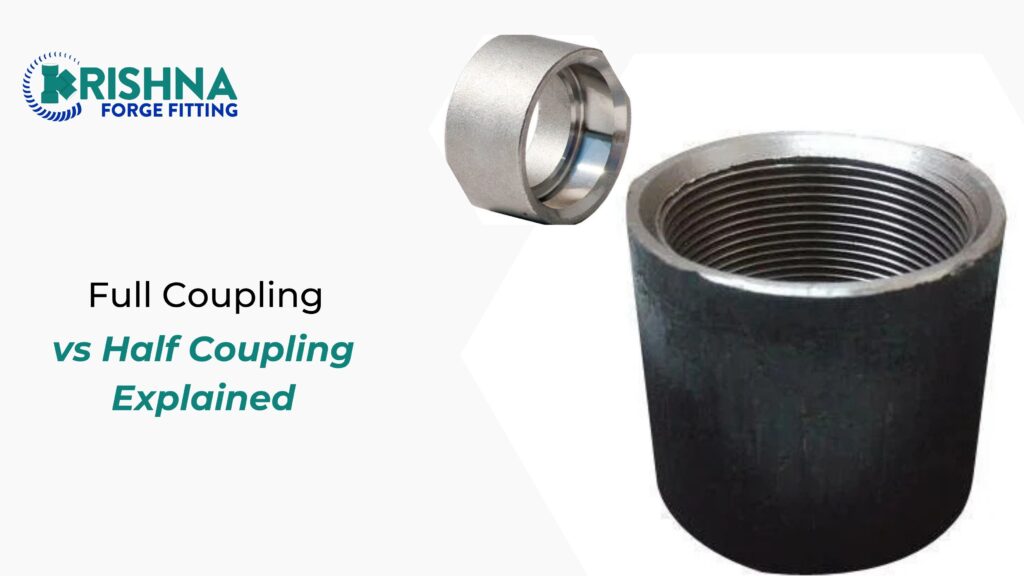
A full coupling is internally threaded or socket-welded on both ends. It joins two pipes of equal diameter in a straight in-line run—the piping equivalent of an extension piece.
Types of Full Coupling
Threaded full coupling: NPT or BSP threads on both ends; no welding required; suited to low-pressure, low-vibration utility and instrument systems.
Socket-weld full coupling: A recessed socket on each end receives the pipe; fillet welded at the shoulder per ASME B31.3; higher fatigue life and leak integrity than threaded in high-cycle service.
Full couplings are the go-to fitting for pipe extensions, repair joints, and meter run connections where two pipe sections meet on the same centreline.
What Is a Half Coupling?
A half coupling has a threaded or socket-welded opening on one end only. The other end is plain and bevelled for direct weld-on attachment to a header pipe, vessel wall, or equipment body.
Types of Half Coupling
Threaded half coupling: One end NPT or BSP; other end weld-on; creates a threaded branch outlet on any weldable surface.
Socket-weld half coupling: One end recessed socket for pipe insertion and fillet weld; other end weld-on; suits higher-pressure branch outlets on headers or vessels.
Half couplings are standard on instrument tappings, chemical injection points, vent and drain connections, and any location where a small-bore branch exits a larger-bore header.
Full Coupling vs Half Coupling
The structural difference drives every application decision:
| Feature | Full Coupling | Half Coupling |
| Connection ends | Two, both pipe-end | One pipe-end + one weld-on |
| Primary function | In-line pipe extension | Branch outlet on header or vessel |
| Weld joints required | 2 socket weld or 0 threaded | 1 weld-on end + 1 socket weld or thread |
| Typical installation | Between two pipe sections | Onto pipe body or vessel wall |
| Cost | Slightly higher, more material | Lower, less material |
A half coupling incorrectly used as a full coupling leaves one open weld-on end exposed, which must be sealed with a cap—adding a joint and a leak point.
Materials and Standards
Both types fall under ASME B16.11 for forged socket-weld and threaded configurations:
Carbon steel (ASTM A105): General service up to 400 °C; steam, oil, gas, water.
Stainless steel (ASTM A182 F304/F316): Corrosion-resistant; chemical processing, food, pharma.
Alloy steel (A182 F11/F22): High-temperature steam and hydrocarbon service above 540 °C.
Pressure Classes per ASME B16.11
Socket-weld: Class 3000, 6000, 9000
Threaded: Class 2000, 3000, 6000
Size range covers NPS ⅛ through NPS 4 for both types. Buyers who downgrade from Class 3000 to Class 2000 to save 15% per unit create the weakest point in the entire branch run—the first location to leak when system pressure spikes.
Applications
Oil and gas uses Class 6000/9000 socket-weld half couplings for chemical injection nozzles, pressure transmitter tappings, and sample points on high-pressure headers where NACE compliance is mandatory. Chemical processing specifies 316L stainless socket-weld half couplings for reactor drain and vent connections that contact acids and solvents. Power generation demands alloy-steel full couplings for superheated steam circuit extensions where thermal cycling makes threaded joints unreliable. Fire protection uses threaded carbon steel full couplings per NFPA 13 for sprinkler branch extensions where rapid installation is the priority.
Selection Guide
Four-Step Checklist
- Define the joint function: in-line pipe extension → full coupling; branch outlet on header or vessel → half coupling.
- Set pressure class: match Class 3000, 6000, or 9000 to maximum allowable working pressure and temperature.
- Choose connection method: socket weld for permanent, high-integrity, vibration-prone service; threaded for maintenance access and low-pressure utility points.
- Verify documentation: ASTM material compliance, heat numbers, ASME B16.11 dimensional conformance, mill test certificates.
One consistently overlooked step: confirm the weld-on end bore matches the host pipe OD before ordering a half coupling. A bore mismatch forces field machining, delays installation, and introduces weld distortion.
Installation and Maintenance
Threaded Installation
Apply PTFE tape or anaerobic pipe sealant; hand-tighten, then advance two full turns with a wrench. Do not overtighten—over-torquing splits the coupling body at the thread root, especially in stainless.
Socket-Weld Installation
Insert pipe to full socket depth; withdraw 1.6 mm (1/16 inch) before welding to allow thermal expansion during the fillet weld. Skipping the gap causes the pipe to push against the socket during weld cooling and cracks the root pass.
Half Coupling Weld-On
Tack-weld in position first; verify alignment before running the full fillet weld bead. For vessel-wall attachments, confirm minimum wall thickness requirements under ASME Section VIII before placing the coupling.
Quality Assurance
Before approving any coupling shipment, verify:
Material traceability: Heat numbers linking each fitting to its mill test certificate, raw billet chemistry, and mechanical properties.
Dimensional conformance: Bore diameter, wall thickness, thread gauging, and centre-to-end lengths against ASME B16.11 tolerance tables.
Hydrostatic test records: Pressure-tested to 1.5× rated pressure for Class 6000 and 9000.
Third-party inspection access: Factory audit rights for critical service or project TPI requirements.
FAQs
Can a half coupling replace a full coupling in an in-line joint?
No. A half coupling has only one pipe-connection end; the other end is designed to weld onto a flat or curved surface. Using it in-line leaves the weld-on end exposed or requires capping it, adding a joint. Always use a full coupling for straight pipe-to-pipe extensions.
Which coupling handles higher pressure—socket weld or threaded?
Socket-weld couplings in the same pressure class handle cyclic stress, vibration, and thermal shock better than threaded equivalents. Threaded couplings rely on thread interference and sealant; both degrade under repeated pressure cycles. For any system with pressure pulsation, thermal cycling, or vibration, specify socket weld.
What is the maximum size for ASME B16.11 forged couplings?
ASME B16.11 covers NPS ⅛ through NPS 4. For larger bore connections, buttweld couplings per ASME B16.9 are used. If you need a branch outlet on a large-bore header above NPS 4, specify a forged weldolet or sockolet instead of a half coupling.
Can half couplings be welded directly onto pressure vessels?
Yes, but the vessel wall thickness must support the weld without localised thinning below ASME Section VIII minimum requirements. The weld-on end bore must match the vessel wall OD contour; mismatches require machining before welding. Always confirm with the vessel manufacturer or a piping stress engineer before placement.
Conclusion
Specify full couplings for in-line pipe extensions and half couplings for branch outlets—get that distinction right before you issue the purchase order. Match pressure class to operating conditions, choose socket weld over threaded for any vibrating or high-cycle system, and request mill test certificates on every shipment.
Krishna Forge manufactures ASME B16.11 forged full and half couplings in carbon steel, stainless steel, and alloy steel—socket-weld and threaded configurations in Class 3000 through Class 9000, NPS ⅛ to NPS 4. Every coupling ships with full material traceability, dimensional inspection reports, and the mill test certificates your project documentation demands.
Need forged couplings with verified ASME compliance and fast delivery? Contact Krishna Forge at krishnaforge.com for technical data sheets, pressure-temperature ratings, and quotes on full and half couplings engineered for your exact service conditions.
