
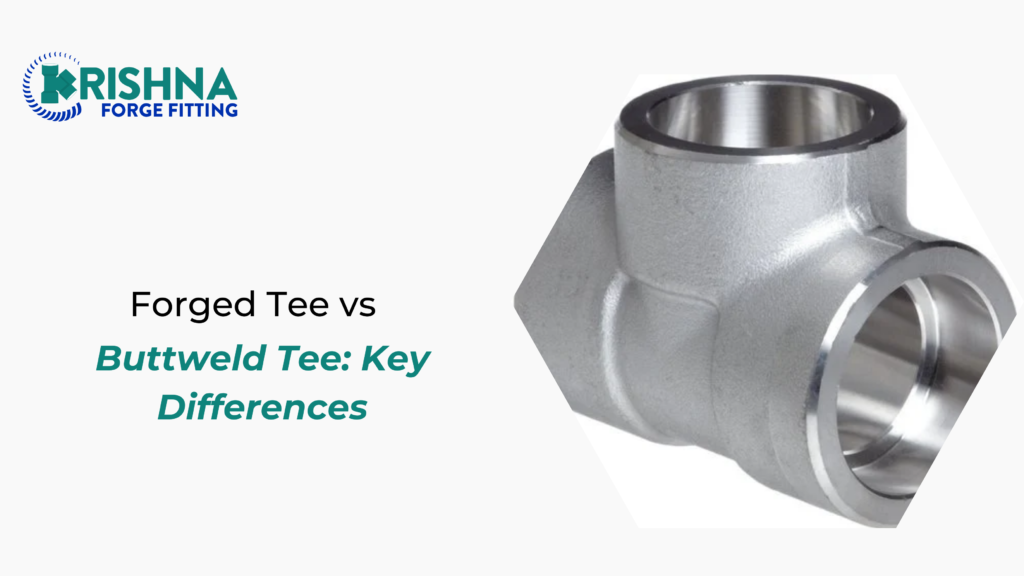
Two tees, same size, same material grade, same branch. One costs three times the other and takes four times as long to install. Buyers who treat forged and buttweld tees as interchangeable line items end up either overpaying on utility piping or under-specifying on a line that needed a full-penetration joint. The split is not about quality — both are good fittings — it is about size, pressure, inspection and what the line has to survive.
This guide sets out how each is made, where the crossover sits, and a six-point check for your next order. Krishna Forge forges tees for industrial service.
What a Forged Tee Is
A forged tee is a solid, heavy-walled fitting pressed from a steel billet in a die, then machined. The three ends are either threaded or counterbored as sockets.
- Standard: ASME B16.11
- Materials: ASTM A105 carbon steel, ASTM A182 F304/F316 stainless, plus MS and GI for utility duty
- Classes: 2000, 3000, 6000 threaded; 3000, 6000, 9000 socket weld
- Sizes: NPS 1/8″ to NPS 4″
The wall is far thicker than the pipe it connects. That thickness is where the pressure class comes from.
What a Buttweld Tee Is
A buttweld tee is formed from pipe. The run is shaped, the branch is drawn or extruded outward, and all three ends are bevelled to match the pipe they weld to.
- Standard: ASME B16.9, with MSS SP-43 for stainless and nickel alloys
- Materials: ASTM A234 WPB carbon steel, ASTM A403 WP304/WP316 stainless
- Sizes: NPS 1/2″ through 48″ and beyond
- Rating: Set by the wall schedule and material grade, not by a class number
Wall thickness matches the connecting pipe. That is the design intent — the fitting is meant to be an extension of the pipe, not a separate pressure part.
Forged Tee vs Buttweld Tee: Comparison
| Point | Forged Tee | Buttweld Tee |
| Standard | ASME B16.11 | ASME B16.9 |
| Size range | 1/8″ to 4″ | 1/2″ to 48″+ |
| Made from | Solid billet, closed die | Pipe, hot formed |
| Wall thickness | Heavy, set by class | Matches pipe schedule |
| Rating basis | Class 2000–9000 | Schedule and grade |
| End prep | Thread or socket | Bevel |
| Joint | Screwed or fillet weld | Full penetration butt weld |
| Bore | Step at socket, or thread | Smooth and continuous |
| Radiography | Not practical | Standard practice |
| Welder skill | Moderate | High |
| Cost per piece | Higher for the fitting | Lower for the fitting |
| Installed cost | Lower on small bore | Lower on large bore |
How Each One Is Made
Closed-Die Forging
A billet is heated, placed in a closed die, and pressed to shape under a press or hammer. Flash is trimmed. The part is then machined — bore, threads or socket counterbores, faces.
The value is in the grain flow. Forging bends the steel’s internal grain around the tee’s contours instead of cutting through it. At the crotch — where the branch meets the run and stress concentrates hardest — the grain follows the shape. That is why a forged tee handles pressure and fatigue better than a machined-from-solid part of identical dimensions.
Hot Forming and Hydraulic Bulge
A buttweld tee starts as pipe. The blank is placed in a die and the branch is pushed out — hydraulically, or by a punch, with the metal drawn from the run wall. The forming stretches and thins the branch, so the starting blank runs heavier than the finished size demands.
The fitting is then heat treated to restore mechanical properties, machined at the bevels, and inspected. Larger sizes may use a welded branch instead of an extruded one, which changes the NDE requirements.
Size Range and Where the Crossover Sits
The two ranges overlap from 1/2″ to 4″. That overlap is where the decision actually gets made.
- Below 2″ — forged is almost always the right answer. Bevelling and radiographing a 3/4″ butt weld is expensive and awkward.
- 2″ to 4″ — genuine crossover. The deciding factors are the service spec, the inspection requirement and whether the line vibrates.
- Above 4″ — buttweld only. Forged fittings are not made above NPS 4 in normal supply.
Pressure Rating: Class vs Schedule
This is where enquiries go wrong, so it is worth being precise.
A forged tee is rated by class — a number like 3000 or 6000 that maps to a pressure-temperature table in ASME B16.11 for the given material.
A buttweld tee has no class. It is rated by the schedule of its wall and the strength of its material, exactly like the pipe it joins. A Schedule 40 A234 WPB tee is rated to whatever Schedule 40 A234 WPB pipe is rated to, at that temperature.
So “Class 3000 buttweld tee” is not a thing. If it appears on a purchase order, someone has mixed two systems and the order needs correcting before it ships.
Joint Integrity, Flow and Inspection
Bore Continuity
A buttweld joint, properly fitted and welded, leaves a smooth continuous bore. No step, no crevice, no turbulence at the joint. For high-velocity service, erosive slurries, pigged lines and anything hygienic, that matters.
A socket weld forged tee leaves a small annular crevice at the 1/16″ expansion gap. In chloride or concentrating service, that crevice is where corrosion starts. A threaded tee has the same issue in the unengaged threads, plus a spiral leak path.
Radiography and NDE
A butt weld can be radiographed or ultrasonically tested through its full thickness. You get a real record of weld quality inside the joint.
A socket weld fillet cannot be meaningfully radiographed. Inspection is limited to surface methods — visual, magnetic particle, dye penetrant. You can prove the surface is sound. You cannot prove the root is.
For lines where a code or client requires volumetric examination of every joint, that single fact decides the fitting type. No amount of good socket welding changes it.
Installation Time, Skill and Cost
Forged, socket weld: no bevel, no root gap, no fit-up alignment jig — the socket does that. One fillet pass on small bore. Fast, forgiving, and a competent welder handles it.
Forged, threaded: no welder at all. No hot work permit. On a live plant, that is often the whole argument.
Buttweld: bevel prep, alignment, root gap, tack, root pass, fill, cap. Purge on stainless. Then NDE. A qualified welder and a qualified procedure, every joint.
The cost pattern flips with size. On a 1″ branch, the forged tee costs more but the joint costs far less, so forged wins on installed cost. On a 6″ branch, forged is not available, and even at 3″ the buttweld fitting is cheap enough that the welding labour is the only real cost.
Worth noting: contractors quoting large small-bore packages often price the fitting and forget the joint. On a skid with 200 small-bore connections, joint labour dwarfs the fitting cost, and going socket weld instead of buttweld can save more than the entire fitting budget.
Types of Tees Available in Each
Forged
- Equal tee, threaded or socket weld
- Reducing tee
- Street tee, with one male end
Buttweld
- Equal tee
- Reducing tee, branch typically two or three sizes down
- Barred tee, with an internal restriction so a pig cannot enter the branch
- Lateral tee, branch at 45°
- Cross, four-way
Choosing Between Them: A 6-Point Check
- What size is the run? Above 4″ → buttweld, decision closed.
- Does the spec require volumetric NDE on every joint? Yes → buttweld.
- Is the fluid corrosive, erosive, or does the line get pigged? Yes → buttweld, for the smooth bore.
- Can you get a hot work permit? No → threaded forged.
- Does the line vibrate? Rotating equipment nearby → buttweld if the size allows, and support the branch properly either way.
- How many joints are in the package? High joint count on small bore → forged, on installed cost alone.
Mistakes That Cost Money
- Writing “Class 3000” on a buttweld line item
- Ordering buttweld tees without stating the wall schedule
- Specifying buttweld on 1/2″ instrument lines and paying for radiography on joints nobody needed to examine
- Using socket weld on a pigged line and blocking the pig
- Mixing A234 WPB buttweld with A105 forged on the same line without checking weldability of both
- Buying without a material test report, then failing a client audit
FAQs
Which is stronger, a forged tee or a buttweld tee? The fitting bodies are both stronger than the pipe. The difference is in the joint. A full-penetration butt weld is stronger and more fatigue-resistant than a socket fillet weld or a threaded joint, so on vibrating or cyclic service buttweld wins where the size allows it.
Can I use a forged tee above 4 inch? Not in normal supply. ASME B16.11 covers forged fittings through NPS 4. Above that, buttweld to ASME B16.9 is the standard route, and it is also cheaper at those sizes.
Do buttweld tees have a pressure class? No. They are rated by wall schedule and material grade, matching the pipe. Any purchase order that puts a class number on a buttweld fitting has mixed two rating systems and should be corrected.
Why can’t socket welds be radiographed? The geometry defeats it. A fillet weld sits at an angle over a lapped joint, so the film cannot give a clean, interpretable image of the root. Surface methods like magnetic particle and dye penetrant are the accepted alternative, and they only examine the surface.
Is a reducing forged tee available in all combinations? Common reductions are stocked; unusual ones are made to order. State both sizes clearly — run size first, then branch — because a 1″ x 1/2″ and a 1/2″ x 1″ are different parts and get confused constantly.
The Bottom Line
Size decides it above 4 inches and below 2. In between, let the inspection requirement, the fluid and the joint count make the call. Forged tees buy you speed and low installed cost on small bore. Buttweld tees buy you a smooth bore, a full-penetration joint and a weld you can actually examine.
Krishna Forge manufactures forged tees — equal and reducing, threaded and socket weld — in mild steel, stainless steel and GI, with raw material checks, controlled forging, dimensional inspection and test documentation on request.
Send your run size, branch size, class, material and end type. Request a quote from Krishna Forge and get the tee your line actually needs.
