
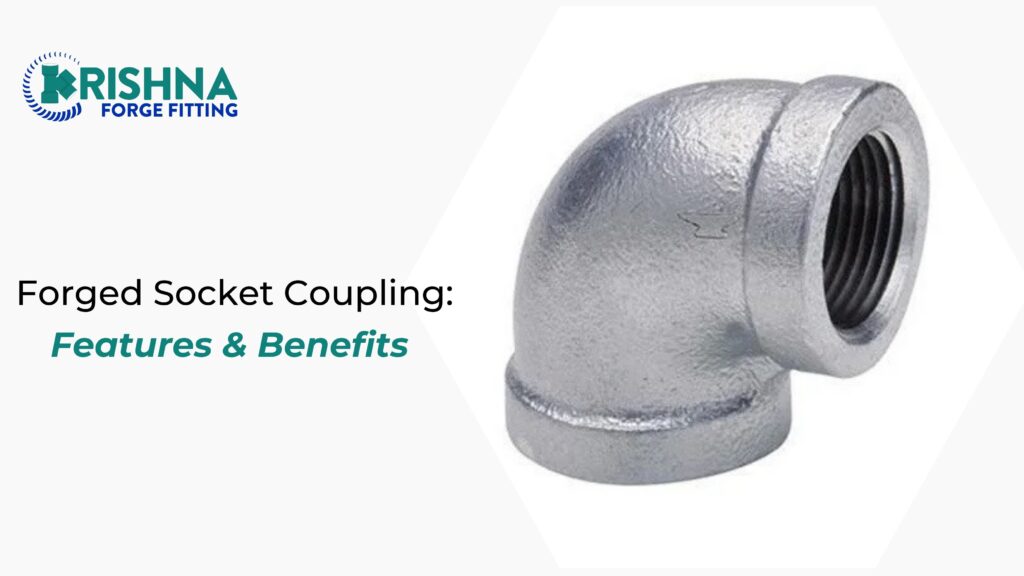
Pick the wrong coupling and you don’t find out right away. You find out weeks or months later, when a joint starts weeping fluid under pressure or a weld seam gives way during a routine inspection. By then, the fitting has already cost you a shutdown.
A forged socket coupling is built to avoid that outcome. It joins two lengths of pipe through a recessed socket end and a fillet weld, and the metal underneath that joint has been shaped, not poured, which changes how it behaves under stress.
This piece walks through what a forged socket coupling actually is, the types available, the features that set it apart, and where it earns its keep. By the end, you’ll know exactly what to look for the next time you’re specifying couplings for a high-pressure line.
What Is a Forged Socket Coupling
A socket coupling connects two pipe ends by accepting each one into a recessed opening, then sealing the joint with a fillet weld around the rim. The pipe slides in; the weld locks it in place. No threading, no gasket, no moving parts to loosen over time.
How It Differs From Threaded Couplings
Threaded couplings rely on machined threads that screw the pipe into place, which works fine for low-pressure, non-critical lines like domestic water or cooling water. Socket weld couplings skip the threads entirely and depend on a continuous weld bead instead. That weld gives you a joint with no threads to strip, corrode, or loosen under vibration — which is exactly why socket weld is the default choice once pressure or temperature climbs past the “safe to shrug off” range.
Types of Socket Couplings
Not every job calls for the same coupling. The differences here aren’t cosmetic — each type solves a specific installation problem.
- Full coupling — socket weld or threaded on both ends, used to join two pipes of the same size
- Half coupling — socket weld or threaded on one end, plain (often welded flat) on the other, commonly used for branch connections
- Reducing coupling — connects two pipes of different diameters in a single fitting
- Regular coupling — has an internal ridge that stops the pipe from being inserted too far, keeping both pipe ends evenly seated
- Slip coupling — has no internal stop, which lets it slide freely along a pipe for repairs in tight spaces where a regular coupling can’t be maneuvered into place
Picking Between Regular and Slip
Regular couplings are the default for new installations because the internal stop guarantees a predictable, even joint on both sides. Slip couplings earn their spot in repair work — a corroded section that needs cutting out, or a tight mechanical room where there’s no room to angle a regular coupling into place. The trade-off is that a slip coupling puts the burden of correct positioning on the installer, since nothing stops it from sliding too far in either direction.
Key Features of Forged Socket Couplings
The forging process is what separates these couplings from cast or fabricated alternatives, and it shows up in five concrete ways.
Grain Continuity
Forging shapes the metal under compressive force rather than pouring it molten into a mold. That compression pushes the internal grain structure to follow the shape of the coupling, aligning it along the paths where stress will actually travel. A cast coupling’s grain structure is essentially random, which means it has no built-in resistance to the load pattern it will face in service.
Lower Porosity
Cast parts cool from a liquid state, and that cooling process traps gas pockets and shrinkage voids inside the metal. Forged parts start and stay solid throughout shaping, which all but eliminates that category of internal defect. Fewer voids means fewer places for a crack to start.
Tight Dimensional Tolerances
Forged couplings hold their dimensions consistently across a production run, which matters at the socket bore — a bore that’s even slightly oversized or undersized changes how well the pipe seats before welding. Precision here isn’t a bonus feature; it’s the difference between a weld that seals cleanly and one that needs rework.
Socket-Weld End Design
The recessed socket end is machined to accept the pipe with a small clearance gap, which the fillet weld then fills and seals. This design gives you a joint that’s mechanically supported by the socket itself, not just held together by the weld bead — a meaningful difference under vibration or thermal cycling.
Material Range
Forged socket couplings are available in a wide span of materials, matched to the fluid and environment:
- Carbon steel for general-purpose, non-corrosive service
- Stainless steel and duplex steel for corrosive or high-purity applications
- Alloy steel for elevated temperature service
- Nickel-based alloys (Inconel, Monel, Hastelloy) for extreme corrosion or high-temperature environments
Benefits of Forged Socket Couplings
Strength and Fatigue Resistance
The aligned grain structure gives forged couplings measurably better fatigue resistance than cast equivalents, which matters most in systems with frequent pressure cycling rather than one sustained load. A pipeline that pressurizes and depressurizes repeatedly puts more wear on a fitting than a line running at constant pressure — and that’s precisely the scenario forged couplings are built to outlast.
Leak-Proof Sealing
The socket weld joint creates a continuous, fused seal around the entire circumference of the pipe, removing the small gaps and thread clearances that give threaded joints their leak potential.
Corrosion Resistance
Matched to the right material grade, forged couplings resist the corrosive attack of process chemicals, seawater, or high-purity fluids over years of continuous service.
Lower Maintenance Burden
Fewer leaks translate directly into fewer emergency repairs, less unplanned downtime, and fewer safety incidents tied to fluid escape.
Applications
Forged socket couplings show up wherever a joint failure isn’t an option:
- Oil and gas pipelines, where pressure surges are a routine operating condition
- Power generation, in high-pressure steam and condensate lines
- Chemical processing, where corrosive media punish any weak seal immediately
- Instrumentation and small-bore piping, where compact, reliable connections matter more than raw throughput
Standards and Specifications
Forged socket couplings are manufactured to ASME B16.11, which governs dimensions, tolerances, and pressure-temperature ratings. Common pressure classes are 3000 LB, 6000 LB, and 9000 LB, and sizes typically range from 1/8 inch up to 4 inches in diameter. Buyers should confirm the pressure class matches actual operating conditions, not just the nominal line size.
FAQs
What’s the difference between a full coupling and a half coupling? A full coupling has a socket or thread on both ends and joins two pipes of the same size. A half coupling has a socket or thread on one end and a plain end on the other, typically used for branch or outlet connections.
Can a forged socket coupling be reused after removal? Generally, no. Removing a welded coupling usually damages the socket end, and re-welding a compromised joint introduces the same defect risk the forging process was meant to avoid.
What size gap is left between the pipe and socket before welding? Standard practice leaves a small gap, often around 1/16 inch, to allow for thermal expansion and to give the weld metal proper penetration.
Do forged socket couplings work with high-temperature steam lines? Yes, provided the material grade is rated for the service temperature — alloy steel and stainless steel grades are common choices for high-temperature steam and condensate systems.
How do I confirm a coupling was actually forged and not cast? Ask the supplier for mill test certificates, heat numbers, and forging process documentation. Radiography or dye-penetrant test reports add further confirmation that the part is free of internal defects.
The Bottom Line
A forged socket coupling costs more to specify correctly than a cast or threaded alternative, and it pays that difference back the first time a pressure cycle would have cracked something weaker. Match the type, material, and pressure class to your actual operating conditions, and the coupling stops being a maintenance item.
At Krishna Forge, we manufacture forged socket couplings with verified material traceability and tight dimensional control, built for systems where a failed joint isn’t an acceptable outcome. If you’re specifying couplings for your next project, talk to our team or browse our current stock to find the right fit.
