
Introduction
Most procurement teams focus on price when sourcing pipe fittings. This creates a race to the bottom where manufacturers cut corners on raw material quality, skip heat treatment steps, or machine fittings to loose tolerances. The result: fittings that leak under pressure, crack during thermal cycling, or fail hydrostatic testing.
Forged pipe fittings cost 15-25% more than cast alternatives but deliver 3-5x longer service life in high-pressure applications. The grain structure created during forging eliminates porosity and weak points that plague cast fittings. India has emerged as a global hub for forged fittings manufacturing, combining metallurgical expertise with cost advantages and export infrastructure.
This guide explains what separates reliable forged fittings manufacturers from generic suppliers. You’ll learn the manufacturing process that creates superior fittings, which material specifications matter, and evaluation criteria that expose quality shortcuts. By the end, you’ll know how to source forged fittings in India without compromising on reliability or delivery schedules.
Types of Forged Pipe Fittings
Socket Weld and Threaded Connections
Forged fittings come in two connection types: socket weld and threaded. Socket weld fittings suit high-pressure piping systems where leak integrity is critical. Threaded fittings allow disassembly for maintenance but have lower pressure ratings.
Common Fitting Types
- Elbows (45°, 90°): Change flow direction with minimal pressure drop
- Tees (Equal, Reducing): Split or combine flow streams
- Couplings (Full, Half): Connect pipe sections or attach branches
- Reducers: Transition between different pipe sizes
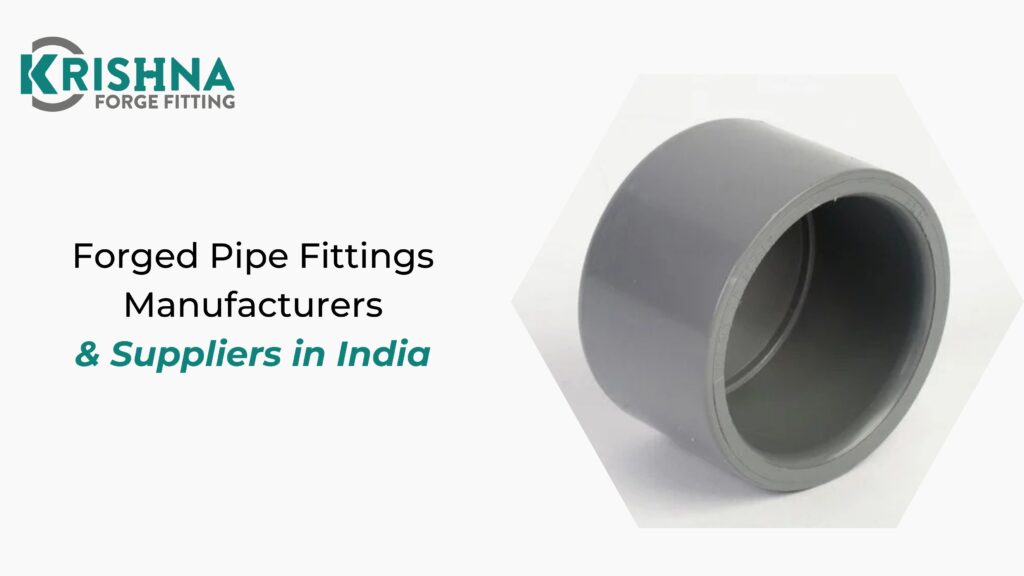
- Caps and Plugs: Seal pipe ends permanently or temporarily
- Crosses: Four-way branch connections (less common due to stress concentration)
- Unions: Enable disconnection without cutting pipe
Pressure classes range from 2000# to 9000#, with higher classes requiring thicker walls and tighter dimensional tolerances.
The Forging Manufacturing Process
Raw Material Selection
Quality forged fittings start with certified bar stock meeting ASTM specifications. Manufacturers who source from unknown foundries or recycle scrap metal produce fittings with inconsistent chemical composition and unpredictable mechanical properties.
Heating and Forging
The steel is heated above its recrystallization temperature (typically 1100-1200°C for carbon steel) to make it malleable. Forging presses apply controlled pressure to shape the metal, aligning grain structure and eliminating internal voids.
Hot forging creates continuous grain flow that follows the fitting contours. This grain structure resists crack propagation and fatigue—advantages that casting can never replicate.
Heat Treatment
After forging, fittings undergo normalizing or quench-and-temper heat treatment. This process refines grain structure, increases strength, and improves toughness. Manufacturers who skip heat treatment produce soft fittings that deform under pressure.
Machining and Finishing
Fittings are machined to final dimensions—socket depth, thread profile, and face finishes must meet ASME B16.11 tolerances. CNC machining ensures consistency. Manual machining introduces dimensional variation that causes fit-up problems in the field.
Quality Control
Legitimate manufacturers perform ultrasonic testing to detect internal defects, magnetic particle inspection for surface cracks, and hydrostatic testing to verify pressure integrity. Each fitting receives dimensional verification before shipping.
Material Specifications That Matter
Carbon Steel (ASTM A105)
The workhorse material for oil and gas, power generation, and general industrial piping. ASTM A105 forgings handle temperatures from -29°C to 425°C and pressures up to 6000 PSI depending on class and size.
Stainless Steel (ASTM A182)
Grades F304, F316, F321, and F347 resist corrosion in chemical processing, food production, and marine environments. F316 contains molybdenum for superior pitting resistance in chloride service.
Duplex and Super Duplex
F51, F53, and F55 grades combine high strength with excellent corrosion resistance. These alloys cost 3-4x more than 316 stainless but eliminate failures in sour gas, seawater injection, and chlor-alkali applications.
Nickel Alloys
Hastelloy, Inconel, and Monel handle extreme corrosion and high temperatures where steel fails. These exotic alloys suit refineries, aerospace, and chemical plants processing aggressive media.
Standards and Certifications
ASME B16.11 governs dimensions, tolerances, pressure-temperature ratings, and testing requirements for forged socket weld and threaded fittings. MSS SP-79, SP-83, and SP-97 provide additional specifications for materials and design.
ISO 9001 certification indicates documented quality processes. Pressure Equipment Directive (PED) certification allows sale into European markets. Indian Boiler Regulations (IBR) approval suits domestic power and steam applications.
Material test certificates (MTCs) trace raw material composition and mechanical properties. Third-party inspection (TPI) by agencies like Lloyd’s, Bureau Veritas, or TÜV adds independent verification for critical projects.
How to Evaluate Indian Manufacturers
Manufacturing Infrastructure
Visit the facility or request detailed documentation. Check for forging presses (not just machining centers), heat treatment furnaces with temperature controls, and in-house inspection equipment. Manufacturers who outsource forging can’t control metallurgical quality.
Material Traceability
Request mill test certificates with every quote. Verify heat numbers, chemical composition, and mechanical properties match specification requirements. Manufacturers without full traceability source from unknown suppliers.
Delivery Track Record
Indian manufacturers typically quote 4-6 weeks for standard forged fittings and 8-10 weeks for exotic alloys. Suppliers who consistently miss deadlines lack production planning or raw material inventory.
Export Experience
Manufacturers with export experience understand documentation requirements, packaging standards, and international quality expectations. Those serving only domestic markets may lack the systems needed for overseas shipments.
Conclusion
Forged pipe fittings from Indian manufacturers offer the combination of metallurgical quality, dimensional precision, and cost advantage that global projects require. Manufacturing capability—forging, heat treatment, and inspection infrastructure—separates reliable suppliers from traders.
Verify certifications, request material test certificates, and check manufacturing infrastructure before ordering. The cheapest fitting becomes expensive when it fails pressure testing or causes field rework.
Ready to source forged pipe fittings from a verified Indian manufacturer? Request detailed technical documentation and material certificates before placing your order.
Krishna Forge manufactures precision forged pipe fittings—socket weld and threaded—in carbon steel (ASTM A105), stainless steel (ASTM A182), duplex, and nickel alloys. Our in-house forging, heat treatment, and CNC machining facilities ensure dimensional accuracy, grain structure integrity, and material traceability per ASME B16.11 and MSS standards. With ISO 9001 certification and third-party inspection capabilities, we deliver forged fittings for oil and gas, chemical processing, power generation, and heavy industry worldwide.
Need forged pipe fittings with verified material properties and dimensional precision?
Visit krishnaforge.com to review our fitting specifications, material grades, pressure classes, and export capabilities. Get forged fittings engineered for high-pressure service—with full traceability and testing that ensures reliability from day one.
