
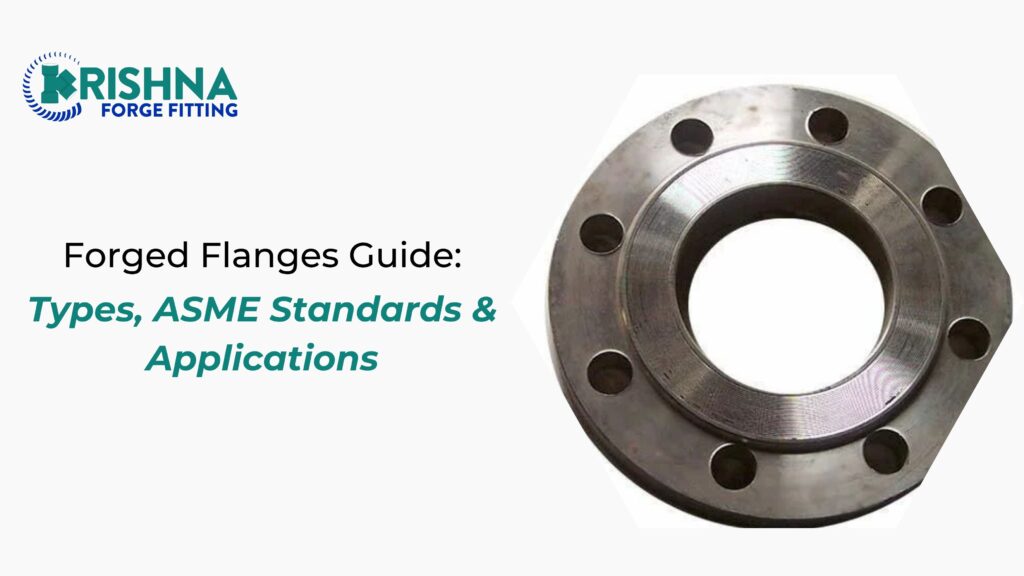
Flange selection errors don’t show up immediately. A weld neck flange substituted with a slip-on to cut costs survives commissioning, then fatigue-cracks under thermal cycling six months into production. A Class 150 flange specified where Class 300 was required holds pressure at ambient temperature, then leaks the first time the system heats up.
Most flange failures in industrial piping trace back to under-specified components—wrong type for the loading condition, wrong pressure class for the operating temperature, or wrong material for the process fluid. Forged flanges eliminate the porosity and weak grain structure that plague cast alternatives, but only when correctly selected and properly installed.
This guide covers every forged flange type governed by ASME B16.5 and B16.47, explains pressure-temperature ratings, and maps material grades to industry applications. By the end, you’ll know which flange type your system requires, which ASTM material specification applies, and how to avoid the specification errors that cause premature failures.
What Are Forged Flanges
A forged flange is a pressure-containing component manufactured by applying compressive force to heated steel billets, creating a continuous grain structure that eliminates internal voids. This grain flow follows the flange contours, making forged flanges significantly stronger and more fatigue-resistant than cast alternatives of the same dimensions.
Forging also produces tighter dimensional consistency. Cast flanges shrink unevenly as they cool, creating dimensional variation that complicates bolt hole alignment and gasket seating. Forged flanges machine to tighter tolerances, reducing fit-up problems in the field.
The performance gap between forged and cast matters most in high-pressure, high-temperature, or cyclic service. For low-pressure water systems, cast flanges are adequate. For oil and gas, chemical processing, and power generation, forged flanges are the baseline specification—not an upgrade.
Types of Forged Flanges
Weld Neck Flanges
The tapered hub transitions stress gradually from the pipe to the flange body, making weld neck flanges the correct choice for high pressure, thermal cycling, and bending loads. The full penetration butt weld creates a joint as strong as the pipe itself. Weld neck flanges cost more and require precise fit-up, but they’re the only type that handles demanding service reliably over the long term.
Slip-On Flanges
Slip-on flanges slide over the pipe and weld at both faces. They’re easier to align and faster to install, but the double fillet weld is weaker than a butt weld. Use slip-ons for low-pressure, non-cyclic service—water lines, HVAC, and utilities.
Socket Weld Flanges
Socket weld flanges suit small bore high-pressure lines (typically NPS 2 and below). The pipe inserts into a recessed socket with a mandatory 1.6mm expansion gap before the fillet weld is applied. Skipping the gap causes thermal expansion to crack the root of the weld.
Blind Flanges
Blind flanges seal pipe ends and vessel openings. They must resist full system pressure acting across their entire face, making them thicker and heavier than other flange types at the same class. They also serve as access points for cleaning, inspection, or future expansion.
Other Key Types
- Threaded flanges: Attach without welding; suited to small bore instrument lines and no-hot-work zones
- Lap joint flanges: Rotate freely on stub ends for easy bolt hole alignment; reduce alloy material cost in expensive piping systems
- Orifice flanges: Include tapped pressure ports for flow measurement instruments
- Reducing flanges: Transition pipe size and flange size in one component
- Long weld neck flanges: Extend the neck for nozzle connections on vessels and columns
ASME Standards for Forged Flanges
ASME B16.5 governs forged flanges from NPS ½ through NPS 24 across six pressure classes: 150, 300, 600, 900, 1500, and 2500. The standard specifies dimensions, tolerances, facing types, bolt patterns, and pressure-temperature ratings for each material group.
ASME B16.47 covers large diameter flanges from NPS 26 through NPS 60 in two series. Series A follows MSS SP-44 dimensions. Series B follows API 605 dimensions. Confirm which series your mating equipment uses before ordering—bolt patterns differ between them.
Material specifications attach to flange grades. ASTM A105 covers carbon steel forgings for ambient and moderate temperature service. ASTM A182 covers alloy and stainless steel forged flanges, with specific grades for each alloy: F304, F316, F51 (duplex), F53 (super duplex), and P-grades for elevated temperature service.
ASTM A350 applies to carbon and low-alloy steel flanges requiring impact testing for low-temperature service—LF1, LF2, and LF3 grades cover progressively lower minimum design temperatures.
Pressure Classes Explained
Pressure class is not the pressure rating. Class 150 carbon steel flanges handle 285 PSI at 38°C but only 75 PSI at 425°C. Every class de-rates as temperature rises, and the de-rating curve differs by material group. Stainless steel maintains higher pressure ratings at elevated temperatures than carbon steel of the same class.
Size also affects ratings independently of class. Larger diameter flanges have reduced thickness-to-diameter ratios that lower allowable pressure. A Class 300 flange rated for 720 PSI at NPS 2 carries lower pressure in NPS 20 at the same temperature.
Always verify pressure-temperature ratings using actual operating temperature, not ambient or nameplate values.
Flange Facing Types
- Raised face (RF): Most common; raised rim concentrates gasket seating stress for reliable sealing across most services
- Flat face (FF): No raised area; required with cast iron or glass-lined equipment where raised face contact would cause cracking
- Ring type joint (RTJ): Metal ring gasket in a machined groove; handles extreme pressure and temperature in API oil and gas applications
Mixing facing types creates sealing problems. Bolting an RF flange against an FF flange concentrates load on the raised area only, distorting the mating flange and producing leak paths.
Materials for Forged Flanges
Carbon steel (ASTM A105) dominates oil and gas, power generation, and general industrial applications. It welds easily and costs less than alloys, handling service from -29°C to 425°C.
Stainless steel grades F304 and F316 resist corrosion in chemical processing, food production, and marine environments. F316 adds molybdenum, providing superior chloride pitting resistance over F304 at a 20-30% cost premium.
Duplex (F51) and super duplex (F53) stainless steel combine high strength with exceptional resistance to stress corrosion cracking in chloride environments where austenitic grades fail. These alloys cost 3-4x more than 316 stainless but eliminate premature failures in offshore, seawater injection, and sour service.
Nickel alloys—Hastelloy, Inconel, Monel—handle the most aggressive media: concentrated acids, high-temperature corrosive gases, and environments that destroy steel in hours.
Manufacturing Process
- Billet selection and testing: Certified raw material with verified chemistry and mechanical properties forms the starting point; non-certified material produces flanges with unpredictable strength
- Heating and press forging: Steel heated above 1100°C becomes malleable; forging presses shape it while aligning grain flow with contours
- Heat treatment: Normalising or quench-and-temper refines grain structure and achieves specified mechanical properties; skipping this step produces soft flanges that deform under bolt load
- CNC machining: Facing, bore, and bolt holes machined to ASME B16.5 tolerances; manual machining introduces dimensional variation that compromises gasket seating
- Inspection and testing: Dimensional verification, hardness testing, and hydrostatic pressure testing before release
Applications by Industry
Oil and gas operations specify weld neck flanges in carbon and alloy steel across wellheads, Christmas trees, and process piping. RTJ facing dominates high-pressure applications.
Chemical and petrochemical plants use stainless steel and exotic alloy flanges where process fluids corrode carbon steel. Material selection follows fluid compatibility data, not generic corrosion ratings.
Power generation plants specify alloy steel P-grades for high-temperature steam lines. Carbon steel creeps under sustained heat above 425°C—alloy grades maintain strength where carbon steel fails.
Refineries combine multiple material grades across different service units. Hydrogen service requires special consideration for hydrogen embrittlement, influencing both material grade and heat treatment requirements.
Conclusion
Forged flanges require correct specification across four dimensions: type, pressure class, facing, and material. Weld neck for demanding service, slip-on for utilities. Class matched to actual temperature, not just pressure. Facing consistent across mating surfaces. Material matched to both temperature and fluid chemistry.
ASME B16.5 and B16.47 set the baseline requirements. ASTM material specifications define what goes into each flange. Together they create a specification framework that prevents failures—but only when applied to actual operating conditions, not nominal design values.
Review your current flange specifications and verify that type, pressure class, and material grade match your actual operating temperature and fluid chemistry. A single under-specified flange creates the weakest point in your entire piping system.
Krishna Forge manufactures precision-forged flanges—weld neck, slip-on, blind, socket weld, threaded, lap joint, and orifice types—in carbon steel (ASTM A105, A350), stainless steel (ASTM A182 F304, F316, duplex, super duplex), and alloy steel grades. Our flanges meet ASME B16.5 and B16.47 dimensional standards across all pressure classes from 150 to 2500, with raised face, flat face, and RTJ facing options. Every flange ships with full material traceability, heat treatment records, and dimensional inspection certificates.
Need forged flanges with verified pressure-temperature ratings and complete material certification? Visit krishnaforge.com to review flange specifications, material grades, pressure classes, and facing options. Get forged flanges engineered to your exact service conditions—backed by technical support that ensures correct specification from design through installation.
