Piping engineers swap equal tees for reducing tees and vice versa more often than any other fitting substitution—and a significant share of those swaps cause flow imbalances, pressure problems, or installation complications that a correct initial specification would have avoided. The mistake rarely surfaces immediately; it shows up months later as uneven flow distribution, excess turbulence, or damaged downstream equipment.
The choice between equal tees and reducing tees depends on three concrete variables: whether branch and run diameters match, how much flow pressure drop the system tolerates, and whether the installation space accommodates additional reducers if the wrong tee type is selected. Getting this wrong doesn’t just affect one joint—it ripples through pressure calculations, pump sizing, and flow balance across the entire distribution network.
Here’s the uncomfortable reality: most procurement teams default to equal tees because they’re simpler to stock and specify, then add separate reducers downstream to handle size transitions. This approach adds joints, increases leak points, and raises installed cost above what a correctly specified reducing tee would have cost in the first place.
This guide breaks down the structural differences, flow behavior, application fit, and selection criteria for both tee types so you specify the right fitting the first time.
Key Design Differences
Outlet Configurations
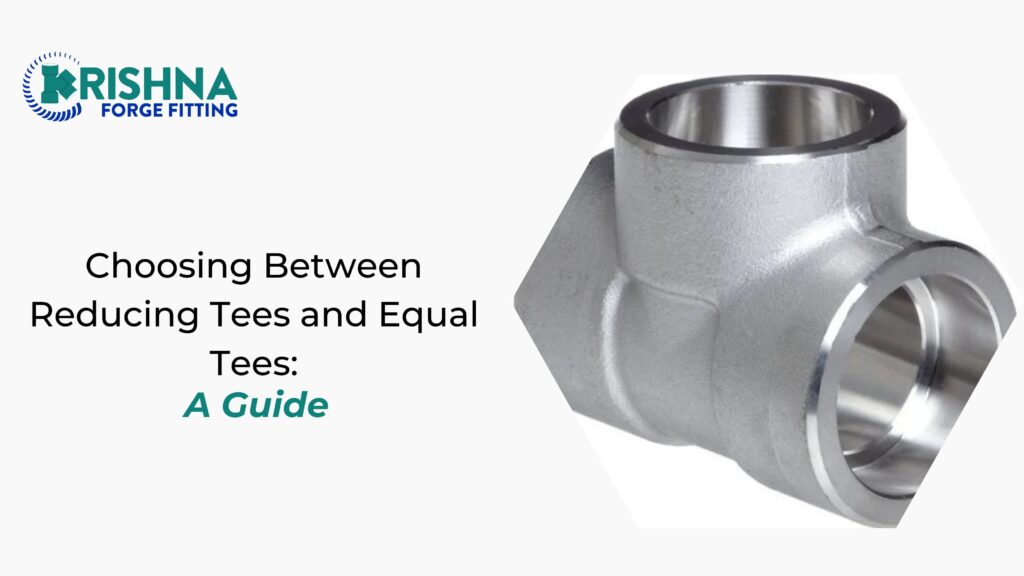
An equal tee connects three pipes of identical diameter—run inlet, run outlet, and branch outlet all share the same nominal size. Flow splits or combines without any cross-sectional area change at the junction.
A reducing tee features a branch outlet smaller than the run diameter. The run ports maintain their original size while the branch transitions to a specified smaller pipe size in a single fitting. Reducing tees are designated by three dimensions—run inlet × run outlet × branch—such as 4″ × 4″ × 2″.
Flow Dynamics and Pressure Drop
Equal tees distribute flow symmetrically when the split ratio approaches 50/50. Pressure drop through the branch leg runs 20-40% higher than through the straight run due to directional change losses, regardless of tee type.
Reducing tees add velocity increase at the branch because the same volumetric flow passes through a smaller cross-section. This velocity increase raises local pressure drop at the branch connection. In systems where branch flow represents less than 30% of total flow, this effect stays manageable. Higher branch flow fractions make the pressure penalty more significant.
Dimensional Characteristics
Equal tees maintain consistent center-to-end dimensions across all three ports. Reducing tees have a shorter center-to-end dimension on the branch side, reflecting the smaller outlet size. This dimensional difference affects installation clearance calculations, particularly in congested pipe racks where space planning relies on standardized fitting dimensions.
Advantages of Equal Tees
Where Equal Tees Perform Best
Equal tees deliver clear advantages in specific conditions:
- Uniform flow splitting: Manifold systems distributing equal flow to parallel branches perform best with equal tees that maintain consistent resistance across all outlets
- High-velocity service: Full-bore branch openings minimize turbulence and erosion in slurry, steam, and high-velocity gas lines
- Inventory simplicity: Single-size fittings reduce stocking requirements and procurement complexity for large installations with consistent pipe sizes throughout
- Symmetrical system design: Balanced HVAC loops, irrigation headers, and fire suppression rings use equal tees to maintain flow symmetry without additional balancing components
Advantages of Reducing Tees
Where Reducing Tees Deliver Value
Reducing tees consolidate what would otherwise require two fittings—an equal tee plus a separate reducer. This combination creates one joint instead of two, reducing potential leak points by 50% at each size transition location.
The space savings matter in confined installations where additional fitting length is unavailable. Instrument connections, sample points, and small-bore branch lines on large process headers routinely use reducing tees rather than full-bore equal tees with downstream reducers.
Key advantages in practice:
- Component count reduction: Each reducing tee eliminates one separate reducer fitting and two weld joints from the installation
- Precise flow extraction: Small branch taps for instruments, chemical injection, and sample lines match the branch pipe size without oversizing the connection
- Cost efficiency at scale: In large process plants with hundreds of size transitions, reducing tees cut total fitting costs by 15-25% compared to equal tee plus reducer combinations
- Cleaner piping layout: Fewer fittings between flow branch points produce more compact piping that’s easier to insulate, support, and maintain
Applications by Industry
Plumbing and Water Supply
Residential and commercial plumbing uses reducing tees wherever main distribution lines feed smaller branch lines to fixtures. A 2″ main supplying ½” fixture branches uses reducing tees throughout rather than equal tees with multiple reducers that would add length and cost to every connection point.
Equal tees dominate in balanced ring main systems and fire suppression headers where consistent pressure across all outlets determines system performance.
HVAC and Irrigation
HVAC chilled water and heating hot water systems use equal tees in reverse return configurations that balance flow through parallel coils. Reducing tees appear at zone takeoffs where main headers supply smaller branch circuits serving individual air handlers or terminal units.
Irrigation mainlines use reducing tees to connect lateral lines without interrupting the hydraulic gradient along the main pipe run.
Chemical Processing and Industrial
Process piping uses reducing tees for instrument taps, analyzer connections, and chemical injection points on large-bore process lines. A 10″ process line feeding a ½” analyzer sample point uses a reducing tee that transitions in one fitting rather than an equal tee with nine sizes of reducers downstream.
High-pressure chemical service requires reducing tees manufactured to ASME B16.11 or MSS SP-97 standards. These standards govern dimensional accuracy, wall thickness, and pressure ratings that generic fittings may not meet.
Material and Manufacturing Considerations
Common Materials and Standards
Tee fittings across both types come in overlapping material ranges matched to service requirements:
- Carbon steel (ASTM A234 WPB): General service to 750°F in oil, gas, and steam
- Stainless steel (304/316): Corrosive chemicals, food, pharmaceutical, and cryogenic service
- Ductile iron: Water, HVAC, and moderate-pressure industrial service
- Alloy steel (P11, P22, P91): High-temperature power generation and refinery service
Quality Factors
Wall thickness consistency determines pressure capacity in tee fittings. Undersized wall thickness at the branch crotch region—where stress concentrations peak—creates the most common quality failure mode. Request radiographic inspection certificates for high-pressure tees rather than accepting dimensional compliance alone.
Selection Criteria
Flow and Sizing Requirements
Follow this decision sequence:
- Confirm branch pipe size relative to run pipe size
- If branch equals run size → specify equal tee
- If branch is smaller than run → specify reducing tee with exact dimensions
- Calculate pressure drop through branch leg for both options at design flow rates
- Verify fitting dimensions fit available installation space before finalizing specification
Pressure and Temperature Ratings
Both tee types follow the same pressure-temperature rating tables within a given material grade and schedule. A Schedule 80 carbon steel reducing tee rates identically to a Schedule 80 equal tee in the same nominal pipe size. Branch size reduction doesn’t reduce run pressure capacity in properly manufactured fittings.
Frequently Asked Questions
Can I use an equal tee with a cap on the branch as a temporary solution?
Yes, but it adds unnecessary flow disturbance and dead leg volume that promotes corrosion and bacterial growth in water service. Specify the correct fitting for permanent installations. Equal tees with capped branches are acceptable for future branch connections only when the branch will be opened later.
Do reducing tees cost more than equal tees of equivalent run size?
Reducing tees typically cost 10-20% more than equal tees in the same run size due to more complex tooling required for the offset branch geometry. This premium disappears when you factor in the cost of the separate reducer fitting that an equal tee installation would require.
What’s the maximum size reduction ratio for reducing tees?
Standard reducing tees accommodate branch reductions down to approximately 25% of run diameter in most standards. More extreme reductions require special fittings or saddle-type connections. For very small branches on large headers—such as ½” on a 12″ run—weldolet or threadolet type fittings handle the geometry more reliably than reducing tees.
Specify the Right Tee Before Ordering
Equal tees and reducing tees serve distinct functions that overlap only in specific size combinations. Verify branch versus run dimensions before specifying and calculate pressure drop implications for your flow rates and system pressure budget.
Request dimensional certifications and material test reports for pressure-rated tee fittings rather than accepting catalog specifications as sufficient quality documentation.
Krishna Forge Fittings manufactures precision-cast equal tees and reducing tees in ductile iron, cast iron, carbon steel, and stainless steel across standard ASME and MSS dimensional specifications. Our casting facility delivers consistent wall thickness, smooth internal surfaces, and accurate branch geometry verified through CMM inspection on every production lot.
We supply both standard catalog sizes and custom reducing tee configurations for specialized applications where standard size combinations don’t match system requirements. Every fitting ships with dimensional inspection data and material certifications on request.
Need tee fittings for your piping project? Contact our technical team with your pipe sizes, pressure ratings, material specifications, and volume requirements. We’ll recommend the correct fitting type and provide detailed quotations with quality documentation.
