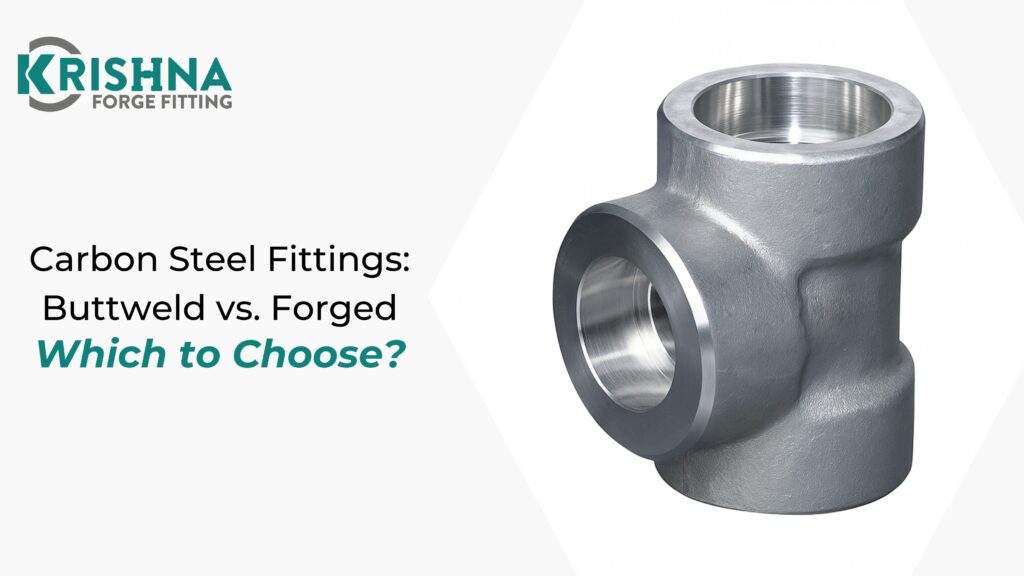
The million-dollar question that keeps procurement engineers awake at night: when the pressure’s on—literally—which carbon steel fitting configuration delivers the goods? Here’s the uncomfortable truth: most piping systems rely on buttweld fittings for their ability to maintain the strength of the piping system due to continuous metal material, yet forged fittings dominate high-pressure applications for reasons that go beyond marketing hype.
The Pressure Point: Where Physics Meets Economics
Forged fittings crush the competition when pressure ratings matter. They’re less likely to crack compared to other types of steel, which is why they’re often used in applications requiring strength. The forging process creates a grain structure that’s fundamentally different from welded alternatives—imagine the difference between a solid oak beam and plywood under stress.
But here’s where it gets interesting: buttweld fittings can keep the strength of the piping system due to continuous metal material. The seamless integration means no weak points where different materials meet. It’s engineering elegance in action.
The breakdown that matters:
- Forged fittings: Handle pressures up to 6,000 PSI with surgical precision
- Buttweld fittings: Excel in large-diameter applications where flow dynamics rule
- Cost differential: Forged runs 20-40% higher, but the pressure tolerance often justifies the premium
Manufacturing Reality Check: Why Process Matters More Than Price
Carbon steel forged fittings are less machineable than other carbon grades but have strong corrosion-resistant characteristics. The forging process work-hardens the material, creating a crystalline structure that resists failure under cyclic loading. Think of it as molecular-level insurance.
Buttweld fittings take a different approach entirely. The buttwelded fittings are stronger and can be used for welding with ease. The seamless welding process eliminates joint stress concentrations that plague threaded connections. For pipeline applications where flow consistency matters, this approach delivers measurable performance gains.
The Hidden Cost Calculator
Smart procurement teams know that upfront pricing tells only half the story. Cost-saving by using buttweld fittings instead of threaded or socket weld fittings becomes significant when you factor in installation time and long-term maintenance.
Here’s the tactical reality:
- Installation speed: Buttweld fittings require skilled welders but eliminate threading time
- Maintenance cycles: Forged fittings handle thermal cycling better, reducing replacement frequency
- Inventory management: Standardizing on one type reduces stock complexity
Application Intelligence: Matching Fittings to Function
These metals have excellent strength and corrosion resistance properties, making them ideal for use in industrial applications such as oil and gas pipelines. But the devil lives in the application details.
When forged fittings dominate:
- High-pressure steam systems (above 1,500 PSI)
- Compact installations where space constraints matter
- Applications requiring frequent disassembly for maintenance
When buttweld fittings excel:
- Large-diameter pipelines (6 inches and above)
- Long-run installations where flow efficiency matters
- Systems where welding quality control is already established
The Krishna Forge Advantage: Engineering Excellence in Action
At Krishna Forge Fitting, we manufacture both configurations because we understand that engineering excellence demands options. Our forged fittings undergo rigorous quality control that ensures pressure ratings are met consistently, while our buttweld solutions deliver the seamless integration that modern piping systems demand.
The difference lies in manufacturing precision. Our forged fittings utilize controlled heating and shaping processes that optimize grain structure for maximum strength. For buttweld applications, we ensure dimensional accuracy that eliminates fit-up issues during installation.
The Decision Framework: Beyond Technical Specifications
The choice between buttweld and forged isn’t just technical—it’s strategic. While Carbon Steel Buttweld Fittings offer smooth flow, strength, and cost advantages, Forged Fittings provide excellent pressure handling and compactness.
Consider these decision drivers:
- System pressure requirements: Above 2,000 PSI, forged fittings provide superior reliability
- Installation constraints: Tight spaces favor forged; long runs favor buttweld
- Maintenance philosophy: Forged fittings offer better serviceable connections
The Verdict: Strategic Selection Over Generic Solutions
Here’s the insight that separates sharp procurement from penny-wise decisions: the best fitting choice depends on your specific application parameters, not industry generalizations. Selecting the perfect Carbon Steel Butt Weld Pipe requires considering factors like size, grade, and pressure ratings for optimal performance.
The companies that win understand this nuance. They don’t choose fittings based on price alone—they optimize for total system performance. Whether you need the pressure-handling capability of forged fittings or the flow efficiency of buttweld solutions, the key is matching the technology to your specific application requirements.
At Krishna Forge Fitting, we supply both configurations because we know that one size doesn’t fit all. Our manufacturing expertise ensures that whether you choose forged or buttweld, you’re getting fittings that deliver consistent performance under real-world conditions.
The smartest procurement decision? Partner with suppliers who understand that fitting selection is system engineering, not commodity purchasing.
