Carbon steel elbows carry most of the world’s oil, gas, steam and water around corners. They are strong, weldable and affordable. They are also easy to get wrong. The same 2-inch 90° elbow can be specified in four grades, three schedules, two radii and four end types. Each combination suits a different job, and only a few suit yours.
This guide explains carbon steel elbow types, grades, standards and schedules, compares carbon steel with stainless steel, and gives a step-by-step selection method.
What Is a Carbon Steel Elbow
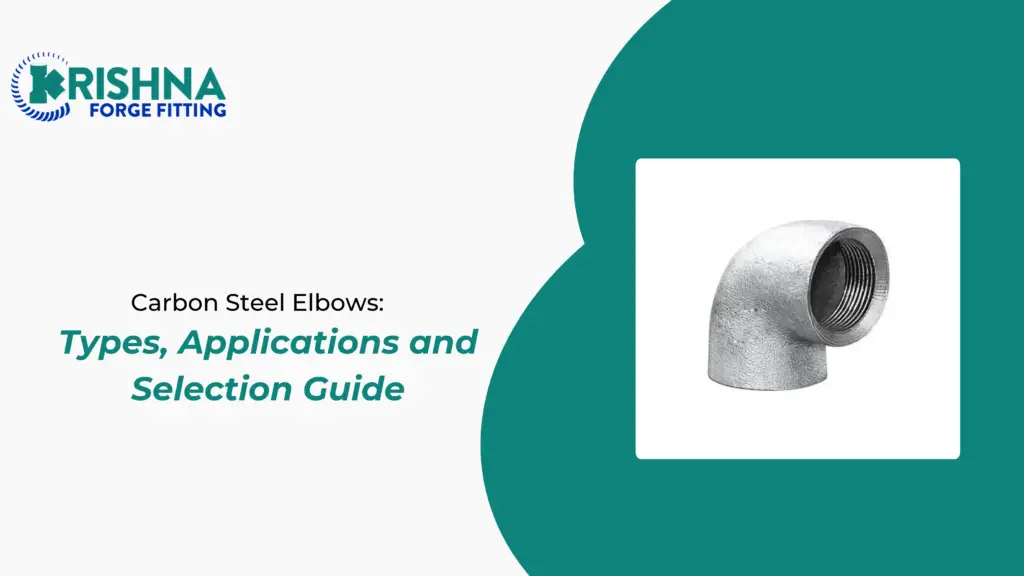
A carbon steel elbow is a pipe fitting made from steel with carbon as its main alloying element. It changes the direction of flow in a piping system, usually by 45° or 90°. Carbon steel elbows are made as butt weld fittings for larger lines and as forged socket weld or threaded fittings for small-bore lines.
Properties of Carbon Steel
- High strength and toughness: handles high pressure and mechanical loads
- Good weldability: in the common low-carbon grades
- Wide temperature range: suitable from moderately low temperatures to around 425°C in standard grades
- Low cost: significantly cheaper than stainless or alloy steel
- Limited corrosion resistance: needs coating, inhibitors or corrosion allowance in wet service
Types of Carbon Steel Elbows
By Angle
- 90° elbow: The standard right-angle turn.
- 45° elbow: A softer turn with lower pressure loss.
- 22.5° elbow: For gentle changes in long pipelines.
- 180° return: Reverses flow, common in heater coils and heat exchangers.
By Radius
- Long radius (LR): Radius of 1.5 × nominal pipe size. The default for process piping.
- Short radius (SR): Radius of 1.0 × nominal pipe size. Used where space is tight; carries a higher pressure drop.
- 3D and 5D bends: Larger radii, used for pigging lines and slurry service.
Angle and radius are separate choices. A 90° elbow can be either long or short radius.
By End Connection
- Butt weld: Bevelled ends welded to the pipe; full-strength joint with a smooth bore.
- Socket weld: For small-bore high-pressure lines up to about NPS 2.
- Threaded: For small utility lines where welding is not practical.
- Flanged: For lines that must be dismantled.
By Manufacturing Method
- Seamless: Formed from seamless pipe by hot induction or mandrel bending. Preferred for high pressure.
- Welded: Formed from plate and welded; used in large diameters.
- Forged: Shaped from solid billet and machined; the standard for socket weld and threaded small-bore elbows.
Special Types
- Reducing elbow: Turns and reduces size together.
- Street elbow: One male and one female threaded end.
Standards and Material Grades
Material Grades
| Grade | Standard | Use |
| WPB | ASTM A234 | General butt weld fittings, moderate and elevated temperature |
| A105 | ASTM A105 | Forged socket weld and threaded fittings |
| WPL6 | ASTM A420 | Low-temperature butt weld service |
| LF2 | ASTM A350 | Low-temperature forged fittings |
| WPHY 42–70 | MSS SP-75 / ASTM A860 | High-yield fittings for high-pressure pipelines |
Dimensional Standards
- ASME B16.9: Factory-made butt weld fittings, including LR and 3D elbows
- ASME B16.28: Short radius butt weld elbows (now largely merged into B16.9)
- ASME B16.11: Forged socket weld and threaded fittings
- MSS SP-43: Light-wall butt weld fittings
Schedules and Wall Thickness
Butt weld elbows must match the pipe schedule so the bores line up and the weld is sound.
- Sch 40 / STD: Common for general process, water and air
- Sch 80 / XS: For higher pressure and corrosion allowance
- Sch 160 and XXS: For very high pressure
For forged elbows, the class number sets wall thickness: Class 3000 socket weld elbows match Sch 80 pipe, and Class 6000 matches Sch 160.
A pattern seen in many plants: elbows wear through before the straight pipe beside them. Flow hits the outer curve harder, so the elbow loses wall faster. Specifying a heavier schedule for elbows than for the pipe in erosive or high-velocity lines is a common and sensible practice.
Coatings and Corrosion Protection
- Black varnish or oil: Temporary protection during storage
- Primer and paint: For above-ground plant piping
- Hot-dip galvanising: For water and outdoor service
- Epoxy or 3LPE coating: For buried pipelines
- Corrosion allowance: Extra wall thickness specified by design
Carbon Steel vs Stainless Steel Elbows
| Point | Carbon Steel | Stainless Steel |
| Strength | High | High |
| Corrosion resistance | Low without coating | High |
| Cost | Lower | Higher |
| Hygienic service | Not suitable | Suitable |
| Typical use | Oil, gas, steam, water, utilities | Chemicals, food, pharma, marine |
Choose carbon steel where the fluid is non-corrosive or where corrosion can be managed. Choose stainless where contamination, chlorides or acids are involved.
Applications
- Oil and gas pipelines and refineries
- Steam and condensate lines in boilers and power plants
- Petrochemical and fertilizer plants
- Water supply, treatment and fire protection
- Compressed air and gas distribution
- Steel plants, shipbuilding and heavy fabrication
- HVAC and chilled water systems
Selection Guide
- Define the service. Fluid, pressure, temperature and whether it is corrosive or erosive.
- Choose the grade. A234 WPB or A105 for general service; WPL6 or LF2 below about −29°C; WPHY for high-yield pipelines.
- Choose the end connection. Butt weld for NPS 2 and above; socket weld or threaded for small-bore.
- Set the angle and radius. Long radius by default; short radius only where space forces it.
- Match the schedule or class. Same as the pipe, or heavier for erosive service.
- Pick seamless or forged for pressure service. Avoid fabricated mitre elbows in pressure lines.
- Specify the coating. Based on location: indoor, outdoor or buried.
- List documentation. MTC, heat number marking, dimensional report and any NDT required.
Installation and Maintenance
- Match bevels and bores before welding; avoid steps at the joint
- Follow approved welding procedures, with preheat where the grade or thickness requires it
- Support piping near elbows to reduce bending stress
- Monitor wall thickness on the outer curve in high-velocity lines
- Repair coating damage promptly to stop rust spreading
Frequently Asked Questions
What is the most common carbon steel elbow grade?
ASTM A234 WPB is the most common grade for butt weld elbows. ASTM A105 is the most common for forged socket weld and threaded elbows.
What is the difference between LR and SR elbows?
A long radius elbow has a centre-line radius of 1.5 times the pipe size. A short radius elbow has a radius equal to the pipe size. LR elbows give lower pressure drop; SR elbows save space.
Can carbon steel elbows be used for steam?
Yes. Carbon steel elbows in suitable grades and schedules are widely used in steam and condensate lines. For very high temperatures, alloy steel grades may be needed.
How do I protect carbon steel elbows from corrosion?
Use paint, galvanising or epoxy coatings depending on location. In corrosive process service, consider corrosion allowance or switch to stainless steel.
Are forged carbon steel elbows better than welded ones?
For small-bore socket weld and threaded fittings, forged elbows are the standard and offer excellent strength. For larger sizes, seamless or welded butt weld elbows are used.
Conclusion
Selecting a carbon steel elbow means making six clear choices: grade, angle, radius, end connection, schedule or class, and coating. Base each on the fluid, pressure, temperature and space available. Use forged elbows for small-bore pressure service and match schedules carefully to prevent weak points at turns.
Run your next elbow specification through the selection guide above, then send it to us for a quote.
About Krishna Forge Fitting
Krishna Forge Fitting manufactures and exports forged carbon steel and mild steel elbows from its plant at Shapar, Veraval, Rajkot. Our range covers socket weld elbows, threaded 90° and 45° elbows, street elbows and forged weld pipe fittings, along with tees, couplings, flanges, nipples, sockets and end caps in MS, SS and GI. We build every elbow from quality raw material, with process controls and final inspection.
