
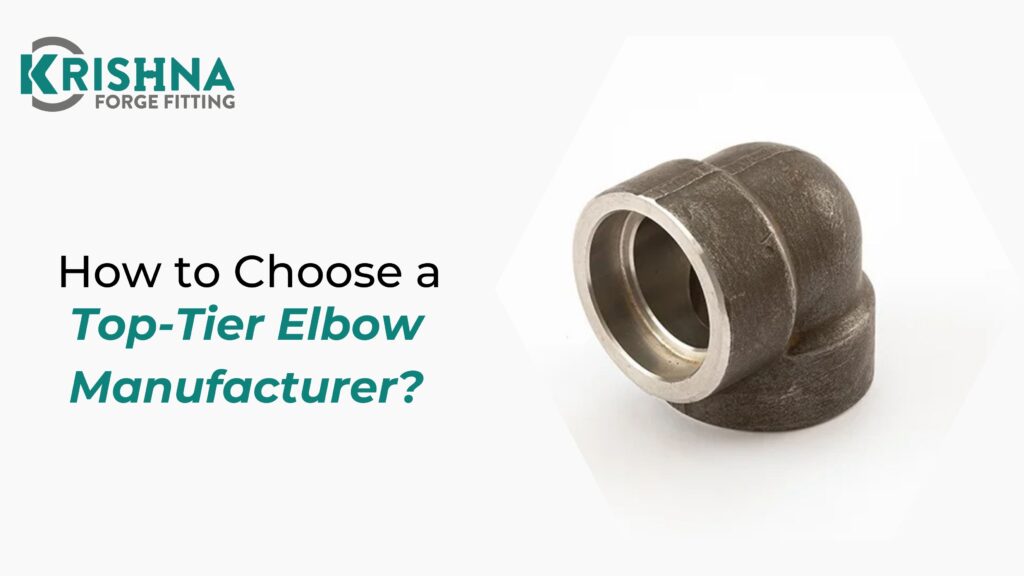
When elbows fail, projects don’t just bend—they buckle. The difference between a quiet, long-life line and a recurring maintenance thriller often comes down to who made your elbows and how they proved it. This buyer’s guide lays out the standards, proof points, and practical checks that separate premium manufacturers from the pack. Krishna Forge—manufacturers of forged elbows and butt-weld fittings built to international standards—offers this framework so your next shortlist is defensible on site and in audit. (Krishna Forge Fitting)
1) Start with standards (or don’t start at all)
A “top-tier” elbow shop leads with standards—not slogans. For butt-weld elbows, ASME B16.9 is the backbone: it defines scope, sizes (NPS 1/2–48), overall dimensions, tolerances, testing, and markings for factory-made wrought fittings. If a vendor can’t map every dimension and tolerance to B16.9, you don’t have a premium partner—you have a guess. (Octal Pipe Fittings)
Short-radius elbows (and returns) live under ASME B16.28, which explicitly covers ratings, overall dimensions, testing, tolerances, and markings for wrought carbon- and alloy-steel short radius elbows. If SR elbows are in your spec (tight racks, compact tie-ins), you’ll want clear B16.28 conformance separate from B16.9. (Sunny Steel)
For light-wall, corrosion-resistant stainless fittings, MSS SP-43 is the reference; serious suppliers know when SP-43 applies (and when it doesn’t). (metalspiping.com)
2) Manufacturing method & integrity (how the elbow gets its backbone)
Premium elbows aren’t just “made,” they’re wrought—hot-formed/forged and heat-treated to land the mechanical properties the code assumes. The B16.28 text even clarifies that “wrought” covers fittings made of pipe, tubing, plate, or forgings—and excludes fabricated fittings with intersection welds (those belong under piping design codes, not B16.28). That distinction matters for fatigue life and inspection regimes. (Sunny Steel)
Ask how the elbow is formed (press/mandrel/extrusion routes), what the heat-treatment is for each grade, and how bevels are prepared. If the answers are vague, expect variability at fit-up and headaches at hydrotest.
3) Dimensional control & markings (what you can verify at goods-in)
Your incoming inspection routine should mirror the standard:
- Center-to-end (A/B), outside diameter, wall, roundness/ovality within B16.9 tolerances.
- End prep (land, angle) consistent with B16.25—so welders aren’t machining on the floor.
- Permanent markings: maker, size, schedule/WT, grade, relevant standard. Marking practices follow MSS SP-25 across much of the industry; a real supplier can show you exactly how parts are marked and traced. (Octal Pipe Fittings)
If you can’t tie a heat number on the elbow to a documented heat on the mill paperwork, you don’t have traceability—you have inventory.
4) Materials you’ll actually specify (and why the range matters)
A credible elbow manufacturer covers the working set:
- Carbon steel (e.g., A234 WPB/WPL6) for mainstream pressure/temperature services.
- Stainless (A403 304/316/L) when corrosion and cleanability rule.
- Alloy & low-temp grades for elevated temperature or sub-zero duty.
- Duplex/super duplex where chloride stress cracking or strength demands push you there.
Look for clear material pages and dimensional coverage (LR/SR, 45°/90°/180°) that match your ecosystem. (ADCO Forge & Fittings Pvt Ltd)
5) Range & options (because “we can make it” isn’t the same as “we stock it”)
Reality check the catalog against your bill of materials:
- Sizes: up to NPS 48 is within the B16.9 envelope—verify actual availability.
- Schedules: Sch 10 through 160 (and XXS where applicable).
- Radius & angles: LR is the default; SR for genuine space constraints; 45°, 90°, 180° as standard.
- Customs: true bends, odd degrees, heavy walls—ask for drawings and prior examples.
The point isn’t brochure poetry; it’s confirming the elbow range that matches your line classes. (Octal Pipe Fittings)
6) QA documents & third-party testing (your paper shield)
You’re not buying metal; you’re buying proof. The minimum viable paperwork stack for elbows on critical service includes:
- MTR/MTC: chemical/physical properties tied to the heat; think of it as the elbow’s DNA.
- PMI where mix-ups are costly.
- NDT (UT/RT/PT/MT) when service, customer specs, or past history justify it.
If a supplier treats MTRs as “available on request,” reconsider. MTRs are table stakes: they certify compliance and trace the part back to melt and process. (B-S Company Inc.)
Third-party inspection (SGS/BV/LR) before shipment isn’t about distrust; it’s insurance against schedule-killing surprises when the crates land. Set your hold points in the PO.
7) LR vs SR (performance isn’t just about fitting in the rack)
Long radius (LR) elbows are the default for a reason: lower pressure drop, gentler flow path, reduced erosion. Short radius (SR) elbows are compact but harsher on hydraulics and more sensitive to erosion—use them when space truly demands it, and only with deliberate calculations. Keep in mind that SR coverage sits in B16.28; your spec and inspection plan should reflect that. (pipingpipeline.com)
8) Supply reliability & export readiness (can they deliver the same quality, repeatedly?)
Great elbows that arrive late aren’t great elbows. Strong suppliers prove:
- On-time performance into your region (incoterms you actually use).
- Export-grade packaging (caps, VCI, crate design, lift points, seaworthy specs).
- Document discipline: packing lists, detailed marking, certificate bundles ready for customs and for your QA archive.
Credible buyer guides emphasize supplier reputation, range, and support—not just price. Build that into your ranking criteria. (EnggPro)
9) Engineering support & responsiveness (because drawings don’t weld themselves)
Top-tier isn’t just about metal; it’s about humans who pick up the phone. You want:
- Dimensional clarifications within hours, not days.
- Help with LR/SR trade-offs when your layout is in a bind.
- Welding/fabrication notes that prevent on-site improvisation.
Supplier selection content aimed at buyers consistently calls out responsiveness and technical depth as core differentiators—treat them as hard criteria, not soft skills. (EnggPro)
10) RFQ checklist (send this, get what you asked for)
Make your request unambiguous:
- Standard (ASME B16.9 or B16.28), size (NPS), schedule/WT, angle (45/90/180), radius (LR/SR).
- Material grade/spec (e.g., A234 WPB, A403 WP316L).
- End prep details if you deviate from standard bevel.
- Documentation: MTRs for each heat, marking per MSS SP-25, PMI/NDT scope, third-party inspection (if any), and traceability from heat to crate.
- Packing/marking instructions and any hold points for witness/inspection.
When elbows miss in the field, 80% of the time the RFQ was too polite to be precise. Tie every requirement to a standard where possible. (Octal Pipe Fittings)
11) Red flags (trust your gut, but verify with evidence)
- Standards fog: supplier can’t cite the clause that covers your tolerance question.
- Paper gaps: MTRs missing or generic; heat numbers that don’t map.
- Marking mysteries: partial or non-permanent markings.
- “We can do anything” with no past drawings or references.
- Lead-time optimism that collapses once you ask for third-party inspection.
Buyer-side resources warn against vague documentation and unverified standards claims—treat these as deal-breakers, not quirks. (EnggPro)
12) How to score vendors (objective beats “seems reliable”)
Create a simple weighted matrix:
- Compliance (B16.9/B16.28/MSS SP-43 where applicable).
- Dimensional range (sizes, schedules, LR/SR coverage).
- Materials supported with heat-treatment capability.
- QC breadth (100% dim check, MTR discipline, PMI/NDT readiness).
- Traceability (heat → MTR → packing list → markings).
- Delivery performance (export readiness, past shipments).
- Engineering support (responsiveness, drawing quality).
Score each factor; shortlist the highest two. Run a pilot batch before the full PO. (Future-you will thank present-you.)
13) The last elbow you’ll regret is the one you didn’t vet
Pick manufacturers who treat standards like contracts, not suggestions; who ship drawings, not adjectives; and who measure their quality in rejected-parts prevented, not brochures printed. That’s how you get elbows that disappear into your system and never reappear in your incident log.
If you want elbows built to the letter of B16.9/B16.28 with clean bevels, traceable paperwork, and production geared for repeatable fit-up, explore Krishna Forge’s forged elbows and butt-weld fittings and send across your RFQ with standards, sizes, schedules, and documentation needs clearly called out. (Krishna Forge Fitting)
Sources for standards & buyer-side checkpoints:
ASME B16.9 scope and size range; tolerances/markings. (Octal Pipe Fittings)
ASME B16.28 short-radius elbows/returns; coverage of ratings/dimensions/testing/tolerances/markings. (Sunny Steel)
MSS SP-43 for light-wall corrosion-resistant butt-weld fittings. (metalspiping.com)
MTR/MTC role in traceability and compliance. (B-S Company Inc.)
Buyer-guide emphasis on supplier reputation, range, documentation, and support. (EnggPro)
