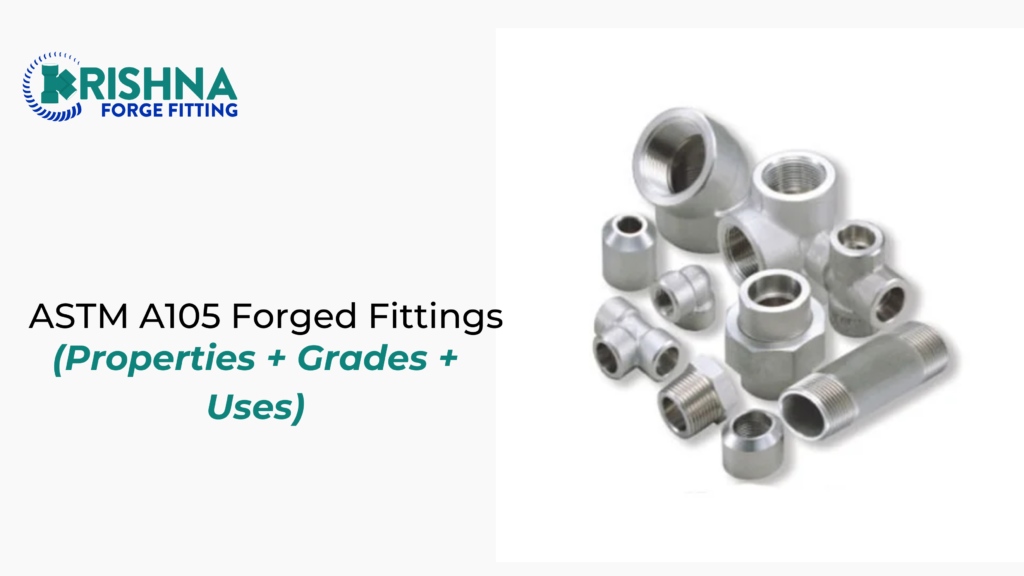
ASTM A105 is the grade you get when you do not specify a grade. It covers most forged fittings sold anywhere in the world, it is cheap, it welds well, and it is wrong more often than buyers realise — because the two places it fails are at the ends of the temperature range, and neither shows up on a hydrotest. This guide covers what the specification actually requires, what the composition and hardness numbers do in practice, the difference between A105, A105N and SA105, exactly where the grade stops being valid, and how to read a mill certificate against the spec.
What ASTM A105 Covers
ASTM A105 is the standard specification for carbon steel forgings for piping applications — flanges, fittings, valves and parts for ambient and higher-temperature service. It covers small forged parts intended for pressure systems.
It is a forging specification. It does not cover plate, bar stock or castings. A fitting machined from A105 bar is not an A105 forging, whatever the certificate says.
Chemical Composition
The Limits
| Element | Limit |
| Carbon | 0.35% max |
| Manganese | 0.60 – 1.05% |
| Phosphorus | 0.035% max |
| Sulphur | 0.040% max |
| Silicon | 0.10 – 0.35% |
| Copper | 0.40% max |
| Nickel | 0.40% max |
| Chromium | 0.30% max |
| Molybdenum | 0.12% max |
| Vanadium | 0.08% max |
The five residual elements — Cu, Ni, Cr, Mo, V — are capped individually and their total must not exceed 1.00%. Chromium and molybdenum together must not exceed 0.32%.
Those residual limits exist because scrap-based steelmaking accumulates them. A steel that meets every individual limit but blows the sum is out of spec, and it is a genuinely common non-conformance in cheap material.
Carbon Equivalent — The Number That Decides Your Welding Cost
This is the number most buyers skip and every welding engineer reads first.
CE = C + Mn/6 + (Cr+Mo+V)/5 + (Ni+Cu)/15
A105 caps carbon equivalent at 0.47% when carbon exceeds 0.30%, and 0.48% when carbon is 0.30% or below.
Why it matters: carbon equivalent predicts how readily the heat-affected zone forms hard, brittle martensite when the weld cools. Higher CE means:
- Preheat becomes mandatory instead of optional
- Higher preheat temperatures — 100°C instead of ambient
- More risk of hydrogen-induced cold cracking
- Tighter control of interpass temperature
- More rework
A fitting at CE 0.35 and one at CE 0.47 both pass the spec. The second one costs you meaningfully more to weld across a few hundred joints, and it fails more often in the field.
If you weld a lot of A105, put a maximum CE of 0.43% on your purchase order. It costs almost nothing at the mill and it changes your welding rejection rate.
Mechanical Properties
The Minimums
| Property | Requirement |
| Tensile strength | 485 MPa (70 ksi) minimum |
| Yield strength | 250 MPa (36 ksi) minimum |
| Elongation in 50 mm | 30% minimum (longitudinal) / 20% (transverse) |
| Reduction of area | 30% minimum |
| Hardness | 187 HBW maximum |
Note that tensile and yield are minimums while hardness is a maximum. That combination is deliberate and it constrains the steelmaker from both sides.
Hardness and Why 187 HBW Matters
The 187 HBW ceiling looks like a machinability requirement. It is not — it is a cracking requirement.
Hard carbon steel in the presence of wet hydrogen sulphide cracks. Sulphide stress cracking is a brittle, fast, low-stress failure mode, and hardness is the controlling variable. NACE MR0175 / ISO 15156, which governs sour service materials, sets 22 HRC (roughly 237 HBW) as the ceiling for carbon steel.
A105’s own 187 HBW limit sits comfortably below that. This is one reason A105 is accepted in sour service where harder grades are not — but only when the fitting is genuinely soft and the certificate proves it, and only with the additional NACE requirements met.
Two practical points:
- If your service has any H₂S, specify NACE MR0175 compliance explicitly. A105 alone does not guarantee it.
- Check hardness on the fitting body, not just on the certificate. Localised hard spots from uncontrolled cooling are real.
The Grades and Conditions
A105 — As Forged
Cooled in air after forging with no controlled thermal treatment. Meets the spec. Grain structure varies through the section, and toughness is unpredictable — because it was never tested.
A105N — Normalized
Reheated above the transformation temperature and air cooled under control. This refines the grain and produces uniform, repeatable properties through the section.
A105N is what you should be specifying. The cost difference is small. The benefit is that toughness and strength become consistent piece to piece rather than dependent on how the part happened to cool.
Many project specs mandate normalized condition for any fitting above a certain wall thickness for exactly this reason.
A105 Quenched and Tempered
Permitted by the spec. Used where higher toughness is needed within the A105 chemistry envelope. Uncommon in fittings, more common in heavy flanges.
ASME SA105 vs ASTM A105
Technically identical requirements. SA105 is the ASME Boiler and Pressure Vessel Code adoption of the ASTM specification.
The practical difference: SA105 material is certified for use in ASME code-stamped equipment. If your fitting goes into a vessel or a boiler under Section VIII or Section I, you need SA105, and the certificate must say SA105. Ordering A105 for code work and finding out at inspection is an expensive surprise.
Temperature Limits — Both Ends
This is where A105 gets misapplied, and it happens at both ends.
The Low-Temperature Cut-Off
A105 has no impact test requirement. None. The specification does not require Charpy testing, so nothing certifies its behaviour below ambient.
Carbon steel has a ductile-to-brittle transition. Below it, the steel fails by fast fracture with essentially no warning and no plastic deformation. For an untested A105 forging, nobody knows where that transition sits.
Most codes and project specs draw the line at around −29°C. Below that, you need ASTM A350 LF2, which is chemically similar but Charpy impact tested at −46°C.
The trap: A105 and LF2 look identical, cost within 15% of each other, and are frequently interchanged by suppliers who see them as the same steel. In a cold climate, on a line that sees autorefrigeration during a depressurisation event, that substitution is a brittle fracture waiting for a cold morning.
Specify LF2 explicitly and check the impact values on the certificate.
The High-Temperature Cut-Off
The allowable stress for A105 drops steadily above 200°C. By 425°C it has lost roughly a third of its ambient value.
Graphitization Above 425°C
Above about 425°C, held for years, the iron carbide in plain carbon steel decomposes and the carbon precipitates as graphite flakes — usually along the heat-affected zone of a weld.
Graphite has essentially no strength. A graphitized weld zone can fail at a fraction of its design load, and it happens after years of apparently normal service.
This is precisely why chrome-moly grades exist. F11, F22 and F91 contain chromium and molybdenum that stabilise the carbides and stop graphitization. For sustained service above 425°C, use them. A105 is not a high-temperature grade regardless of what the pressure table permits for short excursions.
International Equivalents
| Standard | Equivalent |
| EN 10222-2 | P250GH / 1.0460 |
| DIN | C22.8 |
| JIS | S25C / SFVC 2A |
| BS | 1503-221-490 |
| IS | IS 2004 Class 2 |
Equivalent does not mean identical. Composition ranges and testing requirements differ. If your spec calls A105, buy A105 — do not accept an equivalent unless the spec permits substitution.
Where A105 Is Used
- Socket weld and threaded forged fittings, ASME B16.11, Classes 2000 to 9000
- Weld neck, slip-on, blind and threaded flanges to ASME B16.5
- Valve bodies and bonnets
- Refinery and petrochemical process piping at moderate temperature
- Steam and condensate lines within temperature limits
- Fire water systems, plant utility air, cooling water
- Hydraulic power systems
- Structural pressure parts in general industry
Where A105 Should Not Be Used
- Below −29°C — use A350 LF2
- Sustained service above 425°C — use F11, F22 or F91
- Corrosive or chloride-bearing media — use F304L, F316L or duplex
- Sour service without explicit NACE certification
- Hygienic, food and pharmaceutical piping — use stainless
- Anywhere the media attacks carbon steel — A105 has zero inherent corrosion resistance
That last point deserves emphasis. A105 rusts. In wet service it needs a corrosion allowance, a coating, or a different grade. It is a strength material, not a corrosion material.
How to Read an A105 Mill Certificate
Six checks, two minutes:
- Heat number on the certificate matches the stamp on the fitting. If it does not, stop there.
- All ten elements listed, each within limits, and the Cu+Ni+Cr+Mo+V sum under 1.00%.
- Carbon equivalent calculated and stated. If it is absent, compute it yourself from the listed composition.
- Tensile, yield, elongation and reduction of area all above the minimums.
- Hardness stated and under 187 HBW.
- Heat treatment condition stated — as-forged, normalized, or quenched and tempered. If your order said A105N, the certificate must say normalized.
Add a seventh if it applies: for EN 10204 3.2 certification, an independent inspector’s stamp must appear on the document.
FAQs
Is A105 the same as A105N? Same chemistry and same minimum properties. A105N is additionally normalized, which gives uniform grain structure and consistent toughness. Specify A105N unless there is a reason not to.
Can A105 be used for sour service? Sometimes, but only with explicit NACE MR0175 / ISO 15156 compliance stated on the order and certified on the mill test certificate. The A105 specification alone does not guarantee it.
What is the maximum pressure an A105 fitting can hold? It depends on the class and the temperature, not the grade alone. Take the class, read the pressure-temperature table in ASME B16.11 for carbon steel, and apply the design temperature.
Does A105 need to be painted? In any wet or humid environment, yes, or it needs a corrosion allowance in the design. A105 has no corrosion resistance of its own.
How do I tell A105 from A350 LF2 on a shop floor? You cannot, visually. They look identical. The only reliable route is the stamped heat number and the mill certificate, with impact test values present for LF2 and absent for A105.
Conclusion
A105 is the correct default for carbon steel forged fittings between roughly −29°C and 425°C in non-corrosive service. Specify the normalized condition, cap the carbon equivalent at 0.43% if you weld in volume, add NACE compliance if there is any H₂S, and switch to LF2 or chrome-moly the moment you leave that temperature band.
If you have a fitting requirement in A105 or A105N, send us the sizes, classes and service conditions — we will confirm the grade is right before we quote it.
About Krishna Forge
Krishna Forge manufactures ASTM A105 and A105N forged fittings to ASME B16.11 — socket weld and threaded, NPS 1/8 to 4, Classes 2000 through 9000. We supply controlled carbon equivalent on request, NACE MR0175 compliant material where specified, and EN 10204 3.1 or 3.2 certification with every consignment, heat number stamped on each piece.
Send us your A105 fitting schedule for a quote.
