Introduction
Most piping designers default to tees. Two tees in series to create a four-way junction is the textbook approach—familiar, easy to source, and completely adequate for simple layouts. The problem surfaces in compact systems: instrument manifolds, chemical injection headers, fire suppression networks where every centimetre of space and every weld joint is a liability. Two tees mean two fittings, two weld or threaded joints, two potential leak points, and a longer span between the outermost connections.
A cross pipe fitting collapses all four connections into a single forged body—one fitting, four outlets, one set of dimensional tolerances to verify, and a layout footprint roughly 40% shorter than the equivalent two-tee arrangement. This guide explains what a cross fitting is, the specific advantages that make it the better technical choice in the right application, the types and materials available for industrial service, and the selection framework for specifying the correct configuration. You will also get the ASME standards that govern dimensional and pressure compliance, and the quality checks to run before approving a purchase order.
What Is a Cross Pipe Fitting?
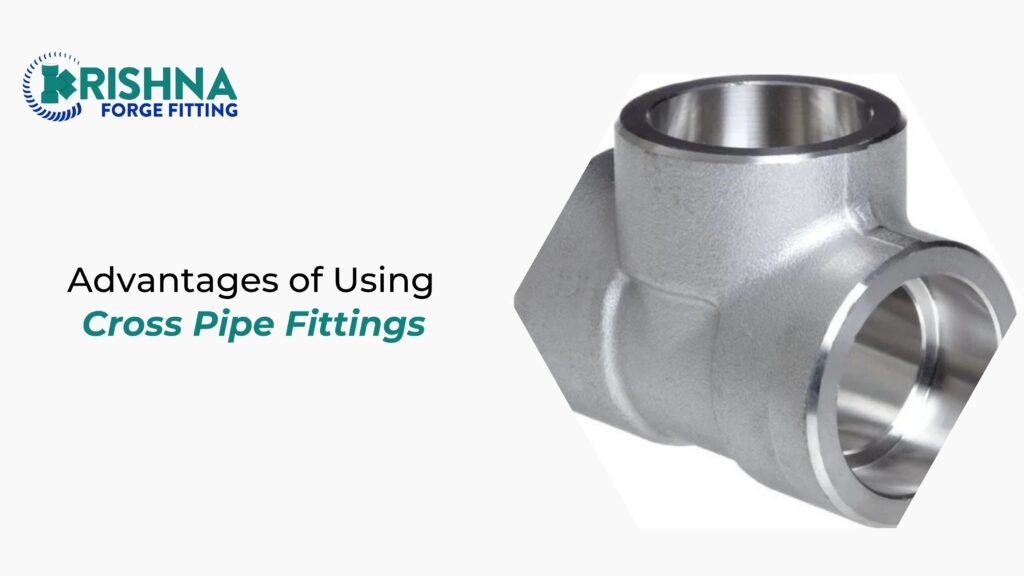
A cross fitting is a four-outlet pipe connector: one inlet and three outlets, or equivalently, two through-flow openings and two perpendicular branch openings—all at 90° in the same plane. It distributes or collects flow from four directions in a single body.
Cross vs tee
A tee handles three connections; a cross handles four. Where two tees would be offset along a run to create four connections, one cross places all four at a single point—critical in manifolds and skid-mounted equipment where routing even 50 mm of additional pipe is impractical.
One important caveat: cross fittings introduce higher stress concentration at the central body than tees because four simultaneous pressure loads converge at one point. This makes material grade and forging quality—not just dimensional fit—non-negotiable for industrial service.
Advantages of Cross Pipe Fittings
Fewer fittings, fewer joints
One cross replaces two tees and eliminates two additional joints from the system. In a 20-manifold assembly, that difference is 20 fewer welds or threaded connections—each one a potential leak point over the system’s service life.
Compact layout footprint
Two tees require clearance between their bodies plus additional pipe between them. A cross puts all four connections at a single point; the centre-to-end distance on a forged NPS 1 Class 3000 cross is roughly 38 mm per outlet. In offshore modules, skid-mounted chemical injection systems, and instrument junction blocks, this dimensional efficiency is the primary reason to specify a cross over tees.
Uniform flow distribution
A cross splits flow symmetrically into opposite and perpendicular branches simultaneously. This matters in fire suppression systems and process sampling manifolds where equal distribution across all four branches is the design target. Two tees in series always give the first tee a flow advantage over the second; a cross balances the split.
Reduced system weight
Fewer fittings directly reduces assembly weight. In suspended piping racks or offshore structures where dead load is a structural design input, fitting count reduction translates into reduced hanger and support loads.
Simplified documentation
One fitting with one mill test certificate and one dimensional inspection report replaces two fittings with two documentation packages. For projects that require strict material traceability—ONGC, EPC, or ASME-coded systems—halving the documentation burden per junction point reduces administrative risk.
Types of Cross Fittings
By geometry
- Equal cross: all four openings at the same nominal size; used when all four connected pipes carry similar flow
- Reducing cross: the two branch openings are smaller than the run openings; used for instrument tappings, small-bore take-offs, or drain connections on a larger header
By connection method
- Socket-weld cross: pipe inserts into recessed sockets; fillet welded per ASME B31.3; highest fatigue life and leak integrity; use in high-pressure, vibration-prone, or cyclic-pressure service
- Threaded cross: NPT or BSP threads on all four outlets; no welding; faster installation; suited to moderate-pressure, low-vibration systems and maintenance-access points
Materials and Construction
Select material by matching service fluid chemistry and temperature limits:
- Carbon steel (ASTM A105): general service; steam, water, oil, gas; up to 400 °C
- Stainless steel (ASTM A182 F304/F316): acids, chlorides, seawater, pharmaceutical
- Alloy steel (A182 F11/F22/F91): superheated steam and high-temperature hydrocarbon service above 540 °C
- Brass: low-pressure water, compressed air, non-ferrous utility systems
Forged crosses outperform cast crosses in high-pressure service because forging aligns grain flow across all four outlets simultaneously, eliminating the porosity that makes cast bodies unreliable under cyclic loading.
Standards and Specifications
ASME B16.11 governs forged socket-weld and threaded cross fittings:
- Size range: NPS ⅛ to NPS 4
- Socket-weld pressure classes: Class 3000, 6000, 9000
- Threaded pressure classes: Class 2000, 3000, 6000
ASME B16.9 covers larger buttweld cross fittings above NPS 4. Both standards specify dimensional tolerances, wall thickness minimums, and material grade requirements that forged crosses must meet to carry a code-compliant stamp.
Applications
Chemical injection manifolds in oil and gas use Class 6000/9000 socket-weld crosses to distribute multiple fluid streams from a single header in the smallest possible footprint. Fire protection systems use threaded carbon steel equal crosses at four-way sprinkler branch intersections where installation speed matters and pressure is moderate. Instrument impulse lines use small-bore reducing crosses to bring four transmitter connections to a single process tapping point. HVAC distribution manifolds use equal crosses to split water or refrigerant flow symmetrically into four branch circuits.
Selection Guide
Five-step checklist
- Verify four-way geometry is required: if only three connections meet, a tee is the correct choice and a cross adds unnecessary cost
- Choose equal or reducing: equal for same-size runs; reducing when branches are smaller take-offs or instrument tappings
- Set pressure class: match Class 3000, 6000, or 9000 to the system’s maximum allowable working pressure
- Select connection method: socket weld for permanent high-pressure or vibration-prone service; threaded for maintenance access or low-pressure utility points
- Request documentation: mill test certificates, ASME B16.11 dimensional conformance, and hydrostatic test records for Class 6000/9000 service
FAQs
When should I use a cross fitting instead of two tees?
Use a cross when four pipes genuinely converge at a single point—manifolds, distribution headers, sprinkler intersections, and instrument junction blocks where adding two tees would extend the layout. Two tees are more practical when the four connections are offset along a run and a cross would force awkward pipe routing. Cross fittings deliver the most value in compact, high-joint-count assemblies where footprint and leak-point reduction are design priorities.
Are cross fittings suitable for high-pressure service?
Forged crosses per ASME B16.11 are rated to Class 9000—the highest pressure class in the standard. The critical requirement is that the forging is properly manufactured with consistent wall thickness at all four outlets; cast or poorly forged crosses thin at the central body intersection and fail under pressure. Always verify ASME B16.11 compliance and request dimensional inspection reports confirming wall thickness at the cross body.
What is the difference between an equal and reducing cross?
An equal cross has the same nominal pipe size on all four openings; flow splits symmetrically in all four directions. A reducing cross has smaller openings on the two branch outlets, typically serving as instrument tappings or small-bore drain/vent connections on a larger-bore main run. A reducing cross eliminates separate reducer fittings downstream and tightens manifold layouts.
What documentation should I request with a forged cross order?
Request mill test certificates with heat number, material chemistry, tensile and yield strength, and hardness data per ASTM A105 or A182. Add dimensional inspection reports confirming ASME B16.11 bore tolerances, wall thickness at the cross body, and centre-to-end dimensions. For Class 6000/9000 service, request hydrostatic test certificates and NDT records.
Conclusion
Specify cross fittings when four connections genuinely converge at one point and compact layout, reduced joint count, and uniform flow distribution are priorities. Lock in geometry, pressure class, and connection method before issuing the purchase order, and verify ASME B16.11 compliance and material traceability on every shipment.
Krishna Forge manufactures ASME B16.11 forged cross fittings—equal and reducing, socket-weld and threaded—in carbon steel, stainless steel, and alloy steel, Class 3000 through Class 9000, NPS ⅛ to NPS 4. Every fitting ships with full material traceability, dimensional inspection reports, and the mill test certificates your project documentation demands.
Need forged cross fittings with verified ASME compliance and fast delivery? Contact Krishna Forge for technical data sheets, pressure-temperature ratings, and quotes on equal and reducing crosses engineered for your exact service conditions.
