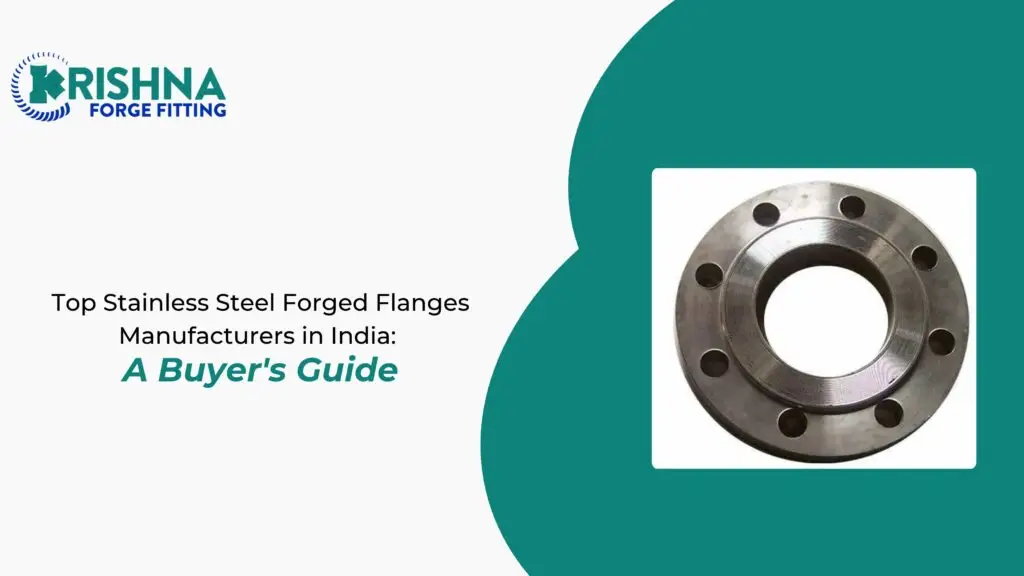
A flange looks like a simple ring of steel with bolt holes. In service it holds a joint against full line pressure, bolt load, thermal expansion and pipe bending stress all at once. When a flange is cut from plate instead of forged, or drilled to the wrong standard, the joint may pass a hydro test and still leak months later.
This buyer’s guide explains stainless steel forged flanges, the main types and facings, grades and standards, and what to evaluate when choosing a manufacturer in India.
What Are Stainless Steel Forged Flanges
A flange connects pipes, valves, pumps and equipment through a bolted joint with a gasket between two faces. A forged flange is made by heating a stainless billet and pressing or hammering it into shape before final machining.
Why Forged and Not Cast or Plate-Cut
- Grain flow: Forging aligns the metal grain with the shape of the flange, which improves strength and fatigue resistance.
- Fewer internal defects: Forging closes voids and porosity that can exist in castings.
- Better through-thickness properties: Flanges cut from plate can have weaker properties across the thickness, which matters at the hub and bolt holes.
Major piping codes call for forged material under ASTM A182 for stainless flanges in pressure service, which is why “forged” appears in most project specifications.
Types of Stainless Steel Flanges
- Weld neck (WN): A long tapered hub butt-welded to the pipe. Best for high pressure, high temperature and cyclic loads.
- Slip-on (SO): Slides over the pipe and is fillet-welded inside and out. Easy to align; suited to lower pressure.
- Socket weld (SW): The pipe sits in a socket and is fillet-welded. Used on small-bore, high-pressure lines.
- Threaded: Screws onto threaded pipe. Used where welding is not allowed.
- Blind: A solid plate that closes a line or nozzle. Allows later extension and pressure testing.
- Lap joint: Used with a stub end; the flange rotates freely, which helps bolt alignment. Useful when the stub end is expensive alloy and the flange can be a cheaper material.
- Reducing: Connects pipes of different sizes.
- Orifice: Has tappings for flow measurement.
Flange Facings
The facing decides how the gasket seals:
- Raised Face (RF): The most common. A raised ring concentrates gasket pressure.
- Flat Face (FF): Used when mating with cast iron or non-metallic equipment, to avoid cracking the mating flange.
- Ring Type Joint (RTJ): A machined groove holds a metal ring gasket. Used for high pressure and high temperature.
Surface finish matters too. Raised faces are usually machined with a serrated spiral finish so the gasket grips the face.
Grades and Material Standards
Stainless forged flanges are usually supplied to ASTM A182:
| Grade | Key Feature | Typical Use |
| F304 | General corrosion resistance | Water, food, mild chemicals |
| F304L | Low carbon for weld-zone protection | Welded systems |
| F316 | 2–3% molybdenum for chloride resistance | Chemical, coastal, pharma |
| F316L | Low-carbon 316 | Welded chemical lines |
| F321 | Titanium-stabilised | High-temperature service |
| F347 | Niobium-stabilised | High-temperature, intergranular corrosion resistance |
| F51 / F53 (Duplex) | High strength, stress-corrosion resistance | Oil, gas, offshore, desalination |
A useful pattern from the field: buyers often over-specify 316 where 304 would work, and under-specify 304 where chlorides are present. Base the grade on the fluid and environment, not habit.
Dimensional Standards and Pressure Classes
- ASME B16.5: Flanges from NPS 1/2 to 24, in Classes 150, 300, 600, 900, 1500 and 2500.
- ASME B16.47: Large-diameter flanges, NPS 26 to 60, Series A and B.
- EN 1092-1: European flanges in PN ratings (PN 6, 10, 16, 25, 40 and above).
- IS 6392: Indian standard for steel pipe flanges.
The pressure a flange can hold drops as temperature rises. A Class 150 stainless flange holds far less pressure at 400°C than at room temperature. Always check the pressure-temperature table for your grade.
Bolt hole patterns differ between standards. An ASME Class 150 flange and a PN 16 flange of the same nominal size will usually not bolt together.
Applications and Industries
- Oil and gas, refineries and petrochemical plants
- Chemical and fertilizer industries
- Power plants, boilers and heat exchangers
- Water treatment and desalination
- Pharmaceuticals, food and dairy
- Shipbuilding and offshore structures
- Steel plants and general process industries
What Buyers Should Evaluate in a Manufacturer
1. Forging Capability
Ask whether flanges are forged in-house, the press or hammer capacity, and the size range covered. Confirm that flanges are forged, not cut from plate.
2. Heat Treatment
Austenitic stainless flanges need solution annealing after forging to restore corrosion resistance. Ask for heat treatment records.
3. Machining Accuracy
Check bore, outside diameter, bolt circle, bolt hole size, face finish and flatness. CNC machining improves consistency across batches.
4. Testing and Inspection
Look for:
- Chemical analysis and PMI
- Tensile and hardness tests
- Ultrasonic testing for internal defects on larger sizes
- Intergranular corrosion testing where specified
- Dimensional and visual inspection
5. Documentation and Marking
Each flange should be marked with manufacturer, standard, grade, class, size and heat number. Ask for MTCs to EN 10204 Type 3.1 or 3.2 as your project requires.
6. Approvals and Third-Party Inspection
Some sectors need specific approvals, such as IBR for boiler service in India. The manufacturer should accept inspection by your chosen agency.
7. Range and Customisation
Standard flanges, non-standard drillings, special facings and drawing-based flanges should all be possible.
8. Delivery and Packing
Flange faces should be protected with caps or wood. Stainless should be packed away from carbon steel to avoid iron contamination.
Common Sourcing Mistakes
- Ordering without stating the dimensional standard and class
- Mixing ASME and EN flanges on one project
- Accepting plate-cut flanges for pressure service
- Ignoring face finish and facing type
- Skipping PMI on receipt
- Not matching flange bore to pipe schedule on weld neck flanges
Buyer Checklist
- Flange type, size, class and standard
- Material grade to ASTM A182
- Facing type and finish
- Bore or schedule (for weld neck and socket weld)
- Test and inspection requirements
- Certificate type
- Marking and packing instructions
- Delivery date and destination
Frequently Asked Questions
What is the difference between forged and cast flanges?
Forged flanges are shaped from solid billets under pressure, giving a dense, aligned grain structure. Cast flanges are poured into moulds and can contain porosity. Forged flanges are preferred for pressure service.
Which flange type is best for high pressure?
Weld neck flanges are the standard choice for high pressure and high temperature. Their tapered hub spreads stress into the pipe smoothly.
Is SS 316 always better than SS 304 for flanges?
Not always. SS 316 performs better in chloride and acidic service. For clean water and mild chemicals, SS 304 is usually adequate and costs less.
Can ASME and EN flanges be bolted together?
Generally no. Bolt circles, bolt sizes and hole counts differ. Use matching standards on both sides of a joint.
What certificate should come with stainless flanges?
At minimum, an EN 10204 Type 3.1 Mill Test Certificate showing chemistry, mechanical properties and heat number. Critical projects may ask for Type 3.2 with third-party witness.
Conclusion
Buying stainless steel forged flanges well means specifying type, facing, grade, standard and class precisely, then choosing a manufacturer who forges, heat treats, machines and tests under one roof. Match the flange to the pipe, the fluid and the temperature, and insist on traceable documents.
Use the buyer checklist above for your next flange enquiry and send it to us for a quote.
About Krishna Forge Fitting
Krishna Forge Fitting manufactures and exports forged flanges and stainless steel forged pipe fittings from its plant at Shapar, Veraval, Rajkot. Alongside flanges, we produce forged elbows, tees, couplings, sockets, nipples and end caps in SS, MS and GI. Quality raw materials, process checks and final inspection go into every flange we dispatch.
