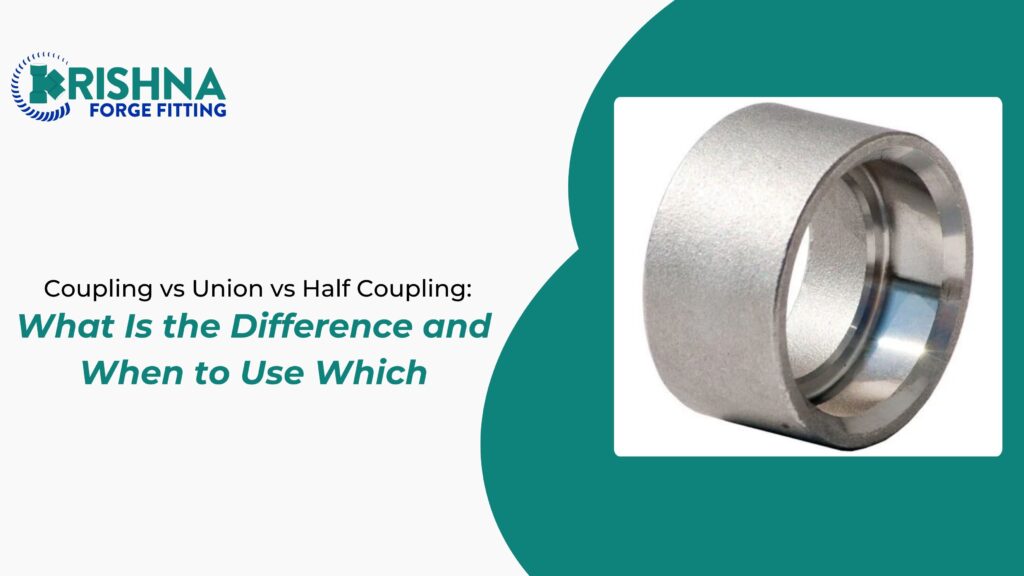
Three fittings, all small, all cheap, and the choice between them decides whether a future maintenance job takes twenty minutes or half a shift. A coupling joins two pipes permanently. A union joins them so they can be taken apart again. A half coupling does something different entirely — it creates a branch off a header. Mixing them up leads to lines that have to be cut to service a valve, or to unions scattered through a system at three times the cost of couplings for no benefit. This guide covers what each one is, the ASME B16.11 basics, and where each belongs. Krishna Forge Fitting forges all three in MS and SS at Shapar, Rajkot.
Quick Comparison
| Coupling | Union | Half coupling | |
| Function | Joins two pipes in line | Joins two pipes with a breakable joint | Creates a branch off a header or vessel |
| Connections | Both ends socketed or threaded | Three pieces: two ends plus a central nut | One end socketed or threaded, one end plain or bevelled |
| Bore | Through-bore | Through-bore | Blind — the plain end welds to the header |
| Disassembly | Cut or unscrew the whole run | Unscrew the central nut | Not applicable |
| Relative cost | Lowest | Highest | Low |
| Typical use | Pipe extension, repair | Valve and equipment isolation points | Instrument taps, vents, drains |
Full Coupling
A short forged sleeve with the same connection at both ends — socket weld or threaded. It joins two lengths of pipe in line, or a pipe to a nipple or a valve.
Types:
- Equal coupling — same nominal size both ends
- Reducing coupling — different sizes each end, for in-line size changes in threaded or socket weld systems
- Slip or repair coupling — no internal shoulder, so it slides along the pipe and lets you insert a replacement section without springing the line apart
Where it belongs: extending a pipe run, repairing a damaged length, connecting instrument and utility piping. Anywhere the joint will stay closed for the life of the installation.
The limitation: a socket weld coupling is permanent. Opening the line means grinding out the fillet weld. A threaded coupling can be unscrewed in principle, but only by rotating the pipe, which is impossible in the middle of a fixed run. That is the entire reason unions exist.
Union
A three-piece fitting: two tailpieces that connect to each pipe, and a central nut that draws them together against a machined seat. Tighten the nut and the joint seals. Loosen it and the two pipes separate without rotating either one.
Types:
- Threaded union — standard for threaded piping
- Socket weld union — welded to the pipe, with the union nut still breakable
- Ground joint union — metal-to-metal seat, no gasket, for steam and higher temperature
- Flanged union — bolted, for larger sizes and higher pressure
- Dielectric union — isolates dissimilar metals to stop galvanic corrosion at the junction
Where it belongs: either side of a control valve, strainer, pump, meter or instrument. Anywhere a component will come out for service.
The economics: unions cost several times what couplings cost. Putting them everywhere is tempting and wasteful. Put them where something will be removed, and nowhere else.
The common error: fitting a union into a line where both ends are already rigidly fixed. If neither side can move even a few millimetres, the union faces are hard to separate and harder to realign. Allow a little flexibility or a support that can be released.
Half Coupling
A half coupling has a socket or thread at one end only. The other end is plain or bevelled and gets welded directly onto the outside of a larger pipe or a vessel wall, over a drilled hole.
The result is a small-bore branch off a large-bore line — exactly what you need for a pressure gauge, a thermowell, a vent, a drain or a sample point.
Socket weld half coupling — fillet welded to the header; the branch pipe then sits in the socket. Threaded half coupling — welded to the header, with a threaded port for an instrument that will be removed periodically.
Where Half Couplings Beat Olet Fittings
On headers in the NPS 2 to NPS 6 range, a half coupling welded to the pipe is an economical alternative to a threadolet or sockolet, and plant specifications commonly allow it.
On larger headers, the contoured base of an olet fitting distributes stress into the run pipe far better than a half coupling’s flat weld footprint. The half coupling concentrates stress at the weld toe, and in a line that cycles thermally that is where cracks start. The cost saving is real but it has a size boundary, and specifications that permit half couplings usually state it.
Standards and Classes
All three are forged fittings under ASME B16.11, which fixes dimensions, tolerances, pressure–temperature ratings, marking and material requirements for socket weld and threaded fittings from NPS 1/8 to 4.
Pressure classes: 2000, 3000 and 6000 for threaded; 3000, 6000 and 9000 for socket weld. Class 3000 covers most standard process and utility work; Class 6000 for high-pressure instrument and injection lines.
Materials follow the same set as other forged fittings — ASTM A105 carbon steel, A182 F304/F304L and F316/F316L stainless, A350 LF2 for low temperature. Mild steel and GI for general fabrication and utility work.
Choosing Between Them
Work through these questions:
- Am I joining two pipes in line, or taking a branch off a header? Branch → half coupling (or an olet on a large header).
- Will anything on this joint ever need to come out? Yes → union. No → coupling.
- Is there a valve, strainer, pump or instrument nearby? Put a union on each side of it.
- Am I changing pipe size in line? Reducing coupling.
- Am I replacing a damaged section in a fixed run? Slip coupling, or a union pair if the repair may recur.
- Are the two pipes different metals? Dielectric union, to break the galvanic path.
The Planning Point Most Projects Skip
Decide union locations at the isolation-and-maintenance stage, not during fabrication. By the time a fabricator is welding the run, the cheapest option always looks like a coupling, and the cost of that choice lands on the maintenance team years later. A single union fitted during construction saves a cutting and rewelding job with a hot work permit every time the valve beside it needs servicing.
FAQs
Can I use a union instead of a coupling everywhere? Technically yes, practically no. Unions cost several times more, add two more leak paths per joint, and have lower fatigue strength in vibrating service. Use them only where disassembly is expected.
What is the difference between a half coupling and a full coupling? A full coupling is socketed or threaded at both ends and joins two pipes in line. A half coupling has one connection and a plain or bevelled end that welds onto a header, creating a branch outlet.
Are unions suitable for high-pressure service? Forged socket weld and flanged unions are made in Class 3000 and 6000 and handle high pressure. Light threaded unions are not. Check the class, not the appearance.
Why does a union sometimes leak after being reassembled? Usually a damaged or dirty seat face. The seal is metal-to-metal on a ground joint union, so any scoring or grit on the seat prevents it closing. Clean and inspect both faces before retightening.
Can a half coupling be welded onto any size header? Not with equal confidence. It works well on headers around NPS 2 to NPS 6. On larger or thermally cycling headers, an olet fitting with a contoured base spreads the stress far better.
Buy Couplings, Unions and Half Couplings From the Forge
Krishna Forge Fitting manufactures and exports industrial couplings, couplers, half couplings, forged socket couplings and union fittings in mild steel, stainless steel and GI, in socket weld and threaded ends, alongside elbows, tees, nipples, pipe sockets, forged flanges, end caps and universal joint crosses. We forge and machine in house at Shapar, Veraval, Rajkot, Gujarat, supplying water treatment plants, sprinkler systems, steel plants, fertiliser units, boilers, heat exchangers and condensers. MS job work to drawing is available.
