
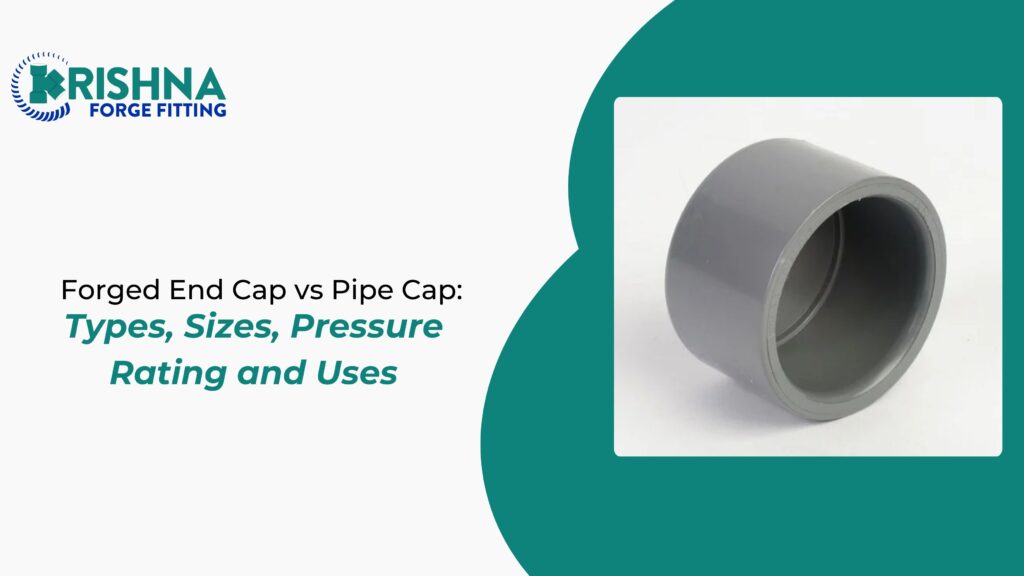
Buyers use “end cap” and “pipe cap” as if they were the same part, and suppliers quote whichever one they stock. They are different components under different standards, made by different processes, and they fail differently when misapplied. A forged end cap closes a small-bore line through a socket or a thread. A butt weld pipe cap closes a larger line with a domed closure and a full-penetration weld. This guide covers both, plus plugs and blind flanges, with the sizes, pressure classes and service conditions that decide which one belongs on your line. Krishna Forge Fitting forges end caps in MS and SS at Shapar, Rajkot.
The Core Distinction
| Forged end cap | Butt weld pipe cap | |
| Standard | ASME B16.11 | ASME B16.9 |
| Manufacture | Closed-die forged, then machined | Formed from pipe or plate |
| Size range | NPS 1/8 to 4 (commonly up to 2) | NPS 1/2 to 48 |
| Connection | Socket weld or threaded | Bevelled, full-penetration butt weld |
| Shape | Solid machined body | Ellipsoidal, hemispherical or flat dome |
| Rating basis | Pressure class — 3000, 6000, 9000 lb | Matches the pipe schedule |
| Bore | Reduced at the joint | Continuous |
| Typical materials | A105, A182 F304/F316, A350 LF2 | A234 WPB, A403 WP304/316 |
The practical boundary sits around NPS 2. Below it, forged caps dominate. Above it, butt weld caps take over because forging a large closed cap is uneconomical and a butt weld gives a cleaner, radiographable joint.
Forged End Caps in Detail
Socket Weld End Cap
The pipe slides into a counterbore in the cap and is fillet welded on the outside. Permanent, strong, resistant to vibration.
Available in Class 3000, 6000 and 9000. Class 9000 exists only in socket weld form.
Watch: leave approximately 1.5 mm of root gap between the pipe end and the socket shoulder before welding. Bottoming the pipe out traps thermal expansion stress in the fillet weld and cracks it.
Threaded End Cap
Female NPT threads screw over a male pipe end. Available in Class 3000 and 6000. No welding, no hot work permit, and the cap can be removed with a wrench.
Also made in male-threaded form, which screws into a female fitting — useful for plugging an unused tee branch or a spare coupling without adding a nipple.
Reducing and Special Caps
Reducing caps close a line while stepping the size down. Some manufacturers also supply caps with a tapping for a drain, a vent or an instrument connection, which turns a dead end into a usable test point.
Typical Forged Cap Ratings
A Class 3000 forged steel cap corresponds roughly to SCH 160 wall. Class 6000 is heavier again, and Class 9000 corresponds to XXS. Working pressure is read from the pressure–temperature table for the material at the operating temperature, not from the class number itself. A carbon steel Class 3000 cap in a 1″ size commonly carries a working pressure in the region of 2000 psi at ambient, and that figure drops as temperature rises.
Butt Weld Pipe Caps in Detail
A butt weld cap is a domed closure with a bevelled end — typically 37.5° to ASME B16.25 — welded directly to a matching bevelled pipe end. Wall thickness matches the pipe schedule, so the cap carries the same rating as the pipe it closes.
The dome shape is not decoration. A curved closure converts internal pressure into membrane stress spread across the surface, which is more efficient than a flat plate carrying the same pressure in bending. That is why a domed cap achieves a given rating with less material than a flat closure.
Shapes: ellipsoidal is standard; hemispherical for the highest pressure; flat for low-pressure and large-diameter water work.
Use it for: permanent dead ends on main lines, header terminations, and temporary closures during hydrostatic testing that get cut off afterwards.
Material matching matters. An A234 WPB cap pairs with carbon steel pipe; an A403 WP316L cap pairs with A312 TP316L pipe. Mismatched grades at a welded joint create problems that show up later as corrosion or cracking.
Caps, Plugs and Blind Flanges
Three parts close a pipe end and they are not substitutes.
Cap — fits over or onto the pipe end, female connection, rated for full system pressure. Permanent closure.
Plug — fits into the pipe or fitting, male connection, usually a square or hex head. Often used to seal an unused port rather than terminate a line, and plugs are generally not intended to carry full system pressure for extended service.
Blind flange — a solid bolted disc. Carries full system pressure and comes off with a spanner. The only one of the three that gives repeatable access.
How to Choose Between Them
- Will anyone need to open this end? If yes, blind flange. Removing a welded cap means cutting it off and destroying it.
- Is this a small unused port on a fitting? Plug.
- Is this a permanent dead end on a pressure line? Cap — forged below NPS 2, butt weld above.
- Is this for hydrotest only? Butt weld cap, cut off afterwards; or a blind flange if the flange is already there.
The Risk People Forget About Dead Ends
A capped branch is a dead leg. Fluid sits there, does not circulate, drops out solids, and concentrates whatever is corrosive in the stream. Microbially influenced corrosion and under-deposit attack start in dead legs far more often than in flowing line. In stagnant water service, a capped stub can perforate while the live line beside it is untouched.
If the branch is there for future expansion, keep it as short as the layout allows, and prefer a blind flange so the stub can be inspected without destroying the closure.
Materials
Carbon steel — A105 for forged caps, A234 WPB for butt weld. General industrial service: steam, utility water, air, hydraulic oil.
Low-temperature carbon steel — A350 LF2, with mandatory impact testing, below -29°C.
Stainless steel — A182 F304/F304L and F316/F316L forged; A403 WP304/316 butt weld. Water treatment, chemical, food and coastal service. The 316 grades resist chlorides that pit 304.
Ordering Checklist
Specify all of these:
- Nominal size
- Cap type — socket weld, threaded, butt weld
- Pressure class (forged) or schedule (butt weld)
- Material grade in full
- Thread standard, for threaded caps — NPT or BSP
- Shape, for butt weld — ellipsoidal, hemispherical, flat
- Surface condition — black, galvanised, mill varnish
- Documentation — MTC correlated to heat number, dimensional report
FAQs
Can I use a pipe cap for hydrostatic testing? Yes. Butt weld caps are routinely used as temporary closures for hydrotest and cut off afterwards. If the end will be reopened more than once, a blind flange is cheaper over the life of the job.
What is the difference between a cap and a plug? A cap fits over the pipe end with a female connection and is rated for system pressure. A plug fits into a fitting with a male connection and is generally used to seal an unused port rather than terminate a pressurised line.
Which classes are available in forged caps? Threaded caps come in Class 3000 and 6000. Socket weld caps come in Class 3000, 6000 and 9000. Class 9000 is socket weld only.
Can a forged end cap be removed and reused? A threaded cap can be unscrewed and reused if the threads are sound. A socket weld cap has to be cut off, which destroys both the cap and a short length of pipe.
Does the cap material have to match the pipe material? For butt weld caps, yes — welding dissimilar grades introduces metallurgical and galvanic problems. For threaded caps the requirement is less strict, but mixing carbon steel and stainless in a wet line still sets up galvanic corrosion.
Order End Caps From the Forge
Krishna Forge Fitting manufactures and exports forged end caps and forged steel caps in mild steel and stainless steel, in socket weld and threaded patterns, alongside industrial fittings, elbows, tees, couplings, half couplings, unions, nipples, pipe sockets, forged flanges and universal joint crosses. We forge a machine in house at Shapar, Veraval, Rajkot, Gujarat, supplying water treatment plants, sprinkler systems, steel plants, fertiliser units, boilers, heat exchangers and condensers. MS job work to draw is available.
