
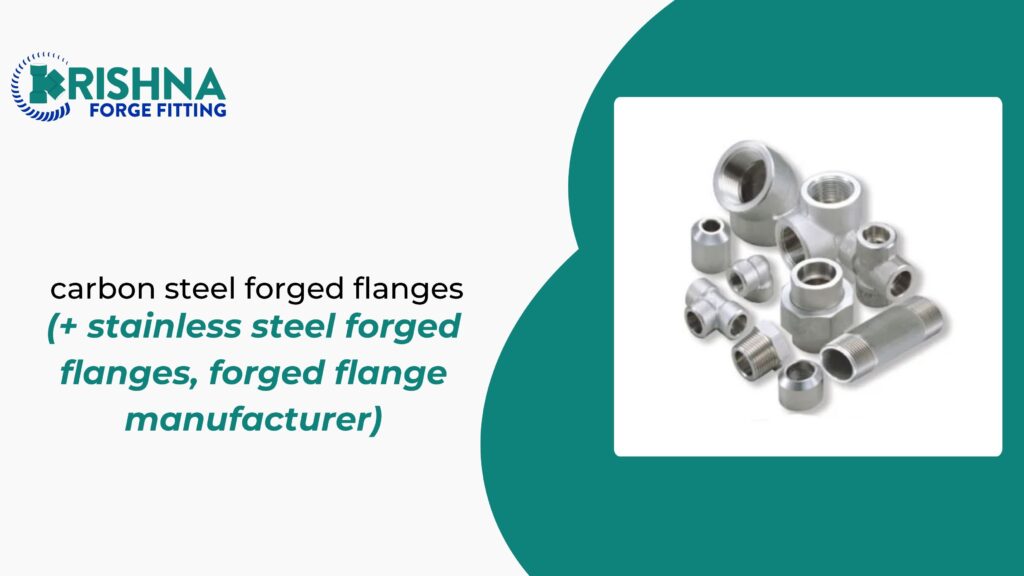
Flange orders go wrong in predictable ways: the wrong face type cracks a cast iron valve body, a slip-on gets specified where the line needs a weld neck, or a bore is machined for the wrong pipe schedule and the joint never aligns. All three are specification errors, not manufacturing errors. This guide walks through the six forged flange types and what each one is actually for, the face options, the carbon steel and stainless steel grades worth knowing, how pressure classes behave, and a practical ordering checklist. Krishna Forge Fitting forges flanges in MS and SS at Shapar, Rajkot, and the detail below comes from the production floor.
Why Forged Flanges
A flange can be forged, cast or cut from plate.
Forging works a heated billet under a closed die, so the metal grain follows the contour of the finished part. There are no internal voids, and fatigue and impact performance are the highest of the three routes. Cast flanges carry porosity risk. Plate-cut flanges have grain running in one direction only, which is a weakness at the hub.
For pressure service, cyclic loading or anything with a code behind it, forged is the specification. Most tender documents say so explicitly, often requiring closed-die forging and inspection of the forged blank before machining.
The Six Forged Flange Types
Weld Neck Flange (WNRF)
A tapered hub transitions from flange thickness down to pipe wall thickness, and the flange is butt welded to the pipe. Because the bore matches the pipe bore, flow stays smooth — less turbulence, less erosion, less pressure drop.
Use it for: high-pressure lines, high-temperature service, cyclic loading, anything radiographed or code-governed. The strongest option and the default for critical service.
Watch: the bore is machined for a specific pipe schedule. A weld neck ordered without a schedule is an incomplete order.
Slip-On Flange (SORF)
Slips over the pipe outside diameter and is fillet welded inside and outside. Easier to align during fabrication, cheaper to buy, shorter overall.
Use it for: general lower-pressure piping, utility lines, water service, fabrication where exact pipe lengths are hard to hold.
Watch: fatigue strength is roughly a third of a weld neck’s. Avoid in vibrating or thermally cycling lines.
Blind Flange (BLRF)
A solid disc with no bore. Closes the end of a pipe, a vessel nozzle or a valve, and carries full system pressure.
Use it for: line termination, hydrotest isolation, future tie-in points, maintenance isolation.
Socket Weld Flange (SWRF)
A counterbored socket receives the pipe, which is then fillet welded on the outside. Small-bore territory, typically 1/2″ to 3″.
Use it for: small-bore, high-pressure lines where a butt weld is impractical.
Watch: leave the standard root gap of about 1.5 mm between the pipe end and the socket shoulder before welding, or thermal expansion cracks the fillet.
Threaded Flange
Internal tapered threads screw onto threaded pipe. No welding, no hot work permit.
Use it for: low-pressure service, locations where welding is prohibited or impractical, galvanised lines where welding would destroy the coating, utility and instrument air.
Lap Joint Flange
A loose backing flange that rotates freely over a stub end. Bolt holes line up without rotating the pipe.
Use it for: systems dismantled often, and lines where an expensive alloy stub end can be paired with a cheap carbon steel backing flange.
Face Types
Three facings cover almost all industrial work.
| Facing | Description | Typical use |
| Raised face (RF) | Gasket seats on a raised ring, concentrating bolt load | Default for most steel piping, Classes 150 to 2500 |
| Flat face (FF) | Full-area contact | Cast iron bodies, GRP, low-pressure water |
| Ring type joint (RTJ) | Metal ring seats in a machined groove | High pressure, high temperature, oil and gas |
The error that costs money: bolting an RF steel flange to an FF cast iron body. The raised face bends the brittle casting and cracks it. Match face types.
Materials and Grades
Carbon Steel Forged Flanges
ASTM A105 — the standard forging grade for ambient and moderate temperature service, usable to roughly 538°C depending on class. Covers water, steam, air, oil and general process service. A105N denotes the normalised condition.
ASTM A350 LF2 — the low-temperature grade, carrying mandatory Charpy V-notch impact testing. Required below -29°C. A105 is not an acceptable substitute at low temperature, no matter how similar the chemistry looks.
Carbon steel flanges need external protection in wet service: galvanising, epoxy, paint or mill varnish. Specify the surface condition on the order, because “carbon steel flange” says nothing about what arrives.
Stainless Steel Forged Flanges
ASTM A182 F304 / F304L — general corrosion resistance for demineralised water, food contact, mild chemical duty.
ASTM A182 F316 / F316L — contains molybdenum, which resists chlorides and many acids that pit 304. The right call for coastal plants, brine, bleach dosing and seawater-adjacent service.
The L grades run lower carbon and resist sensitisation at weld heat-affected zones. Specify them when the flange will be welded and then exposed to a corrosive fluid.
Choosing Between Them
Carbon steel costs a fraction of stainless and matches it on strength. Stainless buys corrosion resistance that does not depend on anyone maintaining a coating. If the flange sits somewhere nobody can reach to recoat, the coating is a delay, not a strategy — go stainless.
Pressure Classes and What They Mean
ASME B16.5 covers 1/2″ to 24″ in Classes 150, 300, 400, 600, 900, 1500 and 2500. Above 24″, ASME B16.47 Series A or B applies, and the two series are not interchangeable.
A Class 150 flange is not rated for 150 psi. The class is a reference label. Actual allowable pressure comes from a pressure–temperature table for the material group, and it falls as temperature rises. At ambient, an A105 Class 150 flange rates well above 150 psi; at 400°C it rates far less.
B16.5 also fixes outside diameter, thickness, hub dimensions, bolt circle, hole count and hole size. Any two conforming flanges of the same size, class and facing will mate. Re-drilling at site always means something did not conform.
Ordering Checklist
Specify all nine. Anything left blank becomes somebody’s assumption.
- Nominal size
- Pressure class
- Flange type — weld neck, slip-on, blind, socket weld, threaded, lap joint
- Face type — RF, FF or RTJ
- Material grade in full — A105, A350 LF2, A182 F304L, A182 F316L
- Bore and schedule, for weld neck and socket weld
- Standard — ASME B16.5 or B16.47 Series A/B
- Surface condition — mill varnish, galvanised, epoxy, bare
- Testing and documentation — MTC correlated to heat number, dimensional report, PMI, NDT
The Check Worth Making Every Time
Confirm the heat number hard-stamped on the flange body matches the heat number on the mill test certificate. Traded stock frequently carries a certificate from a different heat of the same grade. A handheld PMI reading on a sample from the delivered lot settles grade substitution in seconds and catches more than every other inspection combined.
FAQs
What is the difference between A105 and A350 LF2? Both are carbon steel forging grades with similar chemistry. A350 LF2 carries mandatory low-temperature impact testing and is required for service below -29°C. A105 has no such requirement.
Which is stronger, a weld neck or a slip-on flange? Weld neck, by a wide margin in fatigue. The butt weld and tapered hub carry load into the pipe wall smoothly; a slip-on relies on two fillet welds and has roughly a third of the fatigue life.
Can I use a raised face flange against a flat face flange? Not against a cast iron or other brittle body — the raised face bends and cracks it. Steel to steel, machine the raised face off or use a full-face gasket arrangement as the applicable code permits.
Do stainless steel flanges need a different gasket? Not inherently, but graphite and some filler materials can promote crevice corrosion on stainless in chloride service. Match gasket material to the fluid, not just to the flange.
What does the class number tell me about working pressure? Only indirectly. Read the pressure–temperature rating table in ASME B16.5 for the material group at your operating temperature. The class fixes dimensions; the table fixes pressure.
Order Forged Flanges Direct From the Manufacturer
Krishna Forge Fitting manufactures and exports forged flanges in mild steel and stainless steel, alongside industrial fittings, elbows, tees, couplings, half couplings, unions, nipples, pipe sockets, forged end caps and universal joint crosses. We forge and machine in house at Shapar, Veraval, Rajkot, Gujarat, supplying water treatment plants, sprinkler systems, steel plants, fertiliser units, boilers, heat exchangers and condensers. Inspection at our works is welcome, and MS job work to draw is available.
