
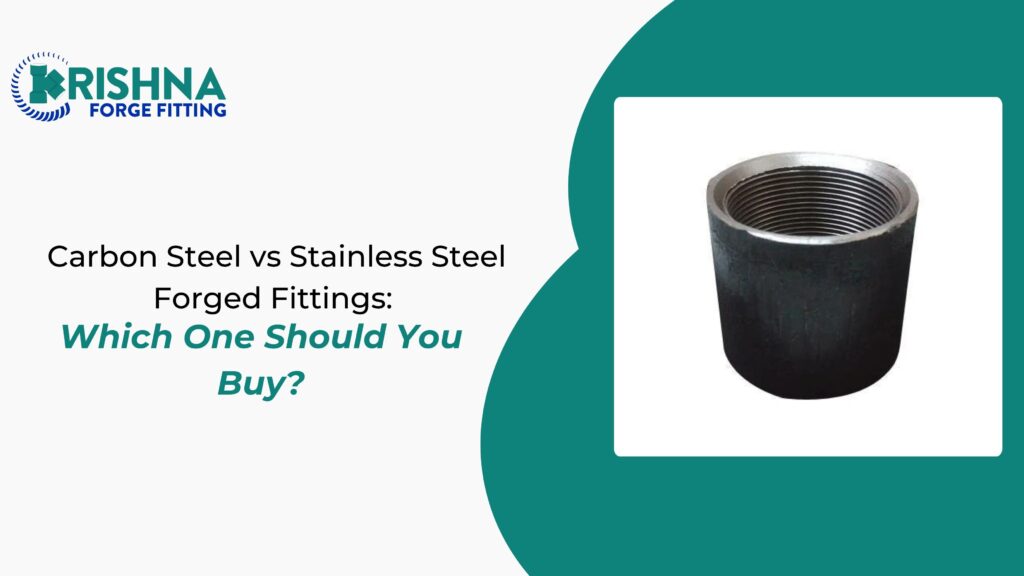
Most buyers settle this question on price per piece and regret it in year four. Stainless typically costs three to four times what carbon steel does for the same size and class, which looks decisive on a quotation and tells you almost nothing about which one belongs in your line. The right answer depends on what the fluid is, how wet the surroundings get, whether anyone can reach the fitting to recoat it, and how long the plant is meant to run. This guide sets out the material differences, the service conditions that decide the call, the cost picture over a full service life, and a selection method you can apply line by line. Krishna Forge Fitting forges both at Shapar, Rajkot.
What Separates the Two Materials
Carbon Steel
Carbon steel is iron plus carbon, with small additions of manganese and silicon. Forged fitting grades sit at the low end of the carbon range — ASTM A105 for standard service, A350 LF2 where low-temperature impact testing is required. Mild steel covers general fabrication and utility work.
Carbon steel gives you high strength, easy weldability, good thermal conductivity and the lowest cost per kilogram of any pressure-rated fitting material. It also has no inherent corrosion resistance. Protection comes from outside: galvanising, epoxy, paint, insulation, or a dry and treated fluid.
Stainless Steel
Stainless steel is iron with at least 10.5% chromium by mass, which forms a thin passive oxide layer that reforms on its own when scratched. The forged fitting grades are ASTM A182 F304, F304L, F316 and F316L.
The practical difference between 304 and 316 is molybdenum, roughly 2–3% in 316. That addition buys resistance to chlorides — seawater, coastal air, bleach, brines, many process acids. Where chlorides are present, 304 pits and 316 generally does not.
The “L” variants run lower carbon so chromium carbides do not precipitate at grain boundaries during welding. Specify L grades whenever the fitting will be welded and then exposed to a corrosive fluid.
Side-by-Side Comparison
| Property | Carbon steel (A105) | Stainless steel (A182 F304/F316) |
| Corrosion resistance | None inherent; relies on coating | Inherent, self-repairing passive layer |
| Relative purchase cost | Baseline | Roughly 3–4× |
| Strength | High tensile; heavier wall for same duty | Comparable; often thinner wall possible |
| Thermal conductivity | Higher — faster heat loss | Lower — better for insulated hot lines |
| Weldability | Straightforward, common consumables | Needs correct filler, purge, heat control |
| Product contamination risk | Rust can enter the stream | Negligible |
| Typical replacement interval in aggressive service | 10–15 years | 25–30 years or more |
| Scrap value at end of life | Low | Substantial |
Where Carbon Steel Is the Correct Choice
Carbon steel is not a compromise. It is the right specification in a large share of industrial piping.
- Steam and condensate lines — treated water, no oxygen ingress, high temperature where stainless offers no advantage
- Compressed air and nitrogen — dry, clean, indoor
- Hydraulic oil circuits — non-corrosive fluid, high pressure, where carbon steel’s strength per rupee wins outright
- Structural and general fabrication — brackets, supports, job work
- Fire sprinkler and utility water — galvanised, periodically inspected, replaceable
- Buried or insulated lines with a maintained coating system
If the fitting sits indoors, in a temperature-controlled space, carrying a clean or treated fluid, carbon steel will outlast the plant it serves.
Where Stainless Steel Earns Its Premium
- Chemical dosing and process lines — acids, caustics, oxidisers
- Water treatment plants — demineralised water is aggressive; chlorination adds chlorides
- Food, beverage, dairy and pharma — contamination is non-negotiable, and washdown chemistry attacks coatings
- Coastal and marine installations — salt spray defeats paint systems on a schedule nobody budgets for
- Fertiliser and petrochemical units — specific corrodents, specific grade
- Inaccessible or embedded runs — anything you cannot reach to recoat should not depend on a coating
A Line Worth Reading Twice
If you cannot physically get to a fitting to inspect and repaint it, the coating is not a corrosion strategy. It is a delay. Accessibility, not aggressiveness, is often the deciding variable.
The Cost Picture Over a Service Life
The purchase price gap is real and large. The lifecycle gap usually runs the other way.
- Purchase — stainless is 3–4× carbon steel.
- Coating and recoating — carbon steel in exposed service needs a paint system at install and renewal every few years. Labour dominates, not paint.
- Replacement cycles — in aggressive conditions, carbon steel may be replaced twice over the period a stainless fitting runs once.
- Downtime — a shutdown to change a corroded fitting costs more than the fitting by orders of magnitude in continuous process plants.
- Scrap recovery — stainless carries meaningful residual value; carbon steel does not.
The uncomfortable part for procurement: the department buying the fitting usually does not carry the maintenance budget, so the cheaper option looks better on the metric being measured. That misalignment, not metallurgy, is why the wrong material gets specified.
A Practical Selection Method
Run these five questions per line, not per project.
- What is the fluid? Name it and name its concentration and temperature. “Water” is not an answer — demineralised water, cooling tower water and potable water behave very differently.
- Are chlorides present? If yes, in the fluid or the surrounding air, go to 316 rather than 304.
- What is the external environment? Coastal, washdown, chemical vapour, outdoors unprotected — these attack the outside of a carbon steel fitting even when the fluid is benign.
- Can the fitting be reached for maintenance? If no, remove coating-dependent options.
- What is the design life? Under ten years with easy access, carbon steel. Twenty-five years in a wet environment, stainless.
Mixing the Two
Zoning is legitimate and common. Specify stainless at the high-risk points — exposed manifolds, washdown zones, salt spray areas, dosing headers — and carbon steel in protected interior runs. Where the two meet, the dissimilar joint becomes a galvanic cell in wet conditions, and carbon steel is the anode that corrodes. Use an isolation kit or a transition spool and keep electrolyte off the junction.
Why Forged, Whichever Material You Pick
Both materials come as forged or cast. Forging works heated bar under a closed die, so grain flow follows the part contour and there are no internal voids. Forged fittings are a single piece with no secondary joint and therefore no built-in leak path. They carry pressure classes of 2000, 3000, 6000 and 9000 lb, dimensioned to ASME B16.11 for socket weld and threaded ends, with NPT threads to ASME B1.20.1.
Choosing stainless and then accepting a cast part undoes most of what you paid for.
FAQs
Is stainless steel stronger than carbon steel? Not categorically. Austenitic stainless grades have comparable tensile strength and better high-temperature behaviour, while carbon steel often has higher yield strength at ambient. The decisive difference is corrosion resistance, not raw strength.
Can carbon steel fittings be used in corrosive service at all? Yes, with a maintained coating, cathodic protection, or a corrosion allowance built into the wall thickness. All three require ongoing attention. Where that attention cannot be guaranteed, specify stainless.
What is the difference between 304 and 316 in practice? 316 contains molybdenum and resists chlorides and many acids that pit 304. For coastal plants, brine service and bleach dosing, the gap is decisive. Inland, in clean water service, 304 is usually sufficient.
Can I weld stainless steel fittings to carbon steel pipe? Yes, with appropriate filler metal and procedure. The resulting dissimilar joint is galvanically active in wet service, so isolate it or use a transition piece.
Does stainless steel rust? It can. Chloride pitting, crevice corrosion under deposits, and surface contamination from carbon steel tooling all produce rust staining on stainless. Correct grade selection and keeping carbon steel grinding debris away during fabrication prevent most cases.
Get Both From One Forge
Specify the material against the service, then buy from the works that makes it. Krishna Forge Fitting manufactures and exports forged fittings in mild steel, stainless steel and GI — elbows, tees, couplings, half couplings, unions, nipples, pipe sockets, flanges, end caps and universal joint crosses — in socket weld and threaded ends, from our plant at Shapar, Veraval, Rajkot, Gujarat. We supply water treatment plants, sprinkler systems, steel plants, fertiliser units, boilers and heat exchangers, and take on MS job work to drawing.
