“As per ASME B16.11” appears on more purchase orders than any other phrase in fitting procurement, and on its own it specifies almost nothing you care about. The standard fixes dimensions, tolerances, classes and markings. It does not fix your material grade, your certification level, your thread form, your testing, or your NACE requirement — and every one of those is a live dispute waiting for a delivery date. This guide covers what B16.11 actually controls, the seven things it deliberately leaves out, what to measure on receipt, and the pre-order checklist that makes a rejected consignment nearly impossible.
What ASME B16.11 Is
Scope
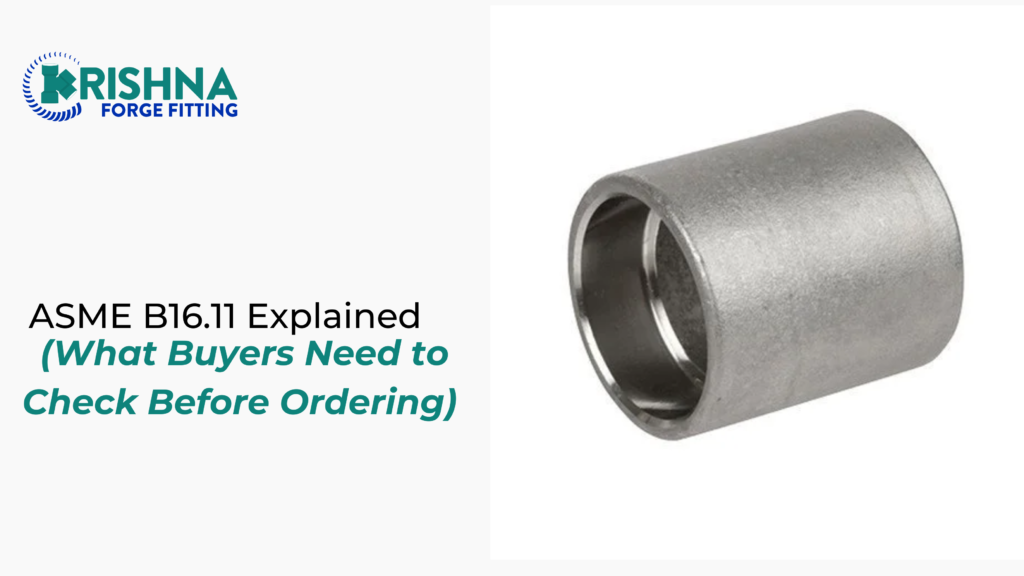
ASME B16.11 is the American National Standard for Forged Fittings, Socket-Welding and Threaded. It sets pressure-temperature ratings, dimensions, tolerances, markings and material requirements for these fittings.
It exists so that a socket weld elbow made in Rajkot and one made in Houston fit the same pipe and hold the same pressure.
The Two End Types
- Socket welding — the pipe enters a machined recess and is fillet welded
- Threaded — tapered threads seal on interference
Those two only. Butt weld fittings are ASME B16.9. Flanges are ASME B16.5.
Size Range
NPS 1/8 through NPS 4, depending on class and end type.
| Class | End type | Size range |
| 2000 | Threaded | 1/8 – 4 |
| 3000 | Threaded + socket weld | 1/8 – 4 |
| 6000 | Threaded + socket weld | 1/8 – 4 (threaded), 1/8 – 2 (SW) |
| 9000 | Socket weld only | 1/8 – 2 |
The Six Things the Standard Actually Fixes
Pressure Classes
Classes 2000, 3000, 6000 and 9000, with threaded and socket weld each getting a different subset. The class is a wall-thickness family tied to a pipe schedule, not a PSI value.
Dimensions
Centre-to-end and centre-to-bottom-of-socket for every fitting type and size. Socket bore diameter and depth. Body wall thickness. Thread engagement lengths. These are what make fittings interchangeable between makers.
Tolerances
Numbers worth knowing, because they are checkable:
- Socket bore to outside concentricity: 0.8 mm (0.03″) maximum
- Concentricity between opposing sockets: 1.6 mm (0.06″) maximum
- Bore and thread alignment: 1 mm per 200 mm maximum deviation
- Wall thickness: minimum thickness must not fall more than 12.5% below nominal
Materials by Reference
The standard does not define materials. It points at ASTM specifications — A105, A182, A350, and related forging standards — and says a fitting must be made from a listed one.
That referencing is the source of most confusion, and we come back to it below.
Markings
Permanent markings, on the body of the fitting.
Pressure-Temperature Ratings
Tables giving allowable working pressure against temperature for each class and material group. This is the part people reach for and the part most often applied to the wrong material group.
What ASME B16.11 Does NOT Cover
This is the section that matters. Every item below is something a supplier can legitimately decide for you if your order does not state it.
The Material Grade
B16.11 lists acceptable material specifications, not the grade you want. “As per B16.11” permits A105, F304, F316, F11, F22, LF2 and more — all compliant.
You must state the ASTM specification and grade on the order. “ASTM A182 F316L” — not “stainless”.
Certification Level
The standard says nothing about EN 10204 3.1 or 3.2, or about third-party inspection. A supplier can ship a compliant fitting with a self-declared 2.2 certificate.
State the certification level.
Thread Standard
B16.11 covers threaded fittings but refers thread form out to ASME B1.20.1 for NPT. If you want BSPT, that is ISO 7-1 and it is a different document entirely.
An order saying “threaded, as per B16.11” does not tell the manufacturer whether to cut NPT or BSPT. This is the single most common cause of a rejected threaded consignment.
State NPT to ASME B1.20.1 or BSPT to ISO 7-1, explicitly.
Installation and Welding
Explicitly outside scope. The expansion gap, fillet weld size, preheat, PWHT and inspection all come from the piping code — ASME B31.1 or B31.3 — not from B16.11.
If your order expects a supplier to advise on welding, it is asking the wrong document.
Pressure Testing
B16.11 does not require the manufacturer to pressure test fittings. It requires that they be capable of withstanding the hydrostatic test applied to the pipe they join.
If you want fittings hydrotested at works, that is an additional requirement you write in.
NACE, Impact Testing and PMI
None of these are in the standard:
- NACE MR0175 / ISO 15156 for sour service
- Charpy impact testing at low temperature
- Positive Material Identification to verify the alloy is what the certificate claims
Each has to be stated separately. PMI in particular is worth adding on any alloy or stainless order — grade substitution is the most profitable form of cheating in this product, and a handheld XRF check takes seconds.
Surface Finish and Preservation
No requirement for coating, oiling, end caps or packaging. Stainless fittings arriving loose in a wooden crate, picking up carbon steel contamination in transit, are technically compliant.
State preservation and packing requirements.
Tolerances Worth Measuring on Receipt
Pull ten pieces from every lot and check four things. Twenty minutes, and it catches most of what goes wrong.
- Wall thickness — measure the body at the thinnest visible point. Compare against the class’s matching schedule. This is the most common quiet substitution.
- Socket bore and depth — the pipe should enter with light clearance and reach a defined shoulder. Too tight means site grinding; too loose means the fillet has to bridge a gap.
- Socket concentricity — a bore visibly off-centre in the body will not weld square.
- Thread engagement — screw a matching gauge or a known-good pipe in by hand. It should take about 3 to 3.5 turns before going stiff.
Add a fifth for stainless and alloy: PMI on one piece per heat.
Markings — What Must Be on the Body
B16.11 requires these to be permanent and legible:
- Manufacturer’s name or trademark
- Material identification — the grade
- Class designation — 3000, 6000, 9000
- Size
- The B16 symbol, indicating conformance to the standard
- Heat number for traceability
Ink stamps that wipe off, adhesive labels only, or a stamp on the packaging rather than the part are all failures. Markings must survive handling and installation.
The Pre-Order Checklist
Twelve lines. Put them all on every order.
- Fitting type and shape
- Nominal size — both sizes on reducing items, written run × run × branch for tees
- Pressure class
- End type — socket weld or threaded
- Thread standard, if threaded — ASME B1.20.1 (NPT) or ISO 7-1 (BSPT), male or female per end
- Material specification and grade — ASTM A105N, A182 F316L, A350 LF2
- Heat treatment condition, where the grade permits options
- Matching pipe schedule, so the supplier verifies wall thickness against it
- Dimensional standard — ASME B16.11
- Certification level — EN 10204 3.1 or 3.2, and any third-party inspection
- Special requirements — NACE MR0175, impact testing at stated temperature, PMI, carbon equivalent cap
- Marking, preservation and packing requirements
The Receiving Inspection Routine
- Check the packing list against the purchase order line by line
- Read the markings on ten random pieces — grade, class, size, B16 symbol, heat number
- Match heat numbers on the parts to the mill certificates
- Verify chemistry and mechanical values on the certificates against the specification
- Measure wall thickness, socket bore and depth on those ten pieces
- Gauge the threads on threaded items
- PMI one piece per heat for alloy and stainless
- Confirm any special requirements are certified — NACE, impact values, CE
Common Disputes and How the Clause Prevents Them
| Dispute | The clause that prevents it |
| Wrong thread form supplied | Thread standard stated explicitly on the order |
| Thin walls | “Wall thickness to match Sch XX; verified before dispatch” |
| Wrong grade in the box | PMI requirement plus heat number traceability |
| No usable certificate | EN 10204 3.1 or 3.2 stated as a condition of dispatch |
| Unmarked fittings | “Marking per ASME B16.11 clause; unmarked material will be rejected” |
| Stainless contaminated in transit | Separate packing and preservation clause |
Each of those is one sentence at the ordering stage and a rejected container at the delivery stage. The asymmetry is the whole point.
FAQs
Does B16.11 apply to butt weld fittings? No. Butt weld fittings are ASME B16.9. B16.11 covers only socket welding and threaded forged fittings, NPS 1/8 to 4.
Is a Class 3000 fitting rated to 3,000 PSI? No. The class designates a wall-thickness family tied to a pipe schedule. Actual allowable pressure comes from the pressure-temperature tables for your specific material group and design temperature.
Can a fitting be marked B16 without meeting the standard? It should not be, and marking it so falsely is a misrepresentation. This is exactly why heat-number traceability and dimensional checks on receipt matter — the marking is a claim, and your inspection is the verification.
Does B16.11 cover fittings above NPS 4? No. Above NPS 4, small-bore forged construction gives way to butt weld fittings under ASME B16.9.
Which piping code governs installation? ASME B31.1 for power piping, B31.3 for process piping. Both cover the expansion gap, fillet weld size, preheat, PWHT and inspection — none of which sit in B16.11.
Conclusion
ASME B16.11 makes fittings interchangeable. It does not make your order complete. Write the grade, the thread standard, the certification level, the matching schedule and any special testing onto every line, and inspect ten pieces from every lot against them. That is the whole discipline.
If you want a second pair of eyes on a fitting specification before it goes out, send it across — we will mark up what is missing before you release it to the market.
About Krishna Forge
Krishna Forge manufactures socket welding and threaded forged fittings to ASME B16.11 — Classes 2000 through 9000, NPS 1/8 to 4, in carbon steel, stainless, alloy, low-temperature and duplex grades. Every piece is permanently marked with grade, class, size and heat number, dimensionally verified against the class before dispatch, and shipped with EN 10204 3.1 or 3.2 certification.
Send us your fitting specification for review and quotation.
