
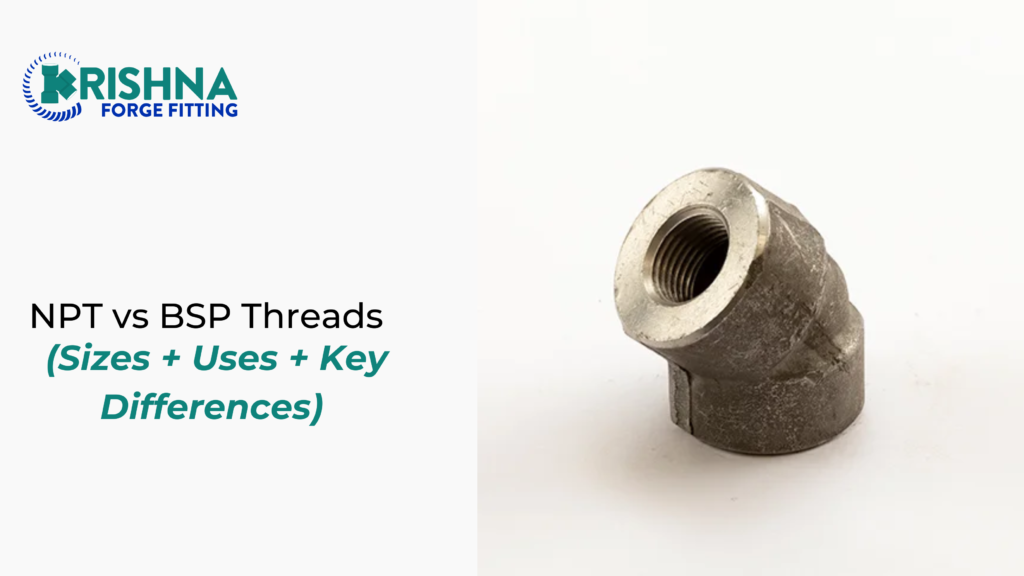
A half-inch NPT male and a half-inch BSPT female have the same nominal size and the same 14 threads per inch. They will screw together by hand. They will take sealant. They will look installed. And they will leak, because one is cut at 60° and the other at 55°, and the flanks never touch across their full face. This is the single most expensive small mistake in threaded piping. This guide covers what separates NPT, BSPT and BSPP, the size and TPI charts for each, where each one is used, and how to write the thread onto a purchase order so the wrong one never ships.
The Three Threads You Are Actually Choosing Between
Most people say “NPT or BSP”. There are really three options, and treating BSP as one thing is where a lot of the trouble starts.
NPT — Tapered, 60°
National Pipe Taper. Governed by ASME B1.20.1. The thread tapers at 1:16, the flanks sit at 60°, and the crests and roots are flat. It seals by metal-to-metal interference as the taper wedges — with sealant filling the small spiral leak path.
BSPT — Tapered, 55°
British Standard Pipe Taper, marked R. Governed by ISO 7-1, BS 21 and EN 10226. Same 1:16 taper as NPT. Flanks at 55°, with rounded crests and roots — the Whitworth profile. Also seals on the threads.
BSPP — Parallel, 55°
British Standard Pipe Parallel, marked G. Governed by ISO 228-1. No taper at all. It does not seal on the threads and never will. It seals on a bonded washer, an O-ring in a groove, or a machined 60° cone at the port face.
That last point catches people. A BSPP joint wrapped in PTFE tape and torqued hard is not sealed — it is jammed.
The Key Differences at a Glance
| Feature | NPT | BSPT | BSPP |
| Thread angle | 60° | 55° | 55° |
| Crest/root | Flat | Rounded | Rounded |
| Taper | 1:16 | 1:16 | None |
| Seals on | Threads | Threads | Washer or O-ring |
| Standard | ASME B1.20.1 | ISO 7-1 / BS 21 | ISO 228-1 |
| Marking | NPT | R | G |
Why the Crest Shape Matters More Than the Angle
The 5° angle difference gets all the attention. The rounded Whitworth crest matters just as much. Even where the angle and pitch happen to line up, an NPT flat crest bottoms out against a BSP rounded root and leaves a helical gap running the full length of the engagement.
Sealant can bridge that gap at 5 bar. It will not bridge it at 200 bar, and it will not survive thermal cycling at any pressure.
Size and TPI Charts
NPT
| Nominal size | TPI | Taper |
| 1/8″ | 27 | 1:16 |
| 1/4″ | 18 | 1:16 |
| 3/8″ | 18 | 1:16 |
| 1/2″ | 14 | 1:16 |
| 3/4″ | 14 | 1:16 |
| 1″ | 11.5 | 1:16 |
| 1 1/4″ – 2″ | 11.5 | 1:16 |
| 2 1/2″ – 4″ | 8 | 1:16 |
BSPT and BSPP
| Nominal size | TPI |
| 1/8″ | 28 |
| 1/4″ | 19 |
| 3/8″ | 19 |
| 1/2″ | 14 |
| 3/4″ | 14 |
| 1″ | 11 |
| 1 1/4″ – 2″ | 11 |
| 2 1/2″ – 4″ | 11 |
The Sizes Where TPI Matches and Still Fails
Look at 1/2″ and 3/4″. Both threads run 14 TPI. A pitch gauge alone will not tell them apart at those sizes — you have to check the angle.
Those two sizes account for a disproportionate share of thread mismatches in the field, for exactly that reason. They are also the two most-used sizes in instrument and utility piping. If you audit one thing on a mixed site, audit half-inch.
Where Each Thread Is Used
This is really a map question, and knowing it saves you from assuming.
NPT Territory
- United States, Canada, Mexico
- Oil and gas equipment built to American specs anywhere in the world
- Most refinery and petrochemical packages engineered by US EPCs
- North American hydraulic and pneumatic equipment
BSP Territory
- India, United Kingdom, Europe, Australia, New Zealand
- South Africa, Middle East, most of Southeast Asia
- China domestic market, alongside metric
- Most Japanese and European machine tools and hydraulic equipment
Industries That Run Both
Some plants live with a permanent mix, and they are the ones that need the tightest discipline:
- Oil and gas in India and the Gulf — American process packages sitting inside BSP-standard plant piping
- Marine and shipbuilding — hulls built in one region, machinery sourced from another
- Imported machinery of any kind — a European press dropped into an NPT plant, or the reverse
- Instrumentation — transmitters and gauges frequently arrive NPT even in BSP plants, because the instrument makers are American
The instrumentation one is worth flagging. Plants that standardised on BSP twenty years ago often have hundreds of NPT tapping points nobody documented, because that is how the transmitters shipped.
What Happens When You Mix Them
The Two-Turn Symptom
A correctly matched tapered joint takes about 3 to 3.5 turns by hand before it goes stiff, then another 2 to 3 turns with a wrench. A mismatched pair behaves differently — it either goes stiff far too early because the crests interfere, or runs on far too long and never firms up.
If a joint feels wrong on the wrench, stop. Do not add force. Back it out and gauge it.
Why Sealant Hides the Problem
PTFE tape and anaerobic sealant will make almost any mismatched joint hold a hydrotest. That is the trap. The hydrotest passes, the line goes into service, and the joint weeps three months later under temperature cycling — usually somewhere inconvenient.
Worse, forcing a mismatched male into a female fitting deforms both. The female fitting is now damaged and will not seal correctly against the right thread either. One wrong assembly can scrap two parts.
How to Identify a Thread in Two Minutes
With a Pitch Gauge
Use a gauge with both 55° and 60° blades. Lay the blade against the thread and hold it to the light. The correct blade shows no light gap along the flanks. This is definitive.
With a Caliper
Measure the outside diameter of a male thread at the first full thread and again four threads back. A difference means it is tapered — NPT or BSPT. No difference means BSPP. Then check the angle to split NPT from BSPT.
Also remember the nominal size is not the measured size. A “1/2 inch” NPT male measures about 21.3 mm across, not 12.7 mm.
From the Marking
Look for NPT, R (BSPT male), Rc (BSPT female), G (BSPP). On forged fittings the marking sits on the body alongside the class and grade. If it is absent, gauge it — do not assume.
How to Specify Threads on a Purchase Order
This is where the mismatch actually gets stopped. Write all four of these on every line item:
- The thread designation — “NPT” or “BSPT (R/Rc)” or “BSPP (G)”. Never just “BSP”, which does not identify taper.
- The governing standard — ASME B1.20.1, ISO 7-1, or ISO 228-1.
- Male or female for each end, stated separately on reducing and adapter items.
- A gauging requirement — “threads to be checked with ring and plug gauges per the applicable standard; gauge report to accompany the consignment.”
Add one clause: “Fittings supplied with a thread form other than that specified will be rejected in full at the supplier’s cost.” That single sentence changes how carefully a supplier reads your order.
FAQs
Can I use an adapter between NPT and BSP? Yes, and it is the correct fix. Use a purpose-made adapter with the correct thread cut on each end. Never force a direct connection.
Is BSPP ever acceptable without a washer or O-ring? No. BSPP has no taper and cannot seal on the threads. If a port has no seat for a seal, it is not a BSPP port.
Which thread handles higher pressure? Neither has an inherent advantage. Pressure capability comes from the fitting’s class and material, not the thread form. A properly gauged, correctly matched joint in either standard performs the same.
Do I still need sealant on a matched tapered joint? Yes. Both NPT and BSPT leave a small helical path at the crest. PTFE tape or an anaerobic pipe sealant fills it. Apply in the direction of thread engagement and keep it off the first thread so nothing shreds into the line.
How many turns should a tapered thread take? Roughly 3 to 3.5 hand-tight, plus 2 to 3 with a wrench. Significantly fewer or more usually means a mismatch or a worn thread.
Conclusion
NPT is 60° and flat-crested. BSPT is 55° and round-crested. BSPP is 55°, parallel, and seals on a washer. Nominal size and TPI will not tell them apart at half-inch and three-quarter-inch — the angle will. Specify the standard, not the nickname, and gauge what arrives.
If you are ordering threaded fittings into a mixed-thread plant, send us your tie-in list and we will confirm the thread form line by line before anything is cut.
About Krishna Forge
Krishna Forge cuts NPT threads to ASME B1.20.1 and BSPT threads to ISO 7-1 on forged fittings in Classes 2000 through 6000, NPS 1/8 to 4, across carbon steel, stainless, alloy and low-temperature grades. Every threaded lot is ring and plug gauged before dispatch, and the gauge report ships with the consignment.
Send us your threaded fitting requirement today.
