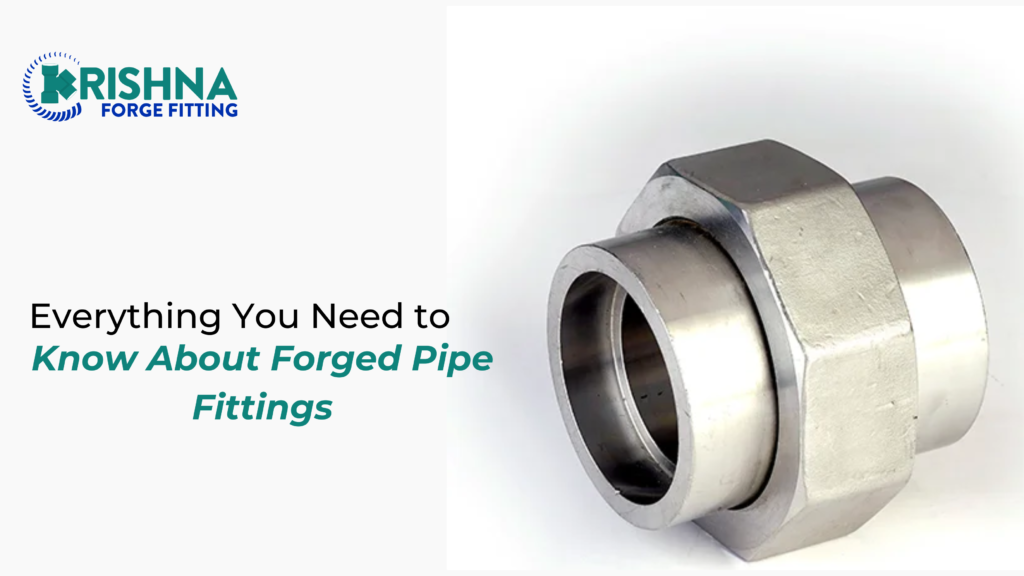
Most piping failures do not start at the pipe. They start at a two-inch fitting that nobody inspected, in a line that runs at 3,000 PSI. Forged pipe fittings carry the highest stress per rupee of any component you buy, and they are the easiest to get wrong — wrong class, wrong thread, wrong grade, right paperwork. This guide walks through what a forged fitting is, how socket weld and threaded types differ, what the pressure classes actually mean, which materials belong in which service, and how to check a fitting before it goes into your line.
What a Forged Pipe Fitting Actually Is
A forged fitting is shaped by squeezing hot steel under pressure in a closed die, then machining it to final dimensions. No pouring. No molten metal filling a cavity. The metal is worked while solid.
That difference decides everything downstream.
Forged vs Cast vs Machined From Bar
- Cast fittings solidify from liquid metal. Gas gets trapped, shrinkage voids form, and the grain structure is random. Fine for low-pressure water lines. Not fine for steam headers.
- Machined-from-bar fittings cut across the grain. The flow lines get severed at exactly the corners that see the most stress.
- Forged fittings keep the grain flowing around the contour of the part. The metal streamlines follow the shape instead of being cut through it.
Why Grain Flow Decides Strength
Here is the part most buyers never hear. Forging does not just remove porosity — it aligns the grain along the load path. A forged elbow tested to destruction typically fails well outside its rated pressure, and it fails by bulging rather than by cracking open. Cast parts fail at voids, without warning, at loads that look safe on paper.
This is why every high-pressure code in the world routes you to forged small-bore fittings above roughly Class 800 service.
The Two Connection Types
Forged fittings come in exactly two joint styles. Pick the wrong one and everything else you specify stops mattering.
Socket Weld Fittings
The pipe slides into a machined recess and gets fillet-welded around the outside. Strong, leak-tight, and permanent.
- Best for high pressure, high temperature, flammable and toxic service
- No leak paths through threads
- Requires a welder, a WPS, and usually NDT
- Leave a 1.6 mm (1/16″) gap at the socket bottom before welding — this lets the weld metal expand instead of cracking the root
That gap is the single most-skipped step on site. Bottom the pipe out, weld it, and thermal expansion puts the fillet in tension from day one.
Threaded Fittings
Male and female tapered threads pull together and seal on the flanks.
- No hot work — usable in running plants and hazardous zones
- Fast to install and dismantle
- Needs sealant or PTFE tape
- Not suitable for cyclic, vibrating or severe-service lines
How to Choose Between Them
| Condition | Go socket weld | Go threaded |
| Hydrocarbon or toxic media | Yes | No |
| Frequent dismantling needed | No | Yes |
| Vibration or thermal cycling | Yes | No |
| Hot work permit unavailable | No | Yes |
| Steam above 150 PSI | Yes | No |
The Full Shape Range
Every forged fitting you will ever order comes from a short list.
- Elbows — 45° and 90°, for direction change
- Tees — equal and reducing, for branch takeoffs
- Couplings, half couplings, reducing inserts — for straight joins and size steps
- Unions — three-piece, for planned dismantling points
- Caps and plugs — for line ends and test points
- Crosses — four-way, common in fire and instrument lines
- Bushings and nipples — for thread transitions
Most projects consume elbows, tees and couplings in roughly a 5:2:3 ratio. Order accordingly.
Pressure Classes Explained
Forged fittings are rated by class, not by a PSI number stamped on the part.
Class 2000, 3000, 6000 and 9000
- Class 2000 — threaded only, light service
- Class 3000 — the workhorse; matches Sch 80 pipe
- Class 6000 — matches Sch 160 pipe
- Class 9000 — socket weld only, matches XXS pipe
How Class Maps to Pipe Schedule
This is the rule buyers forget: the class exists to match the fitting to the pipe wall, not to a pressure you pick from a catalogue. A Class 6000 fitting welded to Sch 80 pipe is wasted money — the pipe fails first. A Class 3000 fitting on Sch 160 pipe is a weak link you paid to install.
Match the class to the schedule. Then check the temperature derating in ASME B16.11 for the actual grade you bought.
Size Limits per Class
- Class 2000 and 3000: NPS 1/8 to 4
- Class 6000: NPS 1/8 to 2 (socket weld) and up to 4 (threaded)
- Class 9000: NPS 1/8 to 2, socket weld only
If a supplier quotes you a Class 9000 socket weld 3-inch fitting, the standard does not cover it. Ask what it is being made to.
Materials and Grades
- ASTM A105 — carbon steel, the default for water, oil, steam and general service up to about 425°C
- ASTM A182 F304 / F304L — general corrosion resistance, food and chemical lines
- ASTM A182 F316 / F316L — adds molybdenum; handles chlorides and marine service
- ASTM A182 F11, F22, F5, F9, F91 — chrome-moly alloys for high-temperature power and refinery service
- ASTM A350 LF2 — impact-tested carbon steel for temperatures down to −46°C
- Duplex F51 / F53 — high strength plus chloride resistance, offshore and desalination
The L grades matter more than most buyers assume. Standard F304 welded and left uncooled can sensitise and fail by intergranular corrosion in service that F304L survives for decades.
Governing Standards
- ASME B16.11 — dimensions, tolerances, pressure classes and markings for socket weld and threaded forged fittings
- ASME B1.20.1 — NPT threads, the North American standard
- ISO 7-1 / BS 21 — BSPT threads, common across India, Europe, the Gulf and Asia
- MSS SP-79, SP-83, SP-97 — reducing inserts, unions and integrally reinforced branch outlets
Where Forged Fittings Are Used
Oil, Gas and Petrochemical
Small-bore process piping, sample lines, drain and vent connections, instrument tapping points.
Power and Steam
Boiler feed lines, blowdown, soot blower piping, steam trap stations. Chrome-moly grades dominate.
Hydraulics, Chemical and Instrumentation
Hydraulic power packs, dosing skids, impulse lines to transmitters. Threaded Class 3000 covers most of it.
How to Read a Fitting Before You Accept It
Here is where most procurement teams stop early. A fitting arriving in a box with a certificate is not the same as a compliant fitting.
Required Markings
ASME B16.11 requires every fitting to carry, permanently:
- Manufacturer’s name or trademark
- Material grade (for example, A105 or F316)
- Class designation (3000, 6000, 9000)
- Size
- Heat number, traceable to the mill certificate
An unmarked or ink-stamped-only fitting is a red flag. Markings must survive handling.
Documents That Should Arrive With the Box
- EN 10204 3.1 or 3.2 mill test certificate
- Chemical analysis matching the grade
- Mechanical properties — tensile, yield, elongation, hardness
- Impact test values where LF2 or low-temperature service applies
- Heat number matching the stamp on the part
Five Defects You Can Spot Without a Lab
- Socket bore out of round — the pipe will not seat square, and the fillet will be uneven
- Thread taper wrong — the fitting bottoms out too early or takes too many turns
- Visible parting line flash left unmachined at the crotch of a tee
- Wall thickness thinner than the matching pipe schedule — measure it
- Surface scale or forging laps in the socket, which trap moisture and start pitting
Check ten pieces from every lot. It takes twenty minutes and catches most of what goes wrong.
Ordering Checklist
Give your supplier all seven, every time:
- Fitting type and shape
- Nominal size (and both sizes for reducing items)
- Pressure class
- End connection — socket weld or threaded, and thread standard
- Material grade and specification
- Applicable standard — ASME B16.11 plus any client spec
- Certification level and any third-party inspection requirement
Missing item four is the most common cause of a rejected consignment. NPT and BSPT look identical in a photograph and will not seal against each other.
FAQs
Can I mix a forged fitting with a butt weld fitting in the same line? Yes, and it is normal. Forged fittings cover NPS 1/8 to 4; butt weld takes over above that. Just confirm the wall thickness matches at the transition.
Does a Class 3000 fitting hold 3,000 PSI? No. The number is a class designation, not a pressure. Actual working pressure depends on material grade and temperature, and comes from the rating tables in ASME B16.11.
Are threaded and socket weld fittings the same price? Usually within 10–15% for the same class and grade. The real cost difference is installation — socket weld needs a qualified welder and inspection.
How long do forged fittings last? In clean, non-corrosive service, longer than the pipe around them. Corrosion allowance and media chemistry decide the life, not the fitting.
What is the difference between a coupling and a union? A coupling is a permanent join. A union has three pieces and can be broken and remade without cutting the line.
Conclusion
Forged fittings are cheap components in expensive lines. Specify the class against the pipe schedule, match the thread standard exactly, insist on heat-number traceability, and check ten pieces from every lot. That is most of the job.
If you are drawing up a fitting requirement now, send us the line list and service conditions — we will come back with the class, grade and quantity breakup.
About Krishna Forge
Krishna Forge manufactures socket weld and threaded forged fittings to ASME B16.11 in carbon steel, stainless, alloy and low-temperature grades, from NPS 1/8 to 4, in Classes 2000 through 9000. Every fitting leaves our plant stamped with heat number, grade and class, backed by a mill certificate you can trace.
Send us your fitting schedule for a quote.
