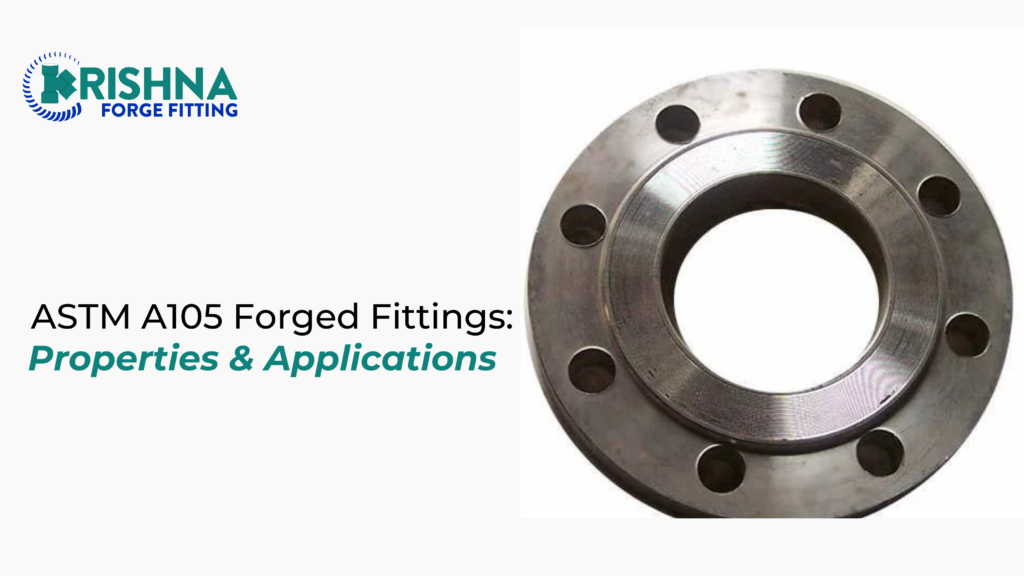
A105 is the most specified carbon steel in the fittings business, and the most casually substituted. Mill certificates get copied, grades get “equivalent,” and the difference only shows up when a flange leaks at temperature or a weld cracks in the heat-affected zone. The specification itself is short and precise — composition limits, a carbon equivalent cap, four mechanical numbers, and a temperature window. This guide walks through all of it, then covers what A105 is good for, where it is the wrong call, and how to check the material you were actually sent. Krishna Forge forges to this spec.
What ASTM A105 Covers
ASTM A105 is the standard specification for forged carbon steel piping components for ambient and higher-temperature service. It covers flanges, fittings, valves and similar parts in pressure systems.
Note what it is not. It is not a pipe spec, not a plate spec, and not a casting spec. If a supplier offers you a cast “A105 equivalent” fitting, they have moved outside the specification entirely.
Dimensionally, forged A105 fittings are made to ASME B16.11 for threaded and socket weld types, and ASME B16.5 for flanges.
Chemical Composition
| Element | Limit (%) |
| Carbon | 0.35 max |
| Manganese | 0.60 – 1.05 |
| Phosphorus | 0.035 max |
| Sulphur | 0.040 max |
| Silicon | 0.10 – 0.35 |
| Copper | 0.40 max |
| Nickel | 0.40 max |
| Chromium | 0.30 max |
| Molybdenum | 0.12 max |
| Vanadium | 0.08 max |
The combined total of copper, nickel, chromium, molybdenum and vanadium must not exceed 1.00%.
Carbon Equivalent and Why It Matters
A105 caps carbon equivalent at 0.47 maximum, calculated by the standard IIW formula that weights manganese, chromium, molybdenum, vanadium, nickel and copper alongside carbon.
This is the number field engineers should care about most and buyers check least. Carbon equivalent predicts weldability. A fitting sitting at 0.46 CE and one at 0.35 CE both pass the spec, both carry a valid certificate, and they behave very differently under the torch. The high-CE part needs preheat and controlled cooling or the heat-affected zone hardens and cracks.
If your shop welds A105 without preheat and mostly gets away with it, you have been buying at the low end of the range without knowing. The day a compliant high-CE heat arrives, the cracks show up and everyone blames the welder.
Mechanical Properties
| Property | Requirement |
| Tensile strength | 70 ksi (485 MPa) minimum |
| Yield strength | 36 ksi (250 MPa) minimum |
| Elongation in 2 in. | 22% to 30% depending on specimen |
| Reduction of area | 30% minimum |
| Hardness | 187 HBW maximum for most sizes; typical range 137–197 HBW |
These are minimums, not targets. A good forging comfortably exceeds them. The hardness ceiling exists partly for machinability and partly as an indirect check that the material has not been over-hardened.
Heat Treatment: A105, A105N and A105-QT
The base specification does not require heat treatment for most sizes and pressure classes. Where it is required — larger sizes, Class 300 and above under certain conditions — the standard permits annealing, normalizing, or quench and temper.
- A105 — as forged, where the standard permits it
- A105N — normalized. Heated above the critical temperature, then cooled in still air. Grain structure refines; toughness and consistency improve.
- A105-QT — quenched and tempered. Higher strength, tighter grain, and the option to meet impact test requirements.
Chemistry is identical across all three. What changes is grain structure, and grain structure is what determines toughness. If your service involves impact loading, thermal cycling, or a customer specification calling for Charpy testing, ask for A105N and get the heat treatment noted on the certificate.
Temperature and Pressure Limits
The service window for A105 runs from -20°F to 800°F (-29°C to 425°C).
Both ends matter:
- Below -29°C, A105 has no guaranteed notch toughness. Carbon steel goes through a ductile-to-brittle transition, and below it a fitting can fail suddenly with no plastic warning. This is what ASTM A350 LF2 exists for.
- Above about 425°C, sustained service risks graphitization — carbide decomposing into graphite flakes over thousands of hours, which quietly destroys creep strength. ASME allows higher temperatures with derated pressures, but for long-term service at elevated temperature, alloy steels like A182 F11 or F22 are the correct answer.
Pressure ratings come from the class and the standard, not the material alone: Class 2000, 3000 and 6000 for threaded fittings, and Class 3000, 6000 and 9000 for socket weld, all to ASME B16.11.
Which Fittings Are Made from A105
- Threaded and socket weld elbows, 45° and 90°
- Equal and reducing tees
- Full couplings, half couplings and reducing couplings
- Hex nipples, hex bushings and plugs
- Unions
- End caps
- Weld neck, slip-on, blind, socket weld and threaded flanges
Applications by Industry
- Oil and gas — wellhead piping, gathering lines, process skids, instrument hook-ups
- Refineries and petrochemicals — utility and process lines within the temperature window
- Power generation — feedwater, condensate and auxiliary steam service
- Steel plants — hydraulic, lubrication and compressed air headers
- Fertiliser and chemical plants — non-corrosive service lines
- Water treatment — high-pressure pumping and distribution
- Boilers and heat exchangers — connections within the allowable range
A105 vs Other Common Grades
| Grade | Use it when |
| A105 | General carbon steel service, -29°C to 425°C |
| A350 LF2 | Low temperature service; impact tested at -46°C |
| A182 F11 / F22 | Sustained elevated temperature; chrome-moly creep strength |
| A182 F304 / F304L | Corrosion resistance needed; general stainless |
| A182 F316 / F316L | Chlorides, salt air, aggressive chemicals |
A105 is not a compromise grade. Within its window it is stronger, cheaper, easier to weld and easier to machine than the alternatives. Outside its window it is the wrong material regardless of price.
Manufacturing and Quality Control
A proper A105 fitting is hot forged, not machined from a bar and not cast. Forging aligns the grain flow around the shape, which is where the fatigue and pressure resistance come from.
The sequence:
- Billet cut from certified, traceable raw material
- Heated to forging temperature and formed in a die
- Trimmed, then heat treated where the spec or order requires
- Machined — bore, threads, socket counterbore, face
- Dimensional inspection against ASME B16.11 or B16.5
- Hardness check, and mechanical or chemical testing per the order
- Marking and documentation
How to Verify You Actually Received A105
- Read the marking. A105 fittings carry the grade, the manufacturer’s mark, the class, size and heat number.
- Match the heat number to the certificate. A mill test report that does not name the heat number stamped on the part proves nothing.
- Check the carbon equivalent is actually printed. Many certificates list composition but omit CE. Ask for it.
- Confirm the heat treatment condition if you specified A105N.
- Run PMI on critical orders. Positive material identification takes seconds and settles the question.
- Check the hardness. It is a quick, cheap, non-destructive sanity check on the whole batch.
Where A105 Is the Wrong Choice
- Cryogenic or cold-climate service below -29°C
- Sustained service above 425°C
- Any corrosive fluid — sour service, chlorides, acids
- Hygienic or food-contact duty
- Anywhere the specification calls for impact testing that A105 is not certified to meet
FAQs
What is the difference between A105 and A105N? Chemistry is the same. A105N has been normalized — heated above the critical temperature and air cooled — which refines the grain and improves toughness and consistency. Specify A105N when impact properties, thermal cycling, or a customer spec demand it.
Can A105 fittings be used in low-temperature service? Not below -29°C. A105 carries no impact testing requirement at low temperature, and carbon steel loses toughness sharply below its transition point. ASTM A350 LF2 is the correct low-temperature equivalent, with Charpy testing built into the specification.
Is A105 the same as A106? No, and confusing them is common. A105 is a forging specification for fittings, flanges and valves. A106 is a seamless pipe specification. They are used in the same system and are not interchangeable.
Do I need a carbon equivalent value on my certificate? If anyone is going to weld the fitting, yes. Carbon equivalent tells your welding engineer whether preheat is required. Two fittings that both pass A105 can sit at very different points on the CE range and need very different welding procedures.
Can A105 fittings be galvanised? Yes, hot-dip galvanising is common for outdoor and water service. Be aware that galvanising takes the part through a zinc bath at around 450°C, and that the coating imposes its own temperature ceiling in service — roughly 200°C before the zinc layer begins to degrade.
The Bottom Line
ASTM A105 is a narrow, well-drawn specification: fixed composition limits, a carbon equivalent cap, four mechanical minimums, and a service window from -29°C to 425°C. Inside that window it is the best value carbon steel available for forged fittings. Outside it, no amount of good manufacturing makes it right. Check the marking, match the heat number, and ask for the carbon equivalent — those three habits eliminate most material problems before they reach the line.
Krishna Forge manufactures forged A105 fittings — elbows, tees, couplings, sockets, nipples, end caps and flanges — with traceable raw material, controlled forging, dimensional inspection to ASME B16.11 and full test documentation on request.
Send us your size, class and quantity. Request a quote from Krishna Forge and get A105 fittings with paperwork that stands up to inspection.
