
Introduction
A cap fitting looks like the simplest component in a piping system — a small piece of metal that closes off an open end. But in high-temperature service, that simplicity is deceptive. Pick the wrong material or the wrong design, and you’re not just risking a leak. You’re risking creep deformation, oxidation failure, or a dead-leg corrosion problem that takes months to show up and hours to cause real damage.
This piece walks through what actually changes when a cap fitting moves from room-temperature water lines into superheated steam, refinery process lines, or boiler systems running above 450°C. We’ll cover the materials that hold up, the design choices that matter, the standards that govern compliance, and the mistakes that quietly shorten service life. By the end, you’ll have a clear framework for specifying cap fittings that perform under heat instead of just surviving the first inspection.
What is a cap fitting
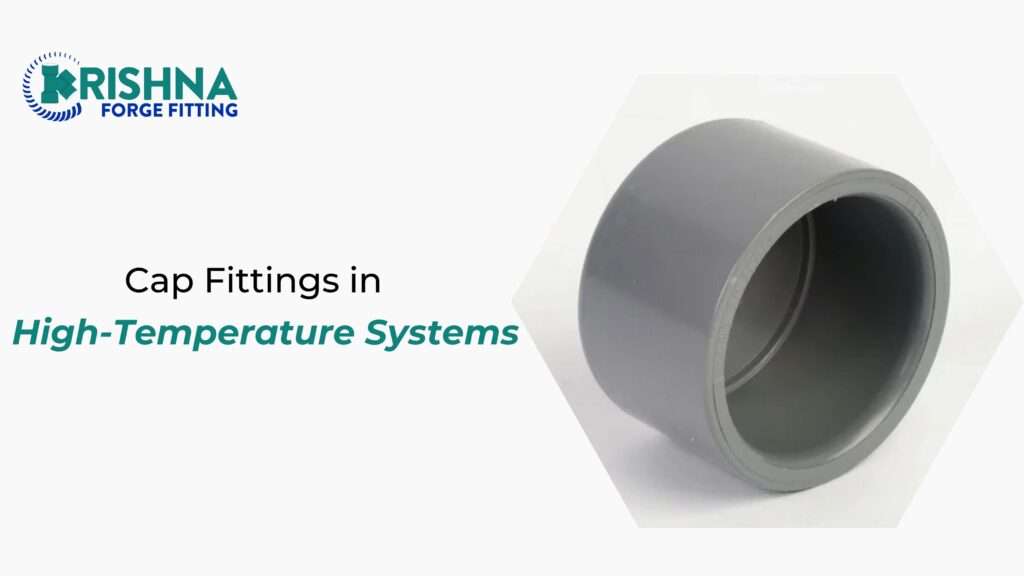
A cap fitting closes off the open end of a pipe. It has a female connection — either threaded or prepared for welding — that fits over the pipe’s outer diameter or beveled edge.
That’s the whole job: seal the end, hold the pressure, and do it without becoming the weak point in the system. In high-temperature service, all three of those requirements get harder to meet at once.
Cap vs. plug — a quick distinction
- A cap fits over the pipe end (female connection)
- A plug fits into a threaded opening (male connection)
- Caps are the standard choice for sealing bare pipe ends; plugs close off fitting ports
Why heat changes the equation
Temperature doesn’t just make metal hot. It changes how metal behaves under stress, and that behavior shift is where most cap fitting failures start.
Creep resistance
Above a certain temperature threshold, metal deforms slowly under constant stress — even at pressures well below its rated yield strength. This is creep, and it’s a time-dependent failure mode. A cap that looks fine on day one can thin out and fail after months of continuous high-temperature exposure.
Thermal expansion
Pipes and fittings expand as they heat up, and that expansion isn’t uniform across a mismatched material pairing. A cap made from a different alloy than the parent pipe expands at a different rate, which builds stress at the weld or thread interface every time the system heats and cools.
Oxidation and scaling
At sustained high temperatures, exposed metal reacts with oxygen and forms scale on the surface. Left unchecked, that scaling eats into wall thickness over time — which is exactly why chromium content matters so much in high-temp alloy selection.
Materials that hold up in high-temperature service
Material selection is the single biggest lever you have. Here’s how the common options stack up:
- Carbon steel (ASTM A234 WPB) — solid for moderate temperatures and standard-duty steam service; loses strength faster as temperatures climb into severe ranges
- Alloy steel (ASTM A234 WP11, WP22) — chromium-molybdenum composition built specifically for creep resistance in high-temperature steam service
- Stainless steel (ASTM A403 WP304L/WP316L) — strong oxidation resistance, common in chemical processing where both heat and corrosive exposure are factors
- Chromium-molybdenum alloys generally — the practical middle ground between cost and high-temperature performance
- PVC and CPVC — fine for hot water lines, but not rated for true high-temperature industrial service
One pattern worth flagging: procurement teams often default to carbon steel because it’s cheaper and familiar, then discover mid-project that the operating temperature exceeds its practical service range. That’s not a materials problem — it’s a spec-review problem that shows up late and costs more to fix than it would have to catch upfront.
Design and installation methods
Buttweld caps
These have beveled ends that weld directly to the pipe, creating a joint as strong as the pipe itself. This is the standard choice for large-diameter, high-pressure, high-temperature lines because there’s no thread interface to become a weak point.
Socket weld caps
Inserted over the pipe end and then welded, these suit smaller-diameter high-temperature and high-pressure applications where a buttweld isn’t practical.
Threaded caps
Screwed onto a male-threaded pipe end. These work for lower-pressure, lower-temperature service, but thread interfaces are more prone to leak paths under thermal cycling than welded connections.
For genuinely high-temperature systems, welded caps (buttweld or socket weld) are almost always the more reliable choice over threaded ones.
Standards that govern compliance
Cap fittings in industrial high-temperature service aren’t a guess-and-check component. They’re governed by specific codes:
- ASME B16.9 — dimensional and design standards for factory-made wrought buttwelding fittings
- ASTM A234 — covers wrought carbon and alloy steel fittings for moderate and high-temperature service
- ASTM A403 — covers wrought austenitic stainless steel fittings
Matching the cap’s metallurgy to the parent pipe isn’t optional. A mismatch invites galvanic corrosion at the joint, and it can also disqualify the assembly from meeting the pressure-temperature rating the system was designed around.
Where these matter most
High-temperature cap fittings show up across a narrow band of demanding industries:
- Power generation — steam pipelines running continuously at high pressure and temperature
- Petrochemical and refining — superheated process lines carrying reactive fluids
- Chemical processing plants — combined heat and corrosive exposure
- Boiler and heat exchanger systems — cyclical heating and cooling that stresses joints repeatedly
Risks of getting it wrong
Dead-leg corrosion
A capped-off section with no flow becomes a dead leg. Stagnant fluid trapped behind a cap in a hot system can lead to localized corrosion or microbial buildup — a slow problem that’s often invisible until a pressure test or inspection catches it.
Thermal cycling fatigue
Systems that heat and cool repeatedly put cyclical stress on the cap’s joint. A cap rated for static high-temperature service isn’t automatically rated for the fatigue that comes with cycling.
Getting the material, design, and standard right on the first spec avoids all three of these — a dead leg, a cycling failure, and a mismatched-metallurgy joint — from becoming a mid-project surprise.
FAQs
Can a carbon steel cap handle high-temperature steam service? Standard carbon steel (A234 WPB) works for moderate temperatures, but as service temperatures climb into severe steam conditions, alloy steel grades like WP11 or WP22 become necessary for adequate creep resistance.
Is a threaded cap ever appropriate for high-temperature systems? Threaded caps are generally reserved for lower-pressure, lower-temperature applications. For sustained high-heat service, buttweld or socket weld caps offer a more reliable seal without a thread interface to fail.
Why does the cap’s material need to match the pipe’s material? Mismatched metallurgy creates uneven thermal expansion and can trigger galvanic corrosion at the joint — both of which shorten service life and compromise the pressure rating of the assembly.
What’s a dead leg, and why does it matter for cap fittings? A dead leg is a section of piping with no active flow, often created behind a cap. In high-temperature systems, stagnant fluid in a dead leg can lead to localized corrosion that’s hard to detect until inspection.
How do I know if I need a buttweld or socket weld cap? Buttweld caps suit larger-diameter, high-pressure lines and create a joint as strong as the pipe itself. Socket weld caps work well for smaller-diameter high-temperature applications where a buttweld isn’t practical.
Conclusion
Cap fittings look like a minor line item, but in high-temperature systems, they carry real consequences for creep resistance, corrosion, and long-term pressure integrity. Match the material and design to the actual operating conditions, and the cap does its job quietly for the life of the system.
At Krishna Forge, we manufacture cap fittings in carbon steel, alloy steel, and stainless steel grades built to hold up under sustained high-temperature service — specced to ASME and ASTM standards from the start. Browse our high-temperature cap fittings at www.krishnaforge.com and get the metallurgy right the first time.
