
Introduction
Pipe nipples cause more unplanned maintenance calls than almost any other fitting category—not because they are complex, but because they are treated as interchangeable. Field data from industrial piping maintenance logs shows 40–50% of threaded joint leaks trace back to the wrong nipple type being installed: a close nipple where a barrel nipple was needed, an NPT thread forced into a BSP fitting, or a Schedule 40 wall where Schedule 80 was required. The fitting costs pennies; the rework costs hours.
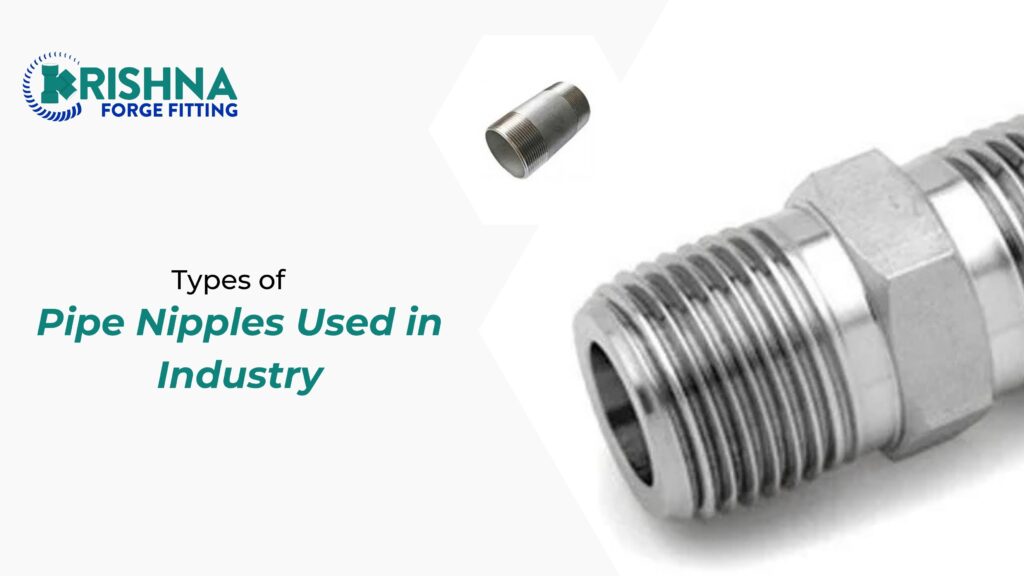
A pipe nipple is a short length of pipe with external (male) threads at one or both ends, used to connect two female-threaded fittings or extend a pipe run. Industry uses at least ten distinct nipple types, each suited to specific installation constraints, pressure requirements, and access conditions.
This guide covers every major nipple type, their end configurations, material grades, pressure-schedule relationships, and the installation details that prevent joint failures.
Standard Nipple Types
Close Nipples
Close nipples are fully threaded end-to-end with no unthreaded centre section. They bring two female fittings as close together as thread length allows—typically under 25 mm apart for small pipe sizes. The fully threaded construction leaves no flat section for wrench grip, making controlled torque difficult without a pipe wrench applied directly to threads.
Use close nipples in tight manifold assemblies, instrument gauge connections, and compact valve clusters where fitting-to-fitting clearance is the design constraint.
Barrel (Running) Nipples
Barrel nipples carry an unthreaded plain centre section between two threaded ends. The plain middle accepts wrench grip without risk of thread damage. Length ranges from 50 mm through 300 mm in standard increments, making these the most commonly stocked nipple type across industrial supply chains.
They suit straight pipe extensions, bridging gaps between fittings, and any application where installation torque control matters.
Hex Nipples
Hex nipples feature a machined hexagonal centre section that accepts a standard open-end or box spanner. This geometry allows precise torque application without slippage onto thread roots. Instrument connections, pressure gauge taps, and chemical injection points favour hex nipples because controlled tightening prevents thread galling—a common failure mode in stainless-to-stainless assemblies.
Shoulder Nipples
Shoulder nipples have a machined step or stop at one end that limits thread engagement depth. This stop ensures consistent seating regardless of installer torque variation, making them reliable where engagement depth affects system geometry—such as valve stem packing connections and instrument nozzle assemblies.
Special Function Nipples
Swage Nipples
Swage nipples taper from one nominal pipe size to a smaller size within a single fitting body. They combine a size transition and a threaded connection, eliminating a separate reducer fitting. Tank nozzles, pressure vessel instrument connections, and equipment drain points frequently use swage nipples to reduce component count and weld joints.
Weld Nipples
Weld nipples carry a plain bevelled end for butt welding and a threaded end for screwed connection. They create a permanent welded-to-threaded transition at vessel walls, heat exchanger shells, and boiler drums where a fully threaded nipple would require drilling and tapping into a pressure boundary. The welded end matches ASME pipe schedule wall thickness for proper weld preparation.
Grooved Nipples
Grooved nipples carry machined roll grooves near each end for mechanical coupling connection. These fit into grooved mechanical couplings used in fire suppression systems, HVAC chilled water circuits, and large-diameter utility lines where screwed or welded connections would slow installation. The grooved connection tolerates vibration better than threaded joints in pump discharge applications.
TOE (Thread One End) Nipples
TOE nipples are threaded at one end only, with the opposite end plain for welding or press-fitting into a pipe or vessel wall. They serve as stub connections on tanks, reaction vessels, and structural piping where one end penetrates a solid surface.
End Configurations
Nipple end configuration determines connection compatibility:
- TBE (Thread Both Ends): Standard for connecting two female fittings.
- TOE (Thread One End): One threaded, one plain-end for welding.
- BBE (Bevel Both Ends): Both ends bevelled for butt welding—used where fully welded construction is required.
- POE (Plain One End): Plain both ends or one end plain for specific welded configurations.
Materials and Schedules
Carbon Steel
ASTM A53 and A106 seamless carbon steel handles most industrial service below 400°C. Black carbon steel suits oil, gas, and steam lines. Galvanised carbon steel extends service in water distribution, fire suppression, and outdoor installations exposed to moisture.
Stainless Steel
Grades 304 and 316 resist corrosion in chemical, food, pharmaceutical, and marine service. Grade 316 handles chloride environments that degrade 304 within months. Stainless nipples are four to six times more expensive than carbon steel but eliminate corrosion-driven replacement cycles in aggressive media.
Schedule Impact on Pressure Ratings
Wall thickness determines pressure capacity at any given pipe size:
- Schedule 40: Standard wall for utility and general service.
- Schedule 80: Extra heavy wall for high-pressure or corrosive service.
- Schedule 160: Used in Class 6000 and hydraulic high-pressure applications.
- XXH (Double Extra Heavy): Maximum wall for extreme pressure service.
Here’s the uncomfortable reality most procurement teams miss: specifying a Class 6000 forged fitting with a Schedule 40 nipple creates a weak link that fails at a fraction of the system’s rated pressure. The nipple wall thickness must match the fitting pressure class, not just the pipe nominal size.
Installation Guidance
Correct installation follows this sequence:
- Inspect threads for burrs, damage, or contamination.
- Wire-brush threads and blow clean with compressed air.
- Apply PTFE tape clockwise to male threads—two full wraps minimum, leaving the first two threads bare.
- Apply paste sealant over tape for gas or high-pressure service.
- Hand-tighten until three to four full threads engage.
- Wrench-tighten two to three additional turns—stop when resistance increases sharply.
- Pressure-test before covering or insulating the joint.
Minimum thread engagement is five to seven full threads depending on pipe size. Insufficient engagement concentrates stress on fewer threads, accelerating fatigue and leak development.
Common Failures
Most nipple failures follow predictable patterns:
- Thread mismatch: NPT forced into BSP fittings—appears tight but never seals under pressure.
- Insufficient engagement: Under-tightening leaves gaps that leak immediately.
- Over-tightening: Cracks fitting bodies and strips thread crests, especially in cast iron female fittings.
- Galvanic corrosion: Carbon steel nipples threaded into stainless or brass fittings in wet service accelerate at the dissimilar metal interface.
- Galling in stainless assemblies: Stainless-to-stainless thread contact without anti-seize compound cold-welds threads during assembly, destroying both components.
Frequently Asked Questions
How is pipe nipple length measured?
Nipple length is measured end-to-end including both threaded portions. A 100 mm nipple measures 100 mm from one thread end face to the other. Close nipples have no unthreaded section, so their length equals the sum of both thread engagement depths—typically 25–50 mm for common pipe sizes.
Can NPT and BSP nipples be used together?
No. NPT threads have a 60° thread angle and a specific taper rate; BSP threads use a 55° angle with a different pitch. They appear dimensionally similar but create interference that prevents proper sealing. Forcing the two standards together strips both thread forms and produces a joint that leaks under any meaningful pressure. Always verify thread standard before ordering.
When should I choose seamless over welded nipple construction?
Seamless construction eliminates the longitudinal weld seam, providing uniform wall properties throughout the nipple body. For high-pressure service above 1,500 PSI, temperature-critical applications, and corrosive media, seamless is mandatory—weld seams create metallurgical discontinuities that concentrate stress and corrode preferentially in aggressive service. Welded construction is acceptable for low-pressure utility service below 300 PSI.
What schedule nipple suits Class 3000 and Class 6000 fittings?
Class 3000 forged fittings require Schedule 80 nipples minimum to maintain consistent pressure capacity across the joint. Class 6000 service requires Schedule 160 or XXH (double extra heavy) wall nipples. Using Schedule 40 nipples with higher-class fittings creates a pressure boundary weak point that fails before the fitting reaches its rated limit.
Conclusion
Pipe nipples are simple fittings with specific technical requirements that prevent or cause joint failures depending on how carefully they are specified. Type, end configuration, thread standard, material grade, and wall schedule each affect whether a joint holds pressure reliably for years or fails within months. Send your pipe size, pressure class, media type, and temperature range to our team for precise nipple specifications.
Krishna Forge Fitting manufactures precision forged pipe nipples in carbon steel and stainless steel grades meeting ASME B16.11 and ASTM A105 specifications. We supply close, barrel, hex, swage, and weld nipple configurations from ½ inch to 4 inches in NPT and BSP thread standards, Schedule 40 through Schedule 160 wall thicknesses, for oil and gas, chemical processing, power generation, instrumentation, and general industrial piping applications.
Every order includes material test certificates with full chemical composition and mechanical properties traceability, dimensional inspection records, and thread gauge verification before shipment.
Request specifications, pressure class guidance, and material certifications at krishnaforge.com. Our engineering team provides application-specific recommendations for nipple type, thread standard, schedule, and material grade for high-pressure, corrosive, and temperature-critical piping systems.
