Introduction
Over 40% of industrial piping failures occur at fitting connection points—not along straight pipe runs. This pattern holds across oil refineries, chemical plants, and power generation facilities because procurement teams routinely select fittings based on price and availability rather than matching specifications to operating conditions. The result: premature failures, unplanned shutdowns, and emergency repair costs that dwarf the original fitting price many times over.
Industrial pipe fittings are the structural connectors that route, redirect, branch, reduce, and terminate flow within every process system. A single piping network might use 15 different fitting types manufactured from 4-5 different material grades across 3 pressure classes. Understanding this complexity isn’t academic—it determines whether your systems run reliably or generate recurring maintenance problems. ASME B16.9 and B16.11 define the dimensional and pressure standards that govern most industrial fittings, but proper selection requires knowledge beyond standard numbers. This guide covers every major fitting type, material option, connection method, selection criteria, and installation requirement for modern industrial applications.
Pipe Fittings Basics
Pipe fittings serve four core functions in industrial piping systems:
- Direction change: Elbows redirect flow at 45°, 90°, and 180°
- Flow branching: Tees and crosses split or combine flow streams
- Diameter transition: Reducers and bushings change pipe size
- Termination: Caps and plugs seal line ends permanently or temporarily
Industrial fittings differ from residential plumbing components in pressure rating, material traceability, and dimensional accuracy. A residential elbow might handle 150 PSI in standard water service. An industrial forged elbow in Class 3000 handles 3000 PSI at ambient temperature with full material certification. The external appearance looks similar; the performance gap is enormous.
Main Types of Pipe Fittings
Elbows
Elbows redirect flow at fixed angles. Long radius (LR) versions with a 1.5D centerline radius create lower pressure drop and less turbulence than short radius (SR) versions with a 1.0D radius. The 40% pressure drop difference between LR and SR becomes critical in high-velocity or energy-sensitive systems.
- 45° elbows: Lowest pressure drop, suit gradual directional changes
- 90° LR elbows: Standard choice for right-angle turns in most applications
- 90° SR elbows: Compact footprint, higher pressure drop, avoid in erosive service
- 180° return bends: Complete flow reversal, used in heat exchangers and compact manifolds
Tees and Crosses
Tees create three-way branch connections; crosses provide four-way distribution. Equal tees maintain consistent diameter across all outlets. Reducing tees step down the branch outlet—a 4x4x2 tee runs 4-inch main pipe with a 2-inch branch. The branch velocity quadruples in this configuration, accelerating erosion in abrasive service if not properly calculated.
Reducers
Concentric reducers center the pipe axis on both ends, suitable for vertical piping where drainage matters. Eccentric reducers keep one side flat—critical in pump suction lines where air pockets from concentric reducers cause cavitation. This distinction is one of the most commonly overlooked specification details in pump installation projects.
Couplings, Unions, and Caps
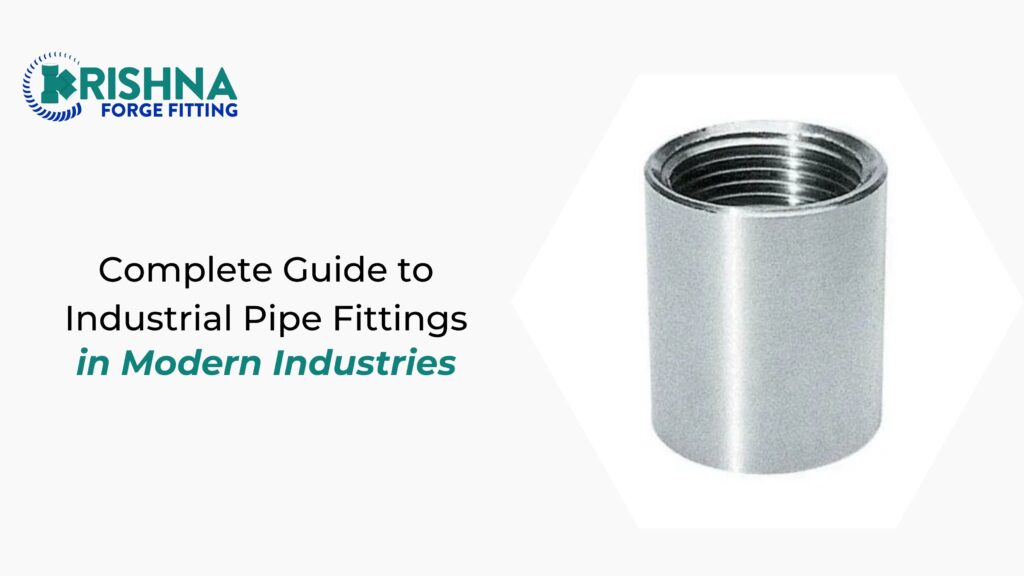
- Full couplings: Join two pipe lengths with threaded or socket weld connections
- Half couplings: Provide branch outlets on pipe bodies without full tees
- Unions: Three-piece assemblies allowing disassembly without cutting pipe
- Caps: Seal pipe ends permanently (welded) or for maintenance access (threaded)
- Plugs: Thread into female fittings for temporary or permanent closure
Branch Connection Fittings (Olets)
Olets create reinforced branch connections directly on pipe runs without full tees. Types include weldolets (butt weld branch), sockolets (socket weld branch), threadolets (threaded branch), and nipolets (nipple-integrated branch). Weldolets suit large-diameter branch connections on high-pressure headers where standard tees aren’t available in the required run size.
Connection Types and End Preparation
Connection method determines installation requirements and long-term integrity:
- Buttweld (BW): Full-penetration weld on beveled ends; highest strength; ASME B16.9
- Socket weld (SW): Pipe inserts into socket for fillet welding; small-bore high-pressure; ASME B16.11
- Threaded (THD): NPT or BSP taper threads; no welding required; Class 3000 max
- Flanged: Bolted face-to-face; allows disassembly; ASME B16.5
Seamless fittings provide superior fatigue resistance through continuous grain structure. Welded fittings contain longitudinal seams that become failure initiation points in high-cycle applications. The 15-20% cost premium for seamless pays back in high-pressure, cyclic, or high-temperature service.
Materials Used in Industrial Fittings
Material selection determines chemical compatibility, temperature limits, and service life more than any other specification variable.
| Material | Grade | Temperature Limit | Best For |
| Carbon Steel | A105 / A234 WPB | 400°F (204°C) | Hydrocarbons, water, general service |
| Stainless Steel | 316 / 316L | 1500°F (815°C) | Acids, chlorides, marine environments |
| Alloy Steel | F11 / F22 / F91 | 1100°F (593°C) | High-temp steam, power generation |
| Duplex SS | 2205 / 2507 | 570°F (300°C) | Offshore, sour service, high chloride |
| Brass / Copper | C26000 / C12200 | 400°F (204°C) | Instrumentation, HVAC, water service |
Carbon steel corrodes within 18-24 months in chlorinated water above 100 ppm. Specifying 316 stainless in the same service provides 15+ years without pitting. The material cost difference recovers quickly against replacement cycles.
Standards and Pressure Ratings
ASME B16.9 governs buttweld fitting dimensions from 1/2-inch through 48-inch. ASME B16.11 covers forged fittings (threaded and socket weld) in Classes 2000, 3000, 6000, and 9000. ASME B16.5 defines flanged fitting dimensions and pressure-temperature ratings from Class 150 through Class 2500.
Pressure ratings decrease with temperature—a Class 3000 fitting handles 3000 PSI at 100°F but only 1440 PSI at 600°F. Always verify the pressure-temperature chart for your specific material grade. Mixing pressure classes within a system creates a failure point at the lowest-rated component regardless of what the rest of the system can handle.
Choosing the Right Fitting
Work through these six variables before specifying any fitting:
- Pipe size and schedule: Fitting bore must match pipe OD and wall thickness
- Operating pressure and temperature: Select class rating with safety margin above surge conditions
- Process fluid: Match material grade to corrosion resistance requirements
- Connection type: Threaded for maintenance access; welded for permanent high-pressure service
- Installation constraints: Space limits radius choices; hot work restrictions favor threaded
- Lifecycle cost: Calculate total cost including installation labor, inspection, and expected service life
Industrial Applications
Each industry imposes specific fitting requirements that generic selection ignores:
- Oil & Gas: NACE-compliant materials for sour service; barred tees in pigged pipelines; heavy-wall alloys at wellheads
- Chemical Processing: 316L or duplex for corrosive fluids; seamless construction to prevent crevice corrosion
- Power Generation: P91 and P22 alloy fittings in superheated steam; creep-resistant grades above 800°F
- Water Treatment: Stainless fittings in chlorinated service; epoxy-coated carbon steel in non-contact applications
- Pharmaceutical: Electropolished 316L with Ra ≤ 0.8 μm surface finish for sanitary compliance
- HVAC and Fire Protection: Standard carbon steel in low-pressure systems; FM-approved fittings for fire suppression
Installation and Maintenance
Pre-Installation Checks
- Verify fitting material matches pipe material and process requirements
- Confirm pressure class equals or exceeds system design pressure
- Inspect threads and bevel faces for damage before installation
- Check bore size matches pipe outside diameter within tolerance
Welded Fitting Installation
- Bevel pipe ends to specified angle (typically 37.5° for butt weld)
- Clean all surfaces to bare metal—scale and oil create weld porosity
- Align and tack weld at 3-4 points to prevent movement
- Complete root and fill passes per qualified welding procedure
- Perform visual inspection plus NDT as required by service class
- Hydrotest at 1.5× design pressure for minimum 30 minutes
Threaded Fitting Installation
- Apply PTFE tape or thread sealant to male threads only
- Hand-tighten first to verify thread engagement
- Add 1.5-2.5 wrench turns per pipe size requirements
- Never over-tighten—fitting cracks are irreparable
Quality and Traceability
Material Test Certificates must trace back to heat codes stamped on every fitting. This documentation becomes essential during plant audits, insurance inspections, and failure investigations. Fittings without traceable documentation get rejected on EPC projects—creating expensive procurement delays while replacement orders are processed.
Third-party inspection adds cost but eliminates the quality uncertainty that causes project delays. Witnessing dimensional checks, hardness tests, and PMI verification before shipment prevents receiving non-conforming materials on site.
Frequently Asked Questions
Which is stronger—threaded or welded fittings?
Welded fittings (buttweld or socket weld) deliver higher structural integrity than threaded alternatives. Full-penetration buttweld joints match pipe wall strength. Threaded connections rely on thread engagement and sealant, creating leak paths under vibration. For permanent high-pressure service, always specify welded connections. Use threaded only where maintenance disassembly justifies the lower strength.
What’s the difference between concentric and eccentric reducers?
Concentric reducers center both pipe axes on the same centerline—appropriate for vertical runs and gas service. Eccentric reducers keep one side flat, offsetting the centerline—mandatory for pump suction lines where the flat-top orientation prevents air pockets that cause cavitation. Specifying concentric on a pump suction line is one of the most common and costly piping design errors.
How do I know if a fitting meets ASME standards?
Look for the manufacturer’s name or trademark, material grade, pressure class or schedule, and heat code stamped directly on the fitting. Request the Material Test Certificate and verify the heat code matches the stamp. Third-party inspection with PMI (positive material identification) testing provides additional confirmation that material composition matches the certificate.
Can I mix carbon steel and stainless steel fittings in the same system?
Direct contact between carbon steel and stainless steel creates galvanic corrosion that accelerates carbon steel degradation. Where both materials exist in a system, use isolation gaskets or dielectric unions at the transition points. Also verify fluid compatibility with both materials—some fluids attack one grade but not the other.
Conclusion
Industrial pipe fittings determine whether complex piping systems operate reliably or generate recurring failures. Select fitting type based on flow function, connection method based on pressure and maintenance requirements, and material grade based on process chemistry and temperature. Verify standards compliance through documented traceability.
Request certified fittings with full material documentation for your next project—contact our engineering team today.
Krishna Forge Fitting manufactures and supplies a complete range of industrial pipe fittings—elbows, tees, reducers, couplings, unions, caps, plugs, and olets—across buttweld, socket weld, and threaded connection types. Our fittings meet ASME B16.9 and B16.11 standards in carbon steel, stainless steel 304/316/316L, duplex, and alloy steel grades from Class 2000 through Class 9000.
Every fitting ships with Material Test Certificates, dimensional inspection reports, and heat code traceability. We maintain inventory across standard configurations with custom sizes and exotic materials available on request. Our technical team provides material selection guidance, pressure-temperature calculations, and installation support for oil and gas, chemical, power generation, water treatment, and pharmaceutical applications.
Order your certified industrial pipe fittings at krishnaforge.com or contact our engineering team to discuss your project specifications, operating conditions, and delivery requirements. We supply reliable fittings with documented quality for demanding industrial systems.
