Introduction
Most piping failures in industrial systems trace back not to pipe itself, but to the fittings connecting it. Procurement teams routinely spec pipe by material grade and schedule, then treat fittings as an afterthought—ordering whatever matches the nominal diameter at the lowest unit price. The result: a Class 2000 coupling on a Class 3000 system, a carbon steel tee in chloride service, or a threaded fitting in a high-vibration loop that backs out over six months.
This guide covers every major pipe fitting category—elbows, tees, couplings, reducers, caps, and more—and explains how connection type, material grade, and standards compliance determine whether your piping system runs reliably for fifteen years or fails an inspection in month three. You will learn the ASME and ASTM standards that govern each fitting category, which industries demand which configurations, and the quality verification steps that separate a credible supplier from a catalog reseller. Whether you manage EPC procurement, operate a refinery, or maintain a chemical processing unit, the selection logic applies consistently.
Types of Pipe Fittings
Elbows
Elbows redirect flow at 45°, 90°, or 180°. Long-radius (LR) elbows use a centerline radius of 1.5× pipe diameter and cut pressure drop by 30–50% compared to short-radius (SR) alternatives at the same flow rate. Use LR elbows wherever flow velocity exceeds 3 m/s; use SR only when physical space forces it.
Tees
Equal tees split or combine flow at three identical-diameter openings. Reducing tees drop the branch to a smaller size—use them when branch flow is a fraction of main-run flow and you want to avoid adding a separate reducer. Specifying an equal tee where a reducing tee belongs forces excess velocity through the branch and increases erosion.
Couplings and Half Couplings
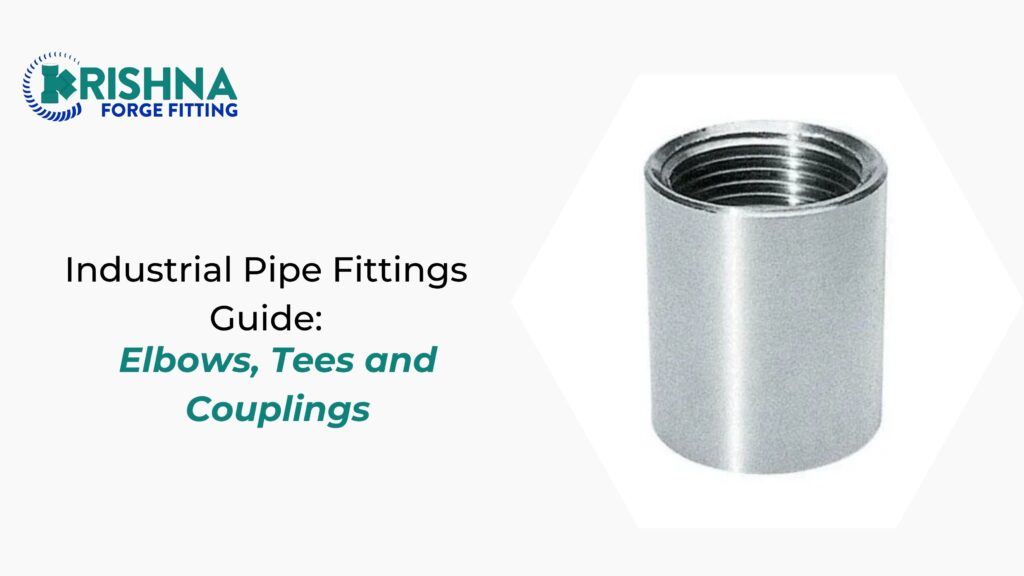
Full couplings join two pipe sections in a straight run; half couplings create branch connections on vessel walls or pipe bodies. Both are compact, high-strength fittings available in socket-weld and threaded configurations per ASME B16.11.
Reducers
- Concentric reducers: symmetric reduction; use on vertical lines
- Eccentric reducers: flat on one side; use on horizontal pump suction lines to prevent air pockets
Eccentric reducers are one of the most under-specified fittings in industrial piping. Engineers default to concentric, air locks, cavitation follows, and pump bearings fail early.
Caps, Plugs, and Unions
Caps seal pipe ends permanently; plugs seal threaded openings. Unions allow disassembly of a pipe run without cutting—use them at flanged equipment connections or maintenance access points where threaded joints will be broken repeatedly.
Connection Types
Connection type defines joint strength, leak integrity, and installation method:
- Butt weld: strongest joint; smooth internal bore; ASME B16.9; for high-pressure and high-temperature service
- Socket weld: pipe inserts into recessed socket; fillet welded at shoulder; ASME B16.11; excellent for vibration-prone small-bore lines
- Threaded: NPT tapered threads; no welding; ASME B16.11; suits low-pressure maintenance access points
- Flanged: bolted joint with gasket; ASME B16.5; allows repeated disassembly at valves and equipment
Socket weld and butt weld fittings consistently outperform threaded in high-cycle service. Threaded joints back out under vibration, especially in small-bore instrument lines.
Materials for Pipe Fittings
Select material by matching fluid chemistry, temperature, and pressure to the ASTM grade:
- Carbon steel (A234 WPB, A105): general service up to 400 °C; oil, gas, water, steam
- Stainless steel (A403 WP304/316): corrosion-resistant; chemical processing, food, pharma
- Alloy steel (A234 WP11/WP22/WP91): high-temperature steam and hydrocarbon service above 540 °C
- Duplex stainless (A815 WP2205): offshore and marine environments requiring both corrosion resistance and high strength
A 316L stainless tee costs 40% more than carbon steel. In chloride-laden or acidic service, the carbon steel alternative corrodes in under two years, driving unplanned downtime and replacement costs that dwarf the original price difference.
Standards and Specifications
Standards define dimensions, pressure ratings, and material minimums—not just paperwork:
- ASME B16.9: buttweld fittings (elbows, tees, reducers, caps); NPS ½–48
- ASME B16.11: forged socket-weld and threaded fittings; NPS ⅛–4; Class 2000–9000
- ASME B16.5: pipe flanges; NPS ½–24; Class 150–2500
- ASTM A234: carbon and alloy steel buttweld fittings
- ASTM A403: stainless steel buttweld fittings
- MSS SP-43: wrought stainless fittings (lighter-wall applications)
Fittings stamped with these standards have passed dimensional checks, hydrostatic testing, and material verification. Fittings marked “equivalent” without traceable mill test certificates have not.
Applications by Industry
Oil and gas projects demand NACE-compliant carbon and alloy-steel forged fittings for sour service; Class 6000/9000 ratings for wellhead and subsea pressures. Chemical processing uses 316L or duplex stainless fittings for acids, caustics, and chlorides that attack carbon steel within months. Power generation specifies P11/P22 alloy-steel fittings for superheated steam circuits at 565 °C and 170 bar. Pharmaceutical and food processing requires electro-polished stainless fittings with Ra < 0.8 µm to meet hygienic standards and prevent contamination.
Quality Assurance and Maintenance
Verification before purchase
- Material traceability: heat numbers, mill test certificates (MTC), chemistry, and mechanical test data traceable to the raw billet
- Dimensional conformance: actual measurements verified against ASME tolerance tables
- NDT records: ultrasonic, dye-penetrant, or magnetic-particle inspection reports for critical service
- Third-party access: confirm the supplier allows factory audits or TPI witness testing
Common failure modes
- Corrosion from material-fluid mismatch (wrong alloy for the service fluid)
- Thread back-out in vibrating small-bore lines (spec socket weld instead)
- Pressure-class underrating (cost-driven downgrade that creates weak points)
Buying Guide
Selecting fittings correctly requires four confirmed data points before you issue a purchase order:
- System pressure and temperature: drives pressure class and material grade
- Fluid chemistry: corrosive, abrasive, or inert service determines alloy selection
- Connection method: welded or threaded based on joint strength and maintenance requirements
- Documentation package: MTC, dimensional report, NDT certificates, and ASME compliance marking
FAQs
When should I choose socket weld over threaded fittings?
Socket-weld fittings provide stronger, leak-tight joints and handle vibration and thermal cycling far better than threaded. They require welding but deliver superior fatigue life in small-bore high-pressure lines. Use threaded only where hot work is restricted or disassembly is frequent.
What is the difference between ASME B16.9 and ASME B16.11?
ASME B16.9 covers factory-made buttweld fittings in larger sizes (NPS ½–48) for high-pressure piping. ASME B16.11 governs forged socket-weld and threaded fittings in smaller sizes (NPS ⅛–4) with pressure classes up to 9000. Both standards specify dimensions, tolerances, and minimum mechanical properties.
Can I use carbon steel fittings in stainless steel piping?
Only if the fluid is non-corrosive and galvanic corrosion risk is managed through isolation flanges or coatings. Mixing carbon and stainless steel in wet or chloride-bearing service accelerates corrosion at the carbon steel fitting faster than either metal alone. Spec consistent material grades throughout the system.
What documentation should I request with every fitting order?
Request the mill test certificate with heat number, chemistry, tensile and yield strength data, and hardness results. Add dimensional inspection reports confirming conformance to ASME tolerances. For critical service, ask for hydrostatic test certificates and NDT reports.
Conclusion
Specify industrial pipe fittings by locking in pressure class, material grade, connection type, and ASME standards compliance before you issue a purchase order. Request mill test certificates and dimensional reports on every shipment. One mis-rated or mismatched fitting creates a weak point that inspection teams find—or operating conditions reveal—at the worst possible time.
Krishna Forge manufactures ASME B16.9 buttweld fittings and ASME B16.11 forged socket-weld and threaded fittings in carbon, stainless, and alloy steel—elbows, tees, couplings, reducers, caps, and unions in Class 150 through Class 9000. Every fitting ships with full material traceability, dimensional inspection reports, and mechanical test data that meet EPC, ONGC, and international project specifications.
Need pipe fittings with guaranteed ASME compliance and full documentation? Contact Krishna Forge at krishnaforge.com for technical data sheets, material certifications, and fast quotes on industrial fittings engineered for your exact pressure, temperature, and service conditions.
