Introduction
A midstream pipeline operator in Rajasthan installed short-radius elbows on a high-velocity sour gas line to cut fitting costs by 22%. Within eight months, hydrogen sulfide corrosion combined with turbulence-induced erosion at the outer bend radius caused two elbow failures, a gas release incident, and ₹64 lakh in emergency shutdown costs. The original cost saving was ₹1.8 lakh.
Here’s what most procurement teams miss: 41% of unplanned piping failures in oil, gas, and power plants trace back to fitting selection errors rather than material defects or weld failures. Elbows and couplings in these industries carry extreme loads—high pressure, high temperature, corrosive media, and thermal cycling simultaneously. This guide covers elbow and coupling types, their specific applications across upstream, midstream, downstream, and power generation, and the material and pressure rating decisions that determine whether fittings last decades or fail in months.
Types of Elbows
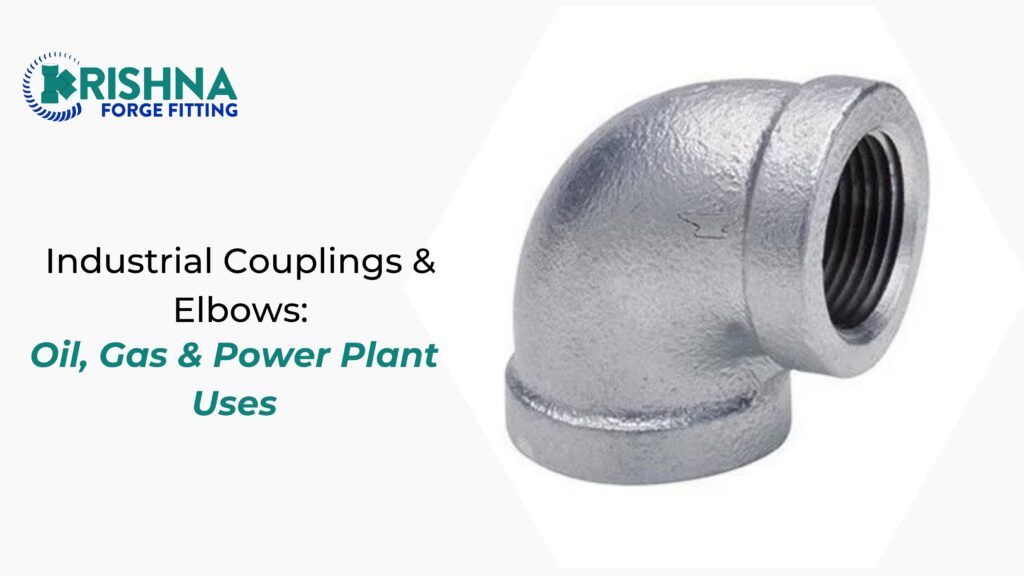
Elbow geometry determines pressure drop, erosion rate, and piggability—three factors that directly affect operating costs.
Long Radius vs Short Radius
Long-radius elbows (centerline radius = 1.5× pipe diameter) reduce pressure drop by 40% compared to short-radius designs at equivalent velocities. The gradual curve minimizes turbulence and keeps fluid contact with the outer wall at safe erosion levels. They’re mandatory on piggable pipeline systems because inspection tools can’t navigate short-radius bends.
Short-radius elbows (radius = 1× diameter) suit space-constrained installations with clean, low-velocity fluids. At velocities above 3 m/s or in any abrasive or corrosive service, they accelerate wall thinning at the extrados faster than inspection intervals can catch.
45-Degree vs 90-Degree Elbows
A 45-degree elbow generates approximately 60% of the pressure drop of a 90-degree elbow for the same pipe size and flow rate. Two 45-degree elbows with a spool piece between them replace a 90-degree turn with significantly lower erosion potential—a configuration standard in high-velocity gas and condensate lines where fitting life matters more than layout compactness.
Forged vs Cast Elbows
Forged elbows use pressed and shaped steel with a refined grain structure aligned along the fitting profile. They handle pressure classes 3000, 6000, and 9000 for small-bore high-pressure service. Investment cast elbows deliver complex geometries, tight dimensional tolerances, and cost efficiency for mid-range pressure classes (Class 150–1500), especially where custom configurations or alloy materials make forging impractical.
Types of Couplings
Coupling selection determines joint integrity, maintenance access, and long-term leak risk at every pipe connection.
Butt Weld Couplings
Butt weld couplings provide the smoothest internal bore and the highest structural integrity of any connection method. They eliminate internal crevices, match full pipe pressure ratings, and remain the default choice for:
- High-pressure oil and gas transmission lines (Class 600 and above)
- High-temperature steam headers in power plants
- Sour service where crevice corrosion accelerates hydrogen embrittlement
- Critical lines carrying hydrocarbons, where any leak carries safety consequences
Socket Weld Couplings
Socket weld couplings seat pipe into a recessed socket and weld at the mouth. They handle up to Class 6000 in small-bore service (DN50 and below) and simplify alignment during fit-up. The internal crevice between pipe end and socket bottom accumulates corrosive residue in wet gas and chemical service—this makes them unsuitable for H2S-bearing fluids or chloride-rich environments where crevice corrosion initiates stress cracking.
Threaded and Grooved Couplings
Threaded couplings (NPT/BSP) suit instrument lines, utility systems, and low-pressure service up to Class 3000 for small bores. Vibration loosens threaded joints without thread sealant and re-torquing.
Grooved couplings clamp over grooved pipe ends with a mechanical housing. They allow rapid disassembly for maintenance—a critical advantage on cooling water systems and non-critical process lines where frequent access reduces downtime.
Oil & Gas Applications
The combination of high pressure, corrosive media, and regulatory exposure makes fitting selection in oil and gas more consequential than in almost any other industry.
Upstream
Wellhead and manifold piping faces the most aggressive conditions: high-pressure sour gas, sand-laden production fluids, and thermal cycling from well startup and shutdown. Standard specifications for upstream elbows include:
- Long-radius 90-degree elbows in AISI 4130 chrome-moly or duplex stainless
- Butt weld connections rated Class 900 or higher
- NACE MR0175/ISO 15156 compliance for sour service
- Wall thickness at minimum Schedule 80; Schedule 160 for high-erosion points
Midstream
Long-distance transmission pipelines require piggable geometry—long-radius elbows with radius-to-diameter ratios of 3:1 or higher for smart pig passage. Butt weld couplings with full-penetration welds and 100% radiographic inspection are mandatory. Carbon steel ASTM A234 WPB handles most midstream service; 22Cr duplex applies where external corrosion or internal chloride content demands higher resistance.
Downstream
Refinery piping combines high temperatures with process chemicals that attack standard carbon steel. Chrome-moly alloy (P11, P22) elbows handle temperatures to 600°C in fired heater outlets and transfer lines. Stainless steel 316 couplings manage acids, caustics, and chloride-bearing streams in distillation and treating units.
Power Plant Applications
Power plants stress fittings through sustained high temperature and pressure cycling that fatigues carbon steel faster than steady-state service.
Steam and Condensate Systems
Main steam headers operate at 540-600°C and pressures to 250 bar in supercritical units. Chrome-moly P91 (9Cr-1Mo) elbows and couplings handle these conditions without creep deformation over 30-year service lives. Conventional carbon steel fails at temperatures above 425°C—substituting P91 is not optional at supercritical conditions.
Condensate return lines run at lower pressure but carry dissolved oxygen and carbon dioxide that corrode carbon steel from the inside out. Stainless steel 304 or copper-nickel couplings extend service life by 3-4 times compared to unprotected carbon steel.
Cooling Water and Feedwater
Cooling water systems move large volumes at low pressure and ambient temperature. Carbon steel long-radius elbows (ASTM A234 WPB) with grooved coupling connections provide the maintenance access these frequently serviced systems need. Internal lining or epoxy coating addresses microbiologically influenced corrosion in open cooling water circuits.
Material Selection Summary
| Service | Elbow Material | Coupling Type |
| Sour gas upstream | Duplex 2205 | Butt weld |
| High-temp steam | P91 alloy steel | Butt weld |
| Refinery process | 316 stainless | Butt weld |
| Midstream pipeline | ASTM A234 WPB | Butt weld |
| Cooling water | ASTM A234 WPB | Grooved |
| Instrument lines | 316 stainless | Threaded |
FAQs
Why do long-radius elbows cost more but remain the standard in oil and gas?
Long-radius elbows cost 15-25% more than short-radius, but they reduce erosion-related replacement frequency by 60-70% in high-velocity gas service. They also enable pipeline pigging, which eliminates expensive hydrostatic retesting programs. Total lifecycle cost favours long-radius elbows decisively in any service above 2 m/s velocity.
What makes P91 alloy steel the standard for supercritical steam fittings?
P91 (9Cr-1Mo-V) maintains tensile strength and creep resistance at temperatures up to 620°C where carbon steel and standard chrome-moly grades deform under sustained load. It also resists steam oxidation without austenitic stainless steel’s thermal expansion mismatch with ferritic pipe. ASME B31.1 and B31.3 both mandate P91 or equivalent for supercritical steam service.
Can grooved couplings be used in oil and gas pipelines?
Grooved couplings suit low-pressure utility and cooling water systems, but they’re not approved for hydrocarbon service on most oil and gas facilities. The mechanical housing depends on elastomeric gaskets that degrade in hydrocarbon exposure over time. Butt weld or socket weld connections are required wherever hydrocarbon containment is safety-critical.
Conclusion
Match elbow geometry and coupling type to your service conditions—pressure class, temperature, media corrosivity, and maintenance access requirements all determine the right specification. Long-radius butt weld fittings in the correct alloy eliminate most of the failure modes that drive emergency shutdowns in oil, gas, and power plants.
Audit your most failure-prone fitting locations this week and verify their geometry and material match the specifications outlined here.
Krishna Forge Fittings manufactures precision investment cast elbows, couplings, and pipe fittings in carbon steel, stainless steel grades through super duplex, P91 alloy steel, and specialty alloys for oil and gas, power generation, refining, and chemical processing applications. Our castings meet ASME, ASTM, and API material standards with full traceability, dimensional accuracy, and NDT-verified wall integrity—eliminating the fitting failures that shut down critical production systems.
Visit https://krishnaforge.com/ to request technical datasheets, material certifications, and fitting quotations for your oil, gas, or power plant piping requirements. Let’s build reliability into your high-pressure systems.
