
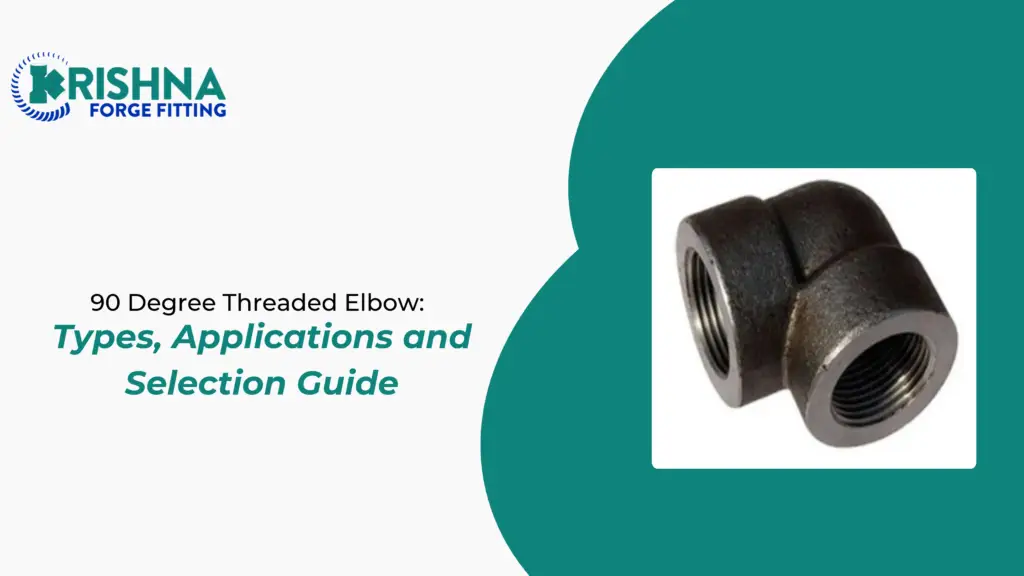
The 90 degree threaded elbow is one of the most common pipe fittings in any plant. It is also one of the most frequently mis-ordered. A buyer asks for “1-inch threaded elbow” and gets the wrong thread form, the wrong class or a cast part where a forged one was needed. The result is a joint that weeps under pressure or cracks under vibration.
This guide explains what a 90 degree threaded elbow is, its main types, thread standards, pressure classes and typical applications, and gives a step-by-step selection method.
What Is a 90 Degree Threaded Elbow
A 90 degree threaded elbow is a pipe fitting that turns the direction of flow by a right angle. Both ends have internal (female) threads that screw onto threaded pipe or male fittings. No welding is needed, so it suits small-bore lines, usually 1/8 to 4 inches, where quick assembly or later dismantling matters.
It is also called a 90° ell, a quarter bend, a screwed elbow or an NPT elbow, depending on region and thread type.
How a Threaded Elbow Works
Pipe threads are tapered. As the pipe screws into the elbow, the taper wedges the threads tighter. A sealant, such as PTFE tape or thread paste, fills the tiny spiral gap left at the thread roots. The tighter fit and the sealant together stop leaks.
The 90° turn creates more pressure drop than a straight run or a 45° bend. Engineers allow for this when they size pumps and compressors.
Types of 90 Degree Threaded Elbows
Standard Elbow (Female x Female)
The most common type. Both ends take threaded pipe.
Street Elbow (Male x Female)
One end has male threads, the other female. A street elbow screws directly into another fitting or valve without a pipe nipple. It saves space and one joint.
Reducing Elbow
The two ends are of different sizes. It turns and reduces the line in one fitting.
By Manufacturing Method
- Forged elbows: Shaped from hot billet under pressure, then machined. Dense grain structure; suitable for higher pressure classes.
- Cast or malleable iron elbows: Common in domestic and low-pressure utility work.
By Material
- Mild steel (MS): General industrial and water service
- Galvanised iron (GI): Water supply and sprinkler lines; zinc coating slows rusting
- Carbon steel (ASTM A105): Oil, gas, steam and process lines
- Stainless steel (ASTM A182 F304/F316): Corrosive, hygienic and marine service
- Brass: Plumbing and instrument fittings
Thread Standards: NPT vs BSP
| Feature | NPT | BSP (BSPT) |
| Origin | American | British / ISO |
| Thread angle | 60° | 55° |
| Taper | 1 in 16 | 1 in 16 |
| Common in | Oil and gas, US-spec projects | Indian water, utility and general industry |
| Related standards | ASME B1.20.1 | ISO 7, IS 554 |
Here is the trap: a 1-inch NPT and a 1-inch BSP thread look almost the same. They may even engage for a few turns. They will not seal properly. Always state the thread standard on the purchase order.
Pressure Classes and Dimensions
ASME B16.11
Forged threaded elbows under ASME B16.11 come in three classes:
- Class 2000: for Sch 80 pipe
- Class 3000: for Sch 160 pipe
- Class 6000: for XXS pipe
The class sets wall thickness and the centre-to-end dimension. Higher classes are heavier and handle more pressure.
IS 1239 Part 2
For mild steel tubular fittings in water, gas and general service, IS 1239 Part 2 is widely used in India. It covers screwed elbows, bends, tees and sockets for light, medium and heavy class pipes.
90° vs 45° Threaded Elbow
- A 90° elbow makes a sharp right-angle turn. It saves space but causes more pressure drop and turbulence.
- A 45° elbow makes a gentler turn with less pressure loss. Two 45° elbows can replace one 90° where flow efficiency matters and space allows.
Applications and Industries
- Water supply, water treatment and fire sprinkler systems
- Compressed air, instrument air and gas lines
- Steam traps, drains and vents
- Boilers, heat exchangers and condensers
- Hydraulic and lubrication circuits
- Chemical dosing and sampling lines
- Fertilizer, steel and fabrication plants
- HVAC and chilled water piping
Advantages and Limitations
Advantages
- No welding, so no hot-work permits
- Quick to install and easy to dismantle
- Ideal for tight spaces and maintenance-heavy lines
- Low installed cost in small sizes
Limitations
- Threads reduce the effective wall thickness
- Joints can loosen under vibration and thermal cycling
- Not suited to very high pressure or large diameters
- Stainless threads can gall if assembled without anti-seize
How to Choose the Right 90 Degree Threaded Elbow
- Confirm the pipe size. Match the nominal bore of the pipe, not the outside diameter.
- Specify the thread standard. NPT or BSP, and tapered or parallel.
- Select the material. Match the pipe material and the fluid. Use stainless for corrosive or hygienic service and GI for water.
- Choose the pressure class. Check design pressure and temperature against the class rating.
- Choose forged for demanding service. Forged elbows handle pressure, shock and vibration better than cast ones.
- Pick the type. Standard, street or reducing, depending on space and layout.
- Ask for documentation. Material certificate, heat number marking and dimensional report.
- Check thread quality on arrival. Use a thread gauge on a sample from each lot.
Installation Tips
- Clean threads before assembly; remove burrs and oil
- Wrap PTFE tape clockwise, 3–4 turns, starting one thread back from the end
- Hand-tighten, then use a wrench for 1–2 further turns; do not overtighten
- Support the pipe near the elbow to reduce bending load on the threads
- Use anti-seize compound on stainless steel threads
Frequently Asked Questions
What is the difference between a 90 degree elbow and a street elbow?
A standard 90 degree elbow has female threads on both ends. A street elbow has one male and one female end, so it connects directly to another fitting.
What sizes are 90 degree threaded elbows available in?
Most forged threaded elbows come in sizes from 1/8 inch to 4 inches. Larger sizes usually use butt weld or flanged elbows.
Which thread type is used in India?
BSP (tapered) is common for water and general utility lines. NPT is common in oil, gas and export projects built to American standards.
Can threaded elbows be used for high-pressure lines?
Forged threaded elbows in Class 3000 and 6000 handle substantial pressure in small sizes. For very high pressure, larger sizes or severe vibration, socket weld or butt weld elbows are preferred.
How do I stop a threaded elbow from leaking?
Use clean, undamaged threads, the correct sealant and the right tightening torque. Leaks often come from mismatched NPT and BSP threads.
Conclusion
A 90 degree threaded elbow is simple, but its performance depends on four details: thread standard, pressure class, material and manufacturing method. Specify all four clearly, choose forged elbows for demanding service, and check thread quality before installation.
Send us your elbow size, thread type and class, and we will quote matching forged elbows.
About Krishna Forge Fitting
Krishna Forge Fitting manufactures and exports forged threaded elbows from its plant at Shapar, Veraval, Rajkot. Our range includes MS 90 degree threaded elbows, 45 degree threaded elbows, street elbows, socket weld elbows and SS forged fittings, along with tees, couplings, nipples, sockets and end caps. We control raw material quality, machining and inspection so each elbow fits right and seals right.
